
Non-FictionInformativeEducational
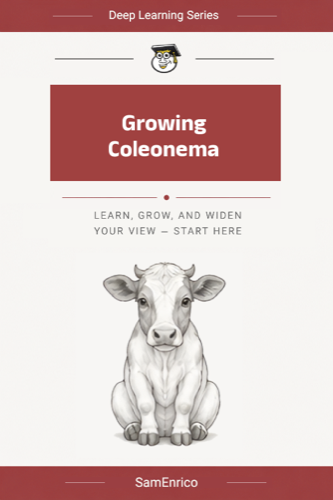
Growing Coleonema eBook
This publication, published by SamEnrico, covers G
This publication, published by SamEnrico, covers Growing Coleonema
Formats
Free sample
Chapter 1: The Fynbos Secret...--The first time I killed a Coleonema, I blamed the nursery. The second time, I blamed the weather. The third time, I stood over a brown, crispy corpse of what was supposed to be a "low-maintenance, drought-tolerant, fragrant evergreen shrub" and realized the problem was not the plant. The problem was everything I thought I knew about gardening.I had watered it like my roses—deeply, regularly, lovingly. I had planted it in premium potting mix—dark, rich, moisture-retentive stuff that cost five dollars a bag.
I had fed it with balanced fertilizer—the same 10-10-10 that made my hydrangeas explode with color. And then I had watched, baffled, as each successive plant turned yellow, then brown, then died with what looked like root rot but couldn't possibly be because I had been so careful.The nursery owner, a weathered woman with dirt under her fingernails and the patience of a saint, finally took pity on me. She walked me to a corner of the greenhouse where a single Coleonema 'White Confetti' sat in a pot of what looked like crushed gravel and sand. It was thriving—vibrant, bushy, covered in buds. "Stop loving it so much," she said.
"It doesn't want your love. It wants to be ignored in exactly the right way."That was my first lesson in the Fynbos Secret: Coleonema does not come from a world of plenty. It comes from a world of scarcity, where survival means adapting to poverty. And until you understand that world, you will keep killing this plant.This chapter is your passport to that world. We are going to travel to the Western Cape of South Africa, to a landscape that looks like nothing you have ever seen—unless you have hiked the chaparral of California, the mallee of Australia, the maquis of the Mediterranean, or the matorral of Chile.
We are going to learn what Fynbos means (literally, "fine-leaved plants"), why it burns, why it starves, and why Coleonema has evolved to thrive in conditions that would kill 90 percent of the plants in your local garden center.By the end of this chapter, you will never look at potting mix the same way again. You will understand why "drought-tolerant" does not mean "water-me-like-a-cactus." And you will have the foundation—the deep, evolutionary why—behind every practical instruction in the rest of this book.Let us begin where Coleonema began: in the fire.The Birthplace of Beauty: Introducing the Fynbos Biome Close your eyes and imagine a landscape. Not a lush, dripping rainforest. Not a manicured English garden. Not a rolling meadow of green grass.
Instead, picture this: ancient, weathered mountains of sandstone and granite, their slopes covered in shrubs that never grow taller than your waist. The colors are muted—silver-greens, gray-greens, olive-greens—punctuated by sudden explosions of color: the electric pink of a protea, the fiery orange of a leucospermum, the delicate white or pink confetti of Coleonema in full bloom.The air smells like nothing else on earth. It is a cocktail of crushed herbs, citrus, pine, and something sweeter—the combined essential oils of a thousand aromatic shrubs baking in the sun. The soil beneath your feet is not soil as you know it. It is sand.
Coarse, nutrient-poor, acidic sand that crumbles through your fingers like the sands of a beach far from the sea. And overhead, the sky is the particular blue that comes only to places with winter rain and summer drought.This is the Fynbos biome. It occupies a mere 0.5 percent of the land area of Africa. Yet it contains nearly 9,000 species of plants—more than the entire British Isles, more than the entire eastern seaboard of the United States. Of those 9,000 species, nearly 70 percent are found nowhere else on the planet.
This is not a garden. This is a botanical treasure chest, and Coleonema is one of its jewels.The Fynbos biome is part of the Cape Floral Kingdom, the smallest but richest of the world's six floral kingdoms. To put this in perspective: the entire continent of North America has one floral kingdom. Europe shares one with Asia. But this tiny corner of Africa—smaller than Portugal, smaller than the state of Mississippi—has its own entire floral kingdom because its plants are so distinct from anything else on earth.And here is the secret that most gardening books will not tell you: Coleonema does not just tolerate the conditions of the Fynbos.
It requires them. You cannot grow this plant to its full potential by adapting it to your garden. You must adapt your garden to it. Or rather, you must understand what it needs and provide those things and only those things.The Fynbos is defined by three interlocking forces: fire, famine, and winter rain. Understand these three forces, and you understand Coleonema.Force One: Fire as a Gardening Partner If you come from a gardening tradition that treats fire as an enemy—something to prevent, to extinguish, to protect your precious shrubs from—the Fynbos will break your brain.
Because in this landscape, fire is not destruction. Fire is renewal.The Fynbos is a fire-adapted ecosystem. That means its plants have evolved not just to survive fire but to depend on it. Some species, like certain proteas, store their seeds in woody cones that only open after a fire. Others, like many restios (reed-like plants), resprout from underground rhizomes within weeks of being burned to the ground.
And Coleonema? Coleonema is what botanists call an "obligate reseeder." It does not resprout from its roots after fire. It dies. But before it dies, it produces a massive seed bank that germinates explosively in the ash-enriched soil.Here is what that means for you as a gardener. Coleonema has evolved to expect periodic, complete renewal.
In the wild, a Fynbos shrub lives about 10 to 20 years before a fire sweeps through and resets the clock. The plant puts all its energy into flowering and seeding in its later years, because it knows its time is limited.In your garden, there is no fire. (Or at least, there should not be.) That means your Coleonema could potentially live longer than it would in the wild. But it also means you have to mimic the effects of fire: rejuvenation, removal of old growth, and the creation of space for new shoots. That is why the pruning chapter (Chapter 7) is so important.
When you cut back an old, leggy Coleonema, you are not harming it. You are performing an artificial fire. You are telling the plant: "Your time has come. Send up new growth from the base."Many gardeners kill Coleonema not by neglect but by failure to prune. They let the plant become woody and sparse, then assume it is dying of old age.
But it is not dying. It is waiting for a fire that never comes. Your pruners are that fire.Force Two: Famine—The Nutrient Poverty That Creates Perfume Now we arrive at the most counterintuitive lesson of the Fynbos: poor soil makes better plants.The soils of the Western Cape are among the most nutrient-poor on earth. They are ancient, weathered, leached by millions of years…
This is the end of the free sample. Get the eBook to keep going. Buy now
About this book
Details
- Author
- Turpin Lucienne
- Publisher
- SamEnrico
- Language
- English
- Genre
- Non-Fiction, Informative, Educational
- Released
- 2026-05-08
- Pages (approx.)
- 160
- Available as
- eBook, Audiobook

Read better in the ZLOADR app
Your eBooks on your phone or tablet. Sign in with your SamEnrico account and start reading.
More by Turpin Lucienne
 Einstein's Nobel LegacyTurpin Lucienne$11.99
 Drug Dependency Nutrition RecoveryTurpin Lucienne$11.99
 Metta for Sleep DisturbancesTurpin Lucienne$11.99
 Anapanasati for DrivingTurpin Lucienne$11.99
 Food Dream MeaningTurpin Lucienne$11.99
 Parent Home Safety GuideTurpin Lucienne$11.99
 Hypochondria Body ScanTurpin Lucienne$11.99
 Financial Stress For AddictsTurpin Lucienne$11.99
 Billy Crystal 700Turpin Lucienne$11.99
 The Lioness of Meroë: Amanishakheto's Golden CampaignTurpin Lucienne$11.99
 The Celestial Calculators: How Ancient Egypt’s Astronomers Charted the CosmosTurpin Lucienne$11.99
 The Line in the Sand: The Israel-Gaza Conflict ExplainedTurpin Lucienne$11.99
You may also like
 Hong Kong Handover 1997Dunn Johnnie$11.99
 Zumba For Postnatal Recovery CourseNeal Christian$11.99
 Zumba for BeginnersLadner Nikia$11.99
 YouTube Comment Mining GuideHumes Pandora$12.99
 Worry Box MeditationCarlin Rudy$11.99
 Workplace Stress MeditationNguyen Lynn$11.99
 Workplace Stress and Sleep RepairHawley Ivory$11.99
 Workplace Perfectionism CureDelaney Jeffry$11.99
 Workplace Injustice Anger GuideWallen Isabelle$11.99
 Work Addiction and Burnout LinkGreenwood Ester$11.99
 Women in Yoga and WellnessBeattie Galina$11.99
 Women in Stand Up ComedyChun Evangeline$11.99