
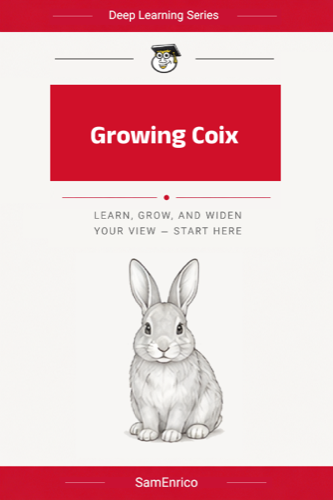
Non-FictionInformativeEducational
Growing Coix eBook
This publication, published by SamEnrico, covers G
This publication, published by SamEnrico, covers Growing Coix
Formats
Free sample
Chapter 1: The Grain That Vanished...–- On a humid morning in the highlands of northern Thailand, a Hmong farmer does something her grandmother taught her sixty years ago. She runs her fingers along a stalk of tall grass, feels for the hard, teardrop-shaped beads nestled where the leaves meet the stem, and twists gently. The beads come free in her palm—some white as rice, others the deep purple of ripe plums. She drops them into a woven basket slung over her shoulder. Later, some will be boiled into a thick, nutty porridge for her grandchildren.
Others will be strung on silk thread and sold to tourists in Chiang Mai as natural beads. And a handful—the most perfect ones—will be saved for next year's planting, just as they have been for four thousand years.This farmer is growing Coix. You have probably never heard of it. You are not alone.In the United States, fewer than one in ten thousand gardeners can identify a Coix plant by sight. In Europe, the number is even smaller.
Walk through the seed racks at any garden center in Ohio or Ontario, and you will find dozens of varieties of tomatoes, peppers, beans, and squash. You will not find Coix. Scan the shelves of health food stores in London or Los Angeles, and you will see quinoa, amaranth, spelt, and teff. You will not see Coix. Search the databases of major agricultural universities, and you will find thousands of research papers on corn, wheat, and rice.
You will find a handful on Coix, most of them published in obscure Asian journals.This is a book about growing one of the most productive, nutritious, and forgiving plants you have never heard of. But before we get our hands dirty, before we talk about soil p H and germination rates and harvesting windows, we need to answer a more fundamental question: How did a plant that once fed millions become a ghost in the agricultural memory of the world?The short answer is that Coix was a victim of its own versatility, displaced first by the sheer caloric density of rice and later by the political economy of corn. But the long answer—the one that matters to you, the gardener or homesteader reading this book—is far more interesting. It is a story about resilience, about the strange economics of staple crops, and about why some plants thrive in the margins while others dominate the center. And it is a story with a happy ending, because Coix is coming back.The Plant With Many Names Before we trace its history, we should agree on what we are calling this plant.
Its scientific name is Coix lacryma-jobi, which translates from Latin roughly as "the tear of Job." The reference is biblical: Job, the righteous man who suffered everything, wept tears that fell to the ground and turned into seeds. The name appears in botanical texts as early as the 16th century, when European herbalists first encountered the plant in Asian trade ports. They saw the glossy, teardrop-shaped beads—white, gray, brown, purple—and immediately reached for a story that would make sense to a Christian audience.But the plant had names long before Linnaeus got hold of it. In China, where it has been cultivated for at least four millennia, it is called Yì Yǐ (薏苡) or Yì Yǐ Rén (薏苡仁) when referring to the dried seed. The first Chinese herbal, the Shennong Bencao Jing (circa 200 CE), lists it as a superior medicinal herb, ranking it alongside ginseng and astragalus.
In Japan, it is hatomugi. In Korea, yulmu. In the Philippines, adlay. In India, gurgur in Hindi and kavu in Malayalam. In Thailand, deu song.
In Vietnam, bo bo. Every culture that encountered Coix gave it a name, and every culture found a use for it.This proliferation of names is a clue to the plant's importance. When a crop has only one name—say, "wheat"—it usually means it arrived recently or is used narrowly. When a crop has dozens of local names, each with its own etymology and cultural associations, it means the plant has been part of daily life for a very long time. Coix is not a newcomer that rode the wave of colonial trade routes.
It is an old companion, one that traveled with people as they moved across Asia, and one that adapted to every new environment it encountered.Four Thousand Years in the Margins The domestication of Coix appears to have occurred independently in at least three regions: the Yangtze River Valley in China, the Salween River Basin in Myanmar and Thailand, and the Narmada River Valley in India. Archaeological evidence places domesticated Coix seeds in Chinese burial sites as early as 2000 BCE, and possibly as early as 4000 BCE depending on which carbon-dating studies you trust. What is not in dispute is that by the time the Roman Empire was building roads across Europe, Coix was already an established crop from Korea to Java, from the Himalayas to the Philippines.But here is what makes Coix different from nearly every other domesticated grain: it was never the first choice. Throughout its history, Coix has been the crop people grew when they could not grow anything else. Rice requires flooded paddies and careful water management.
Wheat demands deep, well-drained soil and a relatively long growing season. Millet and sorghum need heat but hate humidity. Coix, by contrast, grows in waterlogged lowlands where rice would drown. It grows in shallow, acidic soils where wheat would starve. It tolerates flooding, drought, and neglect in ways that would kill corn in a week.In agricultural terms, Coix is a "crop of last resort." But that phrase sounds more negative than it should.
Think of it instead as a "crop of resilience." For the smallholder farmer in the mountains of Laos, where monsoons flood the valleys and droughts parch the hillsides, Coix is not a backup plan—it is the only plan that works year after year. For the indigenous communities of northeastern India, where shifting cultivation leaves soil degraded and weed-choked, Coix is the grain that keeps coming back while other crops fail. For the subsistence farmers of the Philippine uplands, where typhoons flatten cornfields and salt spray burns the leaves of beans, Coix stands tall and produces grain anyway.This is the first principle of growing Coix, and it is worth internalizing now: Coix does not need you to succeed. It will succeed despite you. It will succeed in conditions that would make a conventional gardener weep with frustration.
This is not a plant for the obsessive micromanager who weighs every seed and measures every drop of water. It is a plant for the busy parent, the frugal homesteader, the climate-conscious gardener who wants to grow food without a Ph D in agronomy. If you can keep Coix alive through its first four weeks, it will pretty much take care of itself.The Great Replacement: How Rice and Corn Won So why did Coix disappear from tables across Asia? Why is it a forgotten grain rather than a global staple? The answer is a masterclass in how agricultural economics works, and it…
This is the end of the free sample. Get the eBook to keep going. Buy now
About this book
Details
- Author
- Forrester Harriette
- Publisher
- SamEnrico
- Language
- English
- Genre
- Non-Fiction, Informative, Educational
- Released
- 2026-05-11
- Pages (approx.)
- 156
- Available as
- eBook, Audiobook

Read better in the ZLOADR app
Your eBooks on your phone or tablet. Sign in with your SamEnrico account and start reading.
More by Forrester Harriette
 The Four Phrases Metta MethodForrester Harriette$11.99
 The Pet Care Money StressForrester Harriette$11.99
 Drug Dependency Exercise TherapyForrester Harriette$11.99
 Meditation For Anxious BeginnersForrester Harriette$11.99
 Networking for Fitness ProfessionalsForrester Harriette$11.99
 Fire Dream MeaningForrester Harriette$11.99
 Yoga Class Anxiety GuideForrester Harriette$11.99
 Medicaid Parent GuideForrester Harriette$11.99
 Anapanasati for Work StressForrester Harriette$11.99
 Voyage of the Endurance: The Generation Ship That Could Save HumanityForrester Harriette$11.99
 Dirt to Glory: The Rise of Aussie Freestyle LegendsForrester Harriette$11.99
 The Corsair King: Hayreddin Barbarossa and the Rise of the Ottoman NavyForrester Harriette$11.99
You may also like
 Hong Kong Handover 1997Dunn Johnnie$11.99
 Zumba For Postnatal Recovery CourseNeal Christian$11.99
 Zumba for BeginnersLadner Nikia$11.99
 YouTube Comment Mining GuideHumes Pandora$12.99
 Worry Box MeditationCarlin Rudy$11.99
 Workplace Stress MeditationNguyen Lynn$11.99
 Workplace Stress and Sleep RepairHawley Ivory$11.99
 Workplace Perfectionism CureDelaney Jeffry$11.99
 Workplace Injustice Anger GuideWallen Isabelle$11.99
 Work Addiction and Burnout LinkGreenwood Ester$11.99
 Women in Yoga and WellnessBeattie Galina$11.99
 Women in Stand Up ComedyChun Evangeline$11.99