
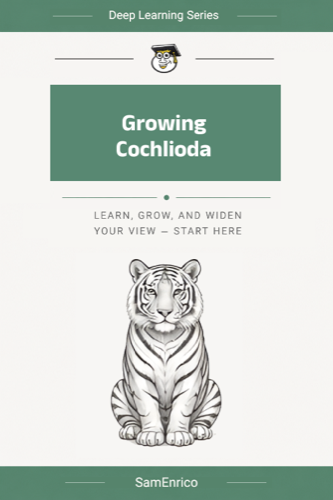
Non-FictionInformativeEducational
Growing Cochlioda eBook
This publication, published by SamEnrico, covers G
by Haag Lynwood
This publication, published by SamEnrico, covers Growing Cochlioda
Formats
Free sample
Chapter 1: The Scarlet Obsession...–- The first time I killed a Cochlioda, I thought I had done everything right. The plant arrived in perfect condition—three fat pseudobulbs, seven glossy leaves, and a root system that looked like a tangled nest of white fishing line. I had read the general orchid books. I knew about watering, about light, about fertilizer. I placed it in an east window, watered it every Tuesday like clockwork, and waited for the spectacular red spikes that the Victorian plant hunters had risked their lives to bring back from the Andes.
Eight months later, I had a dead plant and no flowers. The pseudobulbs had turned to mush. The roots had dissolved into brown sludge. And I had absolutely no idea why.That was fourteen years ago. Today, I grow more than sixty Cochlioda specimens across three genera, and I have never lost a plant to root rot in the last seven consecutive seasons.
The difference between those two versions of me is not talent. It is not expensive equipment. It is not a greenhouse filled with climate controls that cost more than a used car. The difference is one concept that every general orchid book I had read either ignored or got completely wrong.This book exists because that concept is almost never explained to beginner and intermediate growers. And it is killing a lot of orchids.The Lie That Most Orchid Books Tell You Walk into any bookshop with a gardening section.
Pick up any general guide to orchids. Flip to the chapter on Oncidium alliance orchids—the group that includes Cochlioda, Odontoglossum, Miltonia, and their many hybrids. What do you find? A single paragraph. Maybe two.
Often, a single sentence that says something like: "These orchids require intermediate temperatures, bright indirect light, and regular watering."That sentence is not wrong. It is worse than wrong. It is so vague that it might as well be a blank page."Intermediate temperatures" could mean 60°F at night and 75°F during the day. Or it could mean 55°F and 80°F. Those two ranges produce completely different outcomes for a Cochlioda.
"Bright indirect light" could be 1000 foot-candles or 2500 foot-candles—one will keep the plant alive but never blooming, the other will burn the leaves to a crisp within a week. And "regular watering" is the most dangerous phrase in all of orchid literature, because what is regular for a Phalaenopsis in sphagnum moss is death for a Cochlioda in bark.The general orchid books fail for one unassailable reason: they try to cover too much. They cannot give you the specific, counterintuitive, seasonally variable, location-dependent advice that a high-altitude epiphyte from the eastern slopes of the Peruvian Andes actually needs. So they give you safe, generic, watered-down advice that will keep your plant alive for six months—long enough that you will not blame the book when it finally dies.This book is the opposite of that book.What This Book Is—And What It Is Not This book is not a general guide to orchids. There are dozens of those, and some of them are excellent.
If you want to learn how to grow Phalaenopsis on a sunny windowsill or Cattleyas in a temperate greenhouse, go buy one of those books. They will serve you well.This book is a species-specific cultivation manual for Cochlioda—one of the most misunderstood, most rewarding, and most spectacularly beautiful of all the high-altitude Andean orchids. It is written for the grower who is ready to move beyond grocery-store orchids and into the world of species that demand something more than weekly watering. It is written for the collector who has lost a Cochlioda to rot and wants to know exactly what went wrong. It is written for the obsessive—like me—who wants to see a twelve-inch raceme carrying two dozen crimson flowers that look like they were painted by a god who really, really loved the color red.Along the way, you will learn principles that apply to a wide range of cool-growing orchids.
Masdevallias. Draculas. Many species of Odontoglossum. The cool-growing Cymbidiums. Once you master the discipline of growing Cochlioda, you will find that a large swath of the orchid kingdom opens up to you.
But that is a side effect, not the goal. The goal is to turn you into a competent, confident, successful grower of a single, spectacular genus.The Elevation Triangle: A New Way to Think About Cochlioda Every successful Cochlioda grower I have ever met—whether they grow in a climate-controlled greenhouse in Oregon or on a shaded balcony in Sydney—understands three things with intuitive precision. They understand temperature. They understand humidity. And they understand the relationship between these two variables and the plant's roots.I call this understanding the Elevation Triangle.
It is the conceptual framework that organizes everything in this book.Point One: Cool Roots. Most growers obsess over air temperature. They buy thermometers. They check daily highs and lows. They worry about heat waves and cold snaps.
All of that matters. But what matters more—and what almost no general orchid book mentions—is the temperature of the root zone. Cochlioda evolved in the cloud forests of the Andes, where the air is cool and the soil (such as it is, high in the crooks of trees) is even cooler. The roots of a healthy Cochlioda should be 5 to 10 degrees Fahrenheit cooler than the surrounding air temperature. This is not a minor detail.
This is the difference between a plant that grows robustly and one that slowly declines over eighteen months while you wonder what you are doing wrong. We will spend significant time in Chapter 3 on exactly how to achieve this root-zone cooling without expensive equipment.Point Two: Humid Air. Cochlioda comes from misty mountains where humidity rarely drops below 70 percent, even in the dry season. But here is the twist that catches every beginner: high humidity without air movement is a death sentence. Stagnant, wet air is the perfect breeding ground for the fungal pathogens that specialize in attacking fine-rooted epiphytes.
The solution is not to lower humidity—that would stress the plant. The solution is to add gentle, constant airflow. A small fan running 24 hours a day at low speed transforms a dangerous, humid environment into a safe, productive one. Chapter 7 will give you the exact specifications and setup instructions.Point Three: Bright Winter Light. This is the most counterintuitive element of the Elevation Triangle, and the one that most general orchid books get spectacularly wrong.
In winter, when your Cochlioda is dormant, you should give it as much direct sunlight as you possibly can. Full southern exposure. No shade cloth. No sheer curtains. Direct, unfiltered light.
Why? Because the plant is not photosynthesizing actively during dormancy. It is storing energy. It is hardening off its pseudobulbs. It is preparing for the explosive growth of spring.
The energy for that growth comes from sunlight absorbed during the winter rest period. A Cochlioda that spends winter in a dark corner will emerge in spring weak, pale, and unlikely to bloom. A Cochlioda that spends winter in a blazing south window will emerge with fat pseudobulbs and the…
This is the end of the free sample. Get the eBook to keep going. Buy now
About this book
Details
- Author
- Haag Lynwood
- Publisher
- SamEnrico
- Language
- English
- Genre
- Non-Fiction, Informative, Educational
- Released
- 2026-05-08
- Pages (approx.)
- 140
- Available as
- eBook, Audiobook

Read better in the ZLOADR app
Your eBooks on your phone or tablet. Sign in with your SamEnrico account and start reading.
More by Haag Lynwood
 The Thank You Note StrategyHaag Lynwood$11.99
 Self Hypnosis For Field HockeyHaag Lynwood$11.99
 Dream of Teeth FallingHaag Lynwood$11.99
 The Home Goods Impulse BuyHaag Lynwood$11.99
 Heart Disease Parent CareHaag Lynwood$11.99
 Anapanasati for PrisonersHaag Lynwood$11.99
 Money Morning RitualsHaag Lynwood$11.99
 Interview Nerves MeditationHaag Lynwood$11.99
 Ellen Degeneres PuppyHaag Lynwood$11.99
 The Black Panther’s Shadow: The Untold Story of the 1970s Urban Guerrilla MovementHaag Lynwood$11.99
 Love on Two Wheels: The Secret Romance That Saved the Tour de FranceHaag Lynwood$11.99
 How to Become a Brush Loader And Handle AttacherHaag Lynwood$11.99
You may also like
 Hong Kong Handover 1997Dunn Johnnie$11.99
 Zumba For Postnatal Recovery CourseNeal Christian$11.99
 Zumba for BeginnersLadner Nikia$11.99
 YouTube Comment Mining GuideHumes Pandora$12.99
 Worry Box MeditationCarlin Rudy$11.99
 Workplace Stress MeditationNguyen Lynn$11.99
 Workplace Stress and Sleep RepairHawley Ivory$11.99
 Workplace Perfectionism CureDelaney Jeffry$11.99
 Workplace Injustice Anger GuideWallen Isabelle$11.99
 Work Addiction and Burnout LinkGreenwood Ester$11.99
 Women in Yoga and WellnessBeattie Galina$11.99
 Women in Stand Up ComedyChun Evangeline$11.99