
Non-FictionInformativeEducational
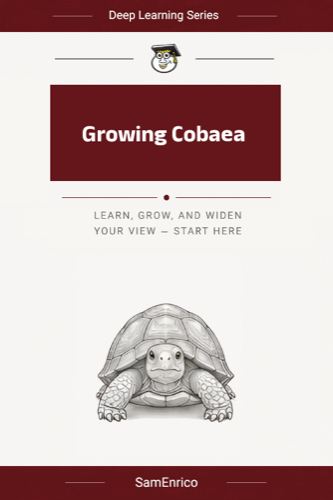
Growing Cobaea eBook
This publication, published by SamEnrico, covers G
by Andres Jamey
This publication, published by SamEnrico, covers Growing Cobaea
Formats
Free sample
Chapter 1: The Vine That Changed Everything--–- Before we talk about soil temperature, pruning groups, or the precise angle at which to position a seed, let me tell you about the first time I saw a Cobaea. I was visiting a friend’s garden in late August, the kind of garden where everything has gone slightly feral by that time of year—tomatoes splitting on the vine, zinnias looking tired, the whole place wearing that exhausted late-summer expression. I rounded the corner of her garage and stopped mid-stride. Someone had spray-painted the back wall of that building in purple, green, and white. That was my first thought.
Someone had vandalized her garage with an artist’s precision. Then I blinked, and the wall moved. A gentle breeze pushed through, and the entire surface rippled like a curtain. It wasn’t paint. It was a plant.
Thirty feet across and fifteen feet high, a living tapestry of overlapping leaves and thousands of flowers, each one the size of a teacup, each one a perfect bell hanging from a ruffled collar. Some were pale greenish-white, newly opened. Others had aged into deep violet-purple, so dark they looked almost black in the shadows. And the scent—honey and damp earth and something else I couldn’t name—rolled off the wall in waves, sweetest at the edges where the evening air was beginning to cool. I stood there for what felt like a long time, not saying anything.
Finally I turned to my friend and asked, with the genuine bewilderment of someone who had been gardening for years and thought he had seen everything, “What is that?” She smiled the smile of someone who has been waiting for this exact question. “Cup-and-saucer vine,” she said. “Cobaea scandens. It’s been there since May.” That was the moment. That was when I realized that everything I thought I knew about fast-growing vines was incomplete.
Clematis was elegant but slow. Morning glories were cheerful but ephemeral. Trumpet vine was aggressive but ugly for eleven months of the year. This thing—this Cobaea—was something else entirely. It had transformed a mundane suburban garage into a cathedral in a single growing season.
And I had never even heard of it.The Problem With Most Gardening Books Let me be honest with you from the start. Most gardening books lie to you. Not intentionally, not maliciously, but they lie all the same. They present plants as if they exist in a vacuum, as if your job is simply to follow a checklist and the plant will obediently perform. Plant here.
Water this much. Fertilize on these dates. Prune like this. And then—magic. The implicit promise is that gardening is a matter of compliance, not relationship.
But Cobaea will not be reduced to a checklist. This vine has personality in the same way a border collie has personality. It is intelligent, stubborn, and occasionally infuriating. It will test your patience during those long weeks when the seeds refuse to germinate. It will reward that patience with growth so fast you can practically watch it happen—I have measured six inches of new growth in a single day.
It will break your heart if you forget to harden it off properly, and it will make you look like a genius when your neighbors ask, “What IS that thing?” This book is not a checklist. It is a conversation between you and one of the most extraordinary ornamental plants ever brought into cultivation. By the time you finish reading, you will understand not just the mechanics of growing Cobaea, but the logic behind those mechanics. You will know why the seeds need to be planted horizontally (and why that strange instruction actually makes sense). You will know why the plant sometimes refuses to bloom despite looking perfectly healthy (and what to do about it).
You will know how to turn one plant into ten, how to keep it alive through winter, and how to design with it so that it becomes the centerpiece of your garden rather than a green blob that ate your porch. And along the way, I hope you will come to love this plant the way I do—not despite its quirks, but because of them.Who This Book Is For You do not need to be an expert gardener to grow Cobaea. In fact, some of my most successful Cobaea stories come from absolute beginners who simply followed instructions and were too inexperienced to know that what they were attempting was supposed to be difficult. That said, this book is written for a specific kind of gardener: the kind who wants to understand why. If you are content to buy a flat of petunias from the hardware store every May and call it a day, this book is not for you.
But if you have ever stood in your garden and wondered what would happen if you pushed harder, tried something unconventional, or attempted a plant that everyone says is “tricky”—then you are my people. Cobaea is the perfect plant for ambitious gardeners because it rewards ambition. A passive gardener who just sticks seeds in the ground and hopes for the best will get a scraggly vine with a handful of flowers in October, right before the frost kills it. An active gardener who soaks the seeds, uses a heat mat, pinches the seedlings, provides the right support, and manages the feeding schedule will get a thirty-foot wall of bloom by mid-July. The difference between those two outcomes is not luck.
It is knowledge, applied consistently. That is what this book provides.What This Plant Is (And What It Is Not)Let us clear up some terminology before we go any further. Cobaea scandens is a perennial vine native to the cloud forests of Mexico, where it grows as a woody climber that can reach fifty feet or more over several years. In its native habitat, it blooms from spring through autumn and never experiences frost. That is the plant’s true nature.
However, most gardeners reading this book live in climates where winter temperatures drop below freezing. In those climates, Cobaea cannot survive outdoors year-round. So we have a choice. We can grow it as an annual—planting new seeds every spring, enjoying the flowers from midsummer until the first hard frost, and then letting it die. This is the easiest path, and there is no shame in it.
An annual Cobaea will still grow fifteen to twenty feet in a single season and produce hundreds of flowers. Alternatively, we can grow it as a tender perennial—starting seeds early, protecting the plant through winter indoors (more on that in Chapter 5), and then putting it back outside the following spring. A two-year-old Cobaea that has been overwintered properly will bloom a full six to eight weeks earlier than a new plant from seed, and it will be significantly larger. I have seen third-year Cobaeas that covered entire arbors and bloomed so heavily that the weight of the flowers pulled the stems downward like weeping willows. Neither approach is right or wrong.
They are simply different commitments. This book will teach you both, and you can decide which fits your climate, your…
This is the end of the free sample. Get the eBook to keep going. Buy now
About this book
Details
- Author
- Andres Jamey
- Publisher
- SamEnrico
- Language
- English
- Genre
- Non-Fiction, Informative, Educational
- Released
- 2026-06-03
- Pages (approx.)
- 138
- Available as
- eBook, Audiobook

Read better in the ZLOADR app
Your eBooks on your phone or tablet. Sign in with your SamEnrico account and start reading.
More by Andres Jamey
 Modern Freudian Dream WorkAndres Jamey$11.99
 Self Hypnosis For Curling DeliveryAndres Jamey$11.99
 Alzheimer s Parent GuideAndres Jamey$11.99
 Anapanasati for CancerAndres Jamey$11.99
 Fentanyl Awareness and Safety GuideAndres Jamey$11.99
 The Virtual Coffee ConnectionAndres Jamey$11.99
 The Comparison Trap EscapeAndres Jamey$11.99
 Public Restroom AnxietyAndres Jamey$11.99
 Afghan Interpreter RescueAndres Jamey$11.99
 The Phantom of the Stock Exchange: How a Rogue Trader Fooled Wall StreetAndres Jamey$11.99
 The Siege of Vukovar: Europe's Forgotten Stand (1991)Andres Jamey$11.99
 Advanced Software Testing & QA MasteryAndres Jamey$11.99
You may also like
 Hong Kong Handover 1997Dunn Johnnie$11.99
 Zumba For Postnatal Recovery CourseNeal Christian$11.99
 Zumba for BeginnersLadner Nikia$11.99
 YouTube Comment Mining GuideHumes Pandora$12.99
 Worry Box MeditationCarlin Rudy$11.99
 Workplace Stress MeditationNguyen Lynn$11.99
 Workplace Stress and Sleep RepairHawley Ivory$11.99
 Workplace Perfectionism CureDelaney Jeffry$11.99
 Workplace Injustice Anger GuideWallen Isabelle$11.99
 Work Addiction and Burnout LinkGreenwood Ester$11.99
 Women in Yoga and WellnessBeattie Galina$11.99
 Women in Stand Up ComedyChun Evangeline$11.99