
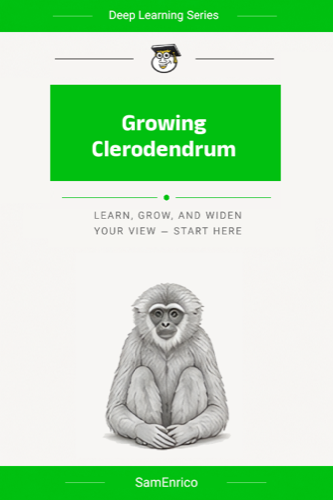
Non-FictionInformativeEducational
Growing Clerodendrum eBook
This publication, published by SamEnrico, covers G
This publication, published by SamEnrico, covers Growing Clerodendrum
Formats
Free sample
Chapter 1: The Undying Obsession...–- Every obsession has an origin story. For some gardeners, it begins with a single photograph—a cascade of white calyxes dripping like porcelain bells, each tipped with a precise drop of crimson. For others, it starts with a neighbor’s fence that vanished overnight beneath a blanket of scarlet blooms. And for many who will read this book, the obsession begins with a moment of panic: the discovery that something they planted as a polite little vine has transformed into a botanical force of nature, sending underground runners across the garden like whispered secrets.My own introduction to Clerodendrum came through the back door of failure. I had killed every orchid I ever owned.
My succulents stretched toward nonexistent light like prisoners reaching through bars. And yet, when a friend thrust a scraggly cutting of Clerodendrum thomsoniae into my hands with the words “This thing is impossible to kill,” I felt not hope but skepticism. I had heard those words before, usually from people who had never met my particular talent for plant neglect.I planted that cutting in a too-small pot with leftover soil from a deceased fern. I placed it on a north-facing windowsill that received approximately forty-seven minutes of weak morning light. I forgot to water it for weeks at a time.
And then, six months later, I walked into my living room to find that the plant had not merely survived—it had thrived. Vines had wrapped themselves around my curtain rod. Flowers exploded from every node. And somewhere beneath the soil, I would later discover, a network of roots had been plotting a quiet takeover of not just the pot but the entire shelf, the floor beneath it, and—if I had not intervened—quite possibly the downstairs neighbor’s apartment.That was the moment I understood that Clerodendrum is not a plant you tend. It is a plant you negotiate with.What This Chapter Will Do For You Before we dive into the botanical details, the historical journey, and the practical checklists that will prepare you for life with Clerodendrum, let me be clear about what this opening chapter is designed to accomplish.
By the time you finish reading these pages, you will understand:Why Clerodendrum has captivated gardeners from Victorian conservatories to modern Instagram feeds How a single genus can produce everything from delicate vines to fragrant trees to aggressive groundcovers Whether your personality and garden style align with the demands of these vigorous plants What questions you must answer before spending a single dollar on a plant Why the plant you thought you understood might surprise you in ways both wonderful and challenging This chapter is not a care manual—those arrive in Part II. This chapter is an invitation. It asks you to consider whether you are ready for a plant that will not sit quietly in the corner and behave itself. It asks you to examine your tolerance for growth, for surprise, for a little bit of chaos. And it asks you to fall in love with one of the most rewarding, frustrating, beautiful, and infuriating genera in the plant kingdom.Let us begin.The Forgotten Royalty of the Plant World In the mid-nineteenth century, if you had money and taste, you owned a Clerodendrum.
The plant hunters of Victorian England—those fearless, often foolhardy adventurers who risked tropical diseases and hostile terrain to bring back botanical treasures—returned from West Africa and Southeast Asia with specimens that left the horticultural establishment breathless. The Clerodendrum thomsoniae, with its dramatic white-and-red flowers, was named for a missionary’s wife who first collected it in Nigeria. It became an instant sensation in the conservatories of the wealthy, where it was trained up pillars and across ceilings, its blooms drawing gasps from dinner guests who had never seen anything like it.But then, as these things happen, fashion moved on. The Edwardians preferred orchids, which required the kind of fussy attention that signaled true expertise. The Victorians had loved Clerodendrum precisely because it grew so easily; by the early twentieth century, that very ease had become a mark against it.
If a plant thrived without constant coddling, the thinking went, it could not be truly prestigious. Clerodendrum was relegated to the back corners of botanical gardens and the forgotten greenhouses of estate sales.For the next hundred years, the genus slumbered in relative obscurity. Occasionally, a dedicated collector would seek out a Clerodendrum ugandense for its astonishing blue flowers—a true blue, rare in the plant world, the color of a high-altitude sky. A gardener in coastal Florida might plant C. inerme as a hedge and forget its origins.
But for the most part, Clerodendrum remained a curiosity, a footnote in encyclopedia-style plant guides that treated it as a single generic entity rather than the diverse and dramatic genus it truly is.Now, we are living through a renaissance. The rise of tropical gardening in formerly temperate zones—fueled by warmer winters and a collective yearning for lush, dramatic spaces—has brought Clerodendrum back into the spotlight. Plant influencers on Instagram have discovered the photogenic qualities of C. quadriloculare, whose two-toned pink-and-white blooms appear in winter when almost nothing else flowers. Home gardeners in Zone 6 have learned that they can grow C.
thomsoniae in containers and overwinter it in their basements, bringing it back out each spring to devour their porches anew. And a new generation of plant lovers has discovered what the Victorians knew all along: Clerodendrum is not difficult. It is different.The 400-Personality Genus To say that Clerodendrum is diverse is like saying the ocean is damp. The genus contains more than four hundred species, distributed across Africa, Asia, Australia, and the Pacific Islands. Some are delicate vines that climb with elegant precision.
Others are coarse shrubs that will fill a five-gallon container within months. Still others become small trees, their trunks thickening over decades into sculptural forms that anchor tropical landscapes.This diversity creates a unique problem for the gardener, and it is the central problem this book exists to solve. Most gardening guides treat Clerodendrum as a monolith. They offer generic advice that might work for C. incisum but will fail utterly for C.
bungei. They warn about suckering without distinguishing between species that sucker aggressively and those that stay politely clumped. They describe flowers as if every Clerodendrum produced the same dramatic white-and-red display, when in fact the genus includes blues, pinks, oranges, yellows, and pure whites in forms ranging from butterfly-like to tubular to spidery to cascading.Throughout this book, we will treat each species as the individual it is. Chapter 2 profiles twelve species and cultivars specifically chosen for home gardeners, from the reliable C. thomsoniae to the fragrant C.
trichotomum to the salt-tolerant C. inerme. You will learn which species climb, which spread, which stay put, and which will require you to install root barriers or risk losing your entire garden to an underground invasion. You will learn which flowers attract hummingbirds (most of them), which emit fragrance that will perfume your entire patio (C. bungei is almost overwhelming), and which will bloom in the darkest days of winter when…
This is the end of the free sample. Get the eBook to keep going. Buy now
About this book
Details
- Author
- Sandlin Sheilah
- Publisher
- SamEnrico
- Language
- English
- Genre
- Non-Fiction, Informative, Educational
- Released
- 2026-05-18
- Pages (approx.)
- 155
- Available as
- eBook, Audiobook

Read better in the ZLOADR app
Your eBooks on your phone or tablet. Sign in with your SamEnrico account and start reading.
More by Sandlin Sheilah
 Dream of Dead PeopleSandlin Sheilah$11.99
 Social Media Shop AddictionSandlin Sheilah$11.99
 Self Hypnosis For Darts AccuracySandlin Sheilah$11.99
 Anapanasati for AnxietySandlin Sheilah$11.99
 Financial Stress And ParentsSandlin Sheilah$11.99
 Building Relationships With VendorsSandlin Sheilah$11.99
 Eritrean Conscript EscapeSandlin Sheilah$11.99
 Elder Parent Caregiving GuideSandlin Sheilah$11.99
 Bridge Crossing AnxietySandlin Sheilah$11.99
 Pyramus and Thisbe: The Wall That Could Not DivideSandlin Sheilah$11.99
 The Silent Archer: Empress Wu Zetian's Secret MarksmanSandlin Sheilah$11.99
 How to Produce a Bicycle Crank and ChainwheelSandlin Sheilah$11.99
You may also like
 Hong Kong Handover 1997Dunn Johnnie$11.99
 Zumba For Postnatal Recovery CourseNeal Christian$11.99
 Zumba for BeginnersLadner Nikia$11.99
 YouTube Comment Mining GuideHumes Pandora$12.99
 Worry Box MeditationCarlin Rudy$11.99
 Workplace Stress MeditationNguyen Lynn$11.99
 Workplace Stress and Sleep RepairHawley Ivory$11.99
 Workplace Perfectionism CureDelaney Jeffry$11.99
 Workplace Injustice Anger GuideWallen Isabelle$11.99
 Work Addiction and Burnout LinkGreenwood Ester$11.99
 Women in Yoga and WellnessBeattie Galina$11.99
 Women in Stand Up ComedyChun Evangeline$11.99