
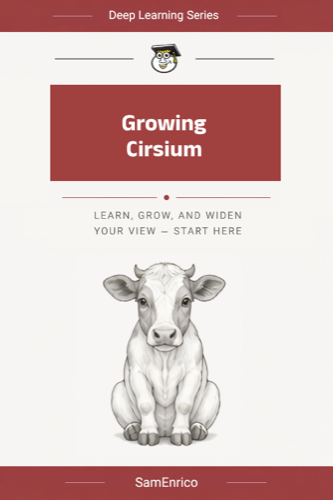
Non-FictionInformativeEducational
Growing Cirsium eBook
This publication, published by SamEnrico, covers G
This publication, published by SamEnrico, covers Growing Cirsium
Formats
Free sample
Chapter 1: The Most Misunderstood Plant--–- I spent ten years trying to kill thistles. Every spring, like a ritual I refused to question, I marched into my garden with gloves, a trowel, and a quiet fury reserved only for plants with spines. I dug. I pulled. I cursed.
And every summer, they returned—taller, angrier, and more numerous than before. It was only when I stopped fighting long enough to actually look at them that I realized the truth: the thistle was not my enemy. It was trying to teach me something, and I had been refusing to listen.This is a book about learning to hear that message. It is not a surrender to weeds, nor is it a permission slip to let your garden run wild. It is, instead, an invitation to reconsider the most despised plant in the Western garden—and in doing so, to become a better, more observant, more ecologically intelligent gardener.
The thistle, I have come to believe, is the most honest plant you will ever grow. It lies about nothing. It hides nothing. It tells you exactly what is wrong with your soil, exactly which creatures depend on it, and exactly where you stand in the relationship between cultivation and wildness.The Confession of a Reformed Thistle-Hater Let me be clear about my credentials. I am not a botanist.
I am not a master gardener with decades of formal training. I am, or was, a typical weekend gardener—the kind of person who bought whatever looked pretty at the nursery, planted it with vague hope, and then spent every subsequent season trying to undo the consequences of my own ignorance. I planted mint in open ground (it took over the herb garden). I let bindweed go for "just a few weeks" (it took two years to eradicate). And I treated every thistle that appeared as an invader to be eliminated with extreme prejudice.The turning point came on a July morning when I was kneeling in my vegetable patch, sweat dripping onto the soil, trying to extract yet another deep-rooted Cirsium arvense—the creeping thistle, the one gardeners love to hate most.
The root broke off six inches down, as it always did, and I sat back on my heels, exhausted and defeated. A bumblebee landed on the purple flower head I had been about to cut. It crawled across the tiny tubular florets with a focus and intensity that I, in my war against the plant, had never bothered to observe. The bee was not alone. Within five minutes, I counted three species of solitary bees, two honeybees, and a painted lady butterfly all visiting the same small patch of thistles—a patch that had produced nothing but frustration for me but apparently offered a banquet for them.That moment changed everything.
Not because I suddenly loved thistles—I didn't. But because I realized that my war was based on an assumption I had never examined: the assumption that thistles had no right to exist in my garden. Where did that assumption come from? From nursery catalogs that never sold thistles. From gardening books that mentioned them only in sections titled "Weed Control." From neighbors who nodded sagely when I complained about "those horrible spiky things." I had inherited a prejudice without ever questioning whether it was justified.What This Book Is and What It Is Not Before we go any further, let me be explicit about the boundaries of this project.
This book is not a defense of letting Cirsium arvense run rampant through your flower beds. The creeping thistle is genuinely problematic in small gardens, and I will give you detailed strategies for controlling it without losing your sanity or your soil health. This book is not a botanical monograph—you will not find exhaustive taxonomic keys or descriptions of every Cirsium species on Earth. (For that, consult the excellent Flora of North America or the European Herbarium Project.) And this book is not a memoir, although I will tell you stories from my own garden because stories stick where instructions fade.What this book is, instead, is a practical, ecological, and occasionally philosophical guide to the genus Cirsium. It is for gardeners who want to understand why thistles appear where they do, what they can teach us about our soil, and which species deserve a place in our gardens for their beauty and their ecological value.
It is for wildlife gardeners who want to support the dozens of bee species, butterfly species, and bird species that depend on thistles for survival. It is for frustrated weed-warriors who have tried everything and still cannot win—because I will show you why losing the war might be the best thing that ever happened to your garden. And it is for the curious, the open-minded, and the brave: gardeners willing to question every assumption they have been taught about what belongs and what does not.Why the Thistle Has Such a Bad Reputation Let us be honest about the thistle's flaws. They are numerous and, in some contexts, genuinely problematic. Start with the spines.
Thistles are armed to the teeth—literally, in the sense that their leaves, stems, and flower bracts are covered in sharp, pointed projections that pierce skin, puncture gloves, and make handling them an exercise in careful choreography. The spines are not merely annoying; they are evolutionarily sophisticated defense mechanisms. Each spine is a modified leaf margin, hardened into a sharp point and reinforced with lignin, the same compound that gives wood its strength. Touch a thistle leaf the wrong way, and you will bleed. Try to pull a thistle without gloves, and you will regret it for days.Then there is the persistence.
Thistles do not die easily. Annual and biennial species produce thousands of seeds per plant, seeds that can remain viable in the soil for up to twenty years. Perennial species like Cirsium arvense reproduce not only by seed but by rhizomes—underground stems that spread horizontally, sending up new shoots every few inches. A single creeping thistle plant can produce a hundred feet of rhizome in a single growing season. Chop that rhizome into pieces with a tiller or a shovel, and each piece becomes a new plant.
This is why mechanical cultivation often makes thistle problems worse: you are not killing the plant; you are cloning it.And then there is the sheer visibility of thistles. They are tall, often exceeding four feet. Their flowers are showy and unmistakable. Their leaves are distinctive and hard to miss. Unlike many weeds that lurk inconspicuously at ground level, thistles announce their presence boldly and unapologetically.
You cannot ignore a thistle. You cannot pretend it is something else. It demands your attention, and for most gardeners, that attention takes the form of irritation.The Hidden Virtues No One Tells You About But every flaw has a corresponding virtue, if you know where to look. The spines that make thistles so unpleasant to handle also make them completely inedible to deer, rabbits, groundhogs, and most other mammalian herbivores. If you have struggled to grow anything in a garden overrun by deer—if you have watched hostas disappear overnight and tulips…
This is the end of the free sample. Get the eBook to keep going. Buy now
About this book
Details
- Author
- Strain Dorthy
- Publisher
- SamEnrico
- Language
- English
- Genre
- Non-Fiction, Informative, Educational
- Released
- 2026-06-02
- Pages (approx.)
- 134
- Available as
- eBook, Audiobook

Read better in the ZLOADR app
Your eBooks on your phone or tablet. Sign in with your SamEnrico account and start reading.
More by Strain Dorthy
 Freudian Dream DecoderStrain Dorthy$11.99
 Spending Freeze for CouplesStrain Dorthy$11.99
 Press Release Word CountStrain Dorthy$11.99
 Rock Climbing Fear Hypnosis GuideStrain Dorthy$11.99
 Networking for New GraduatesStrain Dorthy$11.99
 Medical Debt Coping PlanStrain Dorthy$11.99
 Spontaneity for LeadersStrain Dorthy$11.99
 Rwandan Genocide SurvivorStrain Dorthy$11.99
 The Lost City of Atlantis: Secrets Beneath the WavesStrain Dorthy$11.99
 Panic Attack Intervention GuideStrain Dorthy$11.99
 The Marid’s Bargain: A Djinn’s Unfinished VowStrain Dorthy$11.99
 The Bloodhound and the Blackout: How a Dog Solved the Great New York Power MysteryStrain Dorthy$11.99
You may also like
 Hong Kong Handover 1997Dunn Johnnie$11.99
 Zumba For Postnatal Recovery CourseNeal Christian$11.99
 Zumba for BeginnersLadner Nikia$11.99
 YouTube Comment Mining GuideHumes Pandora$12.99
 Worry Box MeditationCarlin Rudy$11.99
 Workplace Stress MeditationNguyen Lynn$11.99
 Workplace Stress and Sleep RepairHawley Ivory$11.99
 Workplace Perfectionism CureDelaney Jeffry$11.99
 Workplace Injustice Anger GuideWallen Isabelle$11.99
 Work Addiction and Burnout LinkGreenwood Ester$11.99
 Women in Yoga and WellnessBeattie Galina$11.99
 Women in Stand Up ComedyChun Evangeline$11.99