
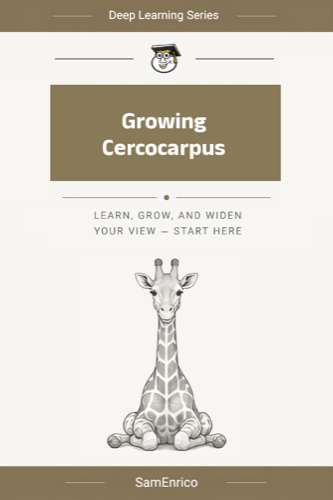
Growing Cercocarpus
This publication, published by SamEnrico, covers G
This publication, published by SamEnrico, covers Growing Cercocarpus
Formats
About this book
Free sample
Chapter 1: The Living Relic--The first time I stood in front of a wild Cercocarpus ledifolius on a windswept ridgeline in central Oregon, I didn’t know what I was looking at. The tree was gnarled, low to the ground, its bark peeling in gray-brown ribbons. Its leaves were small, dark, and curled at the edges like ancient parchment. A naturalist traveling with me pointed and said, “That one has been here since before the Magna Carta.” I laughed. He didn’t.
Later, back in town, a dendrochronologist confirmed it: some of these mountain mahogany specimens exceed 1,300 years in age. They were seedlings when the Roman Empire fell. They were mature trees when Genghis Khan rode. They are still alive today, quietly photosynthesizing through droughts, blizzards, and wildfires that have leveled entire forests around them.This book exists because of that day on the ridgeline. Cercocarpus—commonly known as mountain mahogany—is the most underappreciated, overlooked, and ecologically vital native shrub you have never heard of.
It is absent from nearly every mainstream nursery. It does not appear in glossy garden magazines. No celebrity horticulturist has built a brand around it. And yet, for anyone living in the western United States—from the high deserts of Nevada to the coastal chaparral of California, from the Rocky Mountains of Colorado to the sky islands of Arizona—this plant may be the single best addition you can make to your landscape. It requires almost no water after two years.
It laughs at 100-degree heat and minus-30-degree cold. It bends under heavy snow without breaking. It feeds birds, shelters songbirds, stabilizes steep slopes, and—in an era of catastrophic wildfires—it is remarkably fire-resistant.This chapter is not a botanical lecture. It is an invitation. Before we dive into propagation, pruning, and planting, I want you to understand why this genus matters, what makes it unique, and why—despite all its virtues—you have likely never seen one for sale.
We will explore the three main species you are most likely to grow, the myths that have kept Cercocarpus out of cultivation, and…
This is the end of the free sample. Get the eBook to keep going. Buy now
Contents
- Chapter 1
- Chapter 2
- Chapter 3
- Chapter 4
- Chapter 5
- Chapter 6
- Chapter 7
- Chapter 8
- Chapter 9
- Chapter 10
- Chapter 11
- Chapter 12
Details
- Author
- Dukes Jonelle
- Publisher
- SamEnrico
- Language
- English
- Genre
- Non-Fiction, Informative, Educational
- Released
- 2026-05-06
- Pages (approx.)
- 157
- Available as
- eBook, Audiobook

Read better in the ZLOADR app
Your eBooks on your phone or tablet. Sign in with your SamEnrico account and start reading.
More by Dukes Jonelle
 The Sudoku Brain Protection GuideDukes Jonelle$11.99
 Uber Driver Lounge SecretsDukes Jonelle$11.99
 Key Staff Departure Vendor Notification PlanDukes Jonelle$11.99
 Cannabis Use Disorder MistakesDukes Jonelle$11.99
 Morning Light Exposure PlanDukes Jonelle$11.99
 Infidelity Recovery After Sex AddictionDukes Jonelle$11.99
 Spouse Death and WorkDukes Jonelle$11.99
 Silence Fear Before TalksDukes Jonelle$11.99
 Gun Jumping Penalty RegisterDukes Jonelle$11.99
 The Silk Road’s Shadow Fleet: A Maritime Empire’s Rise and FallDukes Jonelle$11.99
 The Rose of Susa: Love and Betrayal in the Shadow of the Achaemenid EmpireDukes Jonelle$11.99
 How to Start a Computer Business (Beginners Guide)Dukes Jonelle$11.99