
Non-FictionInformativeEducational
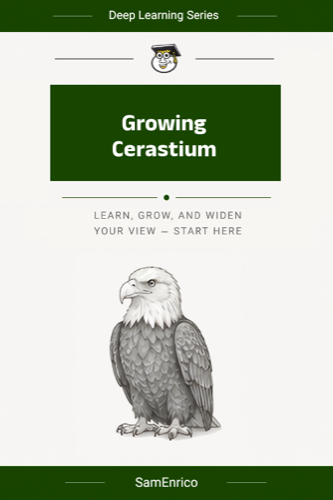
Growing Cerastium eBook
This publication, published by SamEnrico, covers G
This publication, published by SamEnrico, covers Growing Cerastium
Formats
Free sample
Chapter 1: The Lawn Lie–- Every spring, Americans perform a collective ritual that makes no logical sense. We uncoil hoses, start mowers, spread chemicals, and spend billions of dollars convincing a patch of grass to grow exactly three inches tall—only to cut it back down seven days later and start the entire process over again. We water it, feed it, weed it, aerate it, dethatch it, and pray for rain when the water bill climbs too high. And what do we get for all this effort? A green carpet that feeds nothing, drinks like a teenager at a pool party, and dies the moment we stop paying attention.There has to be a better way.This is not another dry gardening manual filled with Latin names and botanical jargon that puts you to sleep by page three.
This is not a textbook for academics who speak in scientific papers. This is a confession, a rescue plan, and a permission slip all rolled into one. My name is Sam Enrico, and for fifteen painful years, I was a full-blown lawn addict. I mowed twice a week from April through October. I owned three different fertilizers for three different seasons.
I had a spreader, a dethatcher, an aerator, a sprayer for weeds I could not even identify by sight, and a shed so full of lawn care products that I could barely fit the lawn mower inside. I spent more money on my lawn each year than I had spent on my first car. And then the drought came and changed everything.The summer of 2018 was the kind of dry that makes farmers cry and reservoirs shrink to mud puddles. My town issued mandatory water restrictions. No lawn watering except on Tuesdays and Saturdays, and even then only with a hand-held hose.
No sprinklers. No soaker hoses. No automatic timers. I stood on my driveway for hours each week with a watering wand, trying to keep eight thousand square feet of Kentucky bluegrass alive one square foot at a time. It was impossible, like bailing out a sinking boat with a thimble.
By July, my perfect lawn was a patchwork of brown and green. By August, it was mostly brown. By September, it was dead. Not sleeping. Not dormant.
Dead down to the roots.But something strange happened in the middle of that brown apocalypse. Along the edge of my driveway, right where the concrete met the soil, a small patch of silver-gray foliage had not only survived the drought. It was thriving. It had spread six inches since spring without any help from me. It had bloomed white flowers back in May, though I had barely noticed them at the time.
And in August, when every other plant in my yard was crisped to toast and crumbling at the touch, this little patch looked fresh, cool, and utterly indifferent to my suffering. It was Cerastium tomentosum. Snow-in-Summer. A plant my grandmother had grown along her rock wall for decades, a plant I had always dismissed as old lady gardening, a plant I had never once watered or fertilized or babied in any way. And there it sat, green and silver and blooming, laughing at my dead lawn.That fall, I did something drastic.
I killed the rest of my lawn. Not with harsh chemicals or a rented sod cutter. I used cardboard, compost, and a complete surrender of my gardening ego. I covered every square foot of dead grass with flattened moving boxes from the grocery store, piled on two inches of compost from the town recycling center, and waited through the winter. The next spring, I planted Cerastium plugs twelve inches apart across the entire front yard.
My neighbors thought I had lost my mind. One asked if I was starting a cemetery. Another predicted I would regret it within a month. A third just shook his head and walked back inside without saying a word.Three years later, that same neighbor knocked on my door and asked for cuttings. He had watched me sit on my porch with lemonade while he pushed a mower through ninety-degree heat.
He had seen the bees hovering over my white blooms while his lawn was a chemical desert. He had done the math on his water bill versus mine. He wanted in.That is what this book is really about. Not just Cerastium, though we will spend twelve chapters getting to know this remarkable plant better than you know most of your relatives. This book is about the gap between what we think a landscape should be and what it actually can be.
It is about the lie we have been sold by the lawn care industry, the housing developers, and the cultural expectation that a proper home has a green rectangle in front of it. And it is about finding a better alternative: a living, breathing, self-sufficient ground cover that asks almost nothing from you and gives everything in return.The Great Lawn Myth Exposed Let us be honest about the lawn for a moment. The manicured English countryside estate lawn, the one we have all been trying to replicate in our own front yards since the days of Levittown, was never intended for ordinary people. It was a flex. A statement of wealth and status.
Only the richest landowners could afford to take perfectly good farmland and cover it with grass that produced nothing, fed no one, and required an entire army of gardeners with scythes and rolling pins to maintain. The lawn was never practical. It was always a performance.When the suburbs exploded after World War II, the lawn became democratized. Suddenly every returning veteran with a VA loan could have his own piece of that American dream. But the maintenance did not get any easier.
We just replaced the scythe with a gas mower, the gardener with the exhausted homeowner, and the hidden cost of labor with the painfully visible cost of water, fertilizer, gasoline, and lost weekends.Consider the actual numbers, because they are staggering. The average American lawn consumes ten thousand gallons of water per year. Per homeowner. That is enough drinking water for a family of four for three full months, poured onto grass that cannot even drink it efficiently because most of it evaporates before it reaches the roots or runs off into the storm drain. The Environmental Protection Agency estimates that landscape irrigation accounts for nearly one-third of all residential water use in the United States, totaling more than nine billion gallons of water per day nationwide.
Nine billion. That is not a typo. That is a crisis hiding in plain sight.Then add the chemicals into the equation. The average lawn receives four to six applications of synthetic fertilizer per year, plus herbicides to kill dandelions and clover, plus pesticides to kill grubs and chinch bugs and armyworms. These chemicals do not stay neatly contained within your property lines.
They run off into the storm drains, into the streams, into the groundwater, into the drinking water. They kill beneficial insects right along with the pests. They create a biological desert where nothing can live except the grass you planted, and even…
This is the end of the free sample. Get the eBook to keep going. Buy now
About this book
Details
- Author
- Stubbs Arlyne
- Publisher
- SamEnrico
- Language
- English
- Genre
- Non-Fiction, Informative, Educational
- Released
- 2026-05-09
- Pages (approx.)
- 151
- Available as
- eBook, Audiobook

Read better in the ZLOADR app
Your eBooks on your phone or tablet. Sign in with your SamEnrico account and start reading.
More by Stubbs Arlyne
 Spouse Grief Exercise TherapyStubbs Arlyne$11.99
 Upwork Niche Domination PlanStubbs Arlyne$11.99
 Sudden Key Departure Customer Retention GuideStubbs Arlyne$11.99
 Cannabis Use Disorder WorkplaceStubbs Arlyne$11.99
 Delayed Sleep Phase GuideStubbs Arlyne$11.99
 The Relapse Prevention Field GuideStubbs Arlyne$11.99
 The Magnesium Brain ProtectionStubbs Arlyne$11.99
 Five Minute Speaker ResetStubbs Arlyne$11.99
 Tiamat's Last Stand: The Titan of ChaosStubbs Arlyne$11.99
 FTC Merger Litigation ReviewStubbs Arlyne$11.99
 The Maestro and the Mogul: How Ravi Shankar Redefined Global Music ContractsStubbs Arlyne$11.99
 How to Start a Crop Preparation for Primary Market (cleaning, Trimming, Grading, Etc.) Business (BegStubbs Arlyne$11.99
You may also like
 Hong Kong Handover 1997Dunn Johnnie$11.99
 Zumba For Postnatal Recovery CourseNeal Christian$11.99
 Zumba for BeginnersLadner Nikia$11.99
 YouTube Comment Mining GuideHumes Pandora$12.99
 Worry Box MeditationCarlin Rudy$11.99
 Workplace Stress MeditationNguyen Lynn$11.99
 Workplace Stress and Sleep RepairHawley Ivory$11.99
 Workplace Perfectionism CureDelaney Jeffry$11.99
 Workplace Injustice Anger GuideWallen Isabelle$11.99
 Work Addiction and Burnout LinkGreenwood Ester$11.99
 Women in Yoga and WellnessBeattie Galina$11.99
 Women in Stand Up ComedyChun Evangeline$11.99