
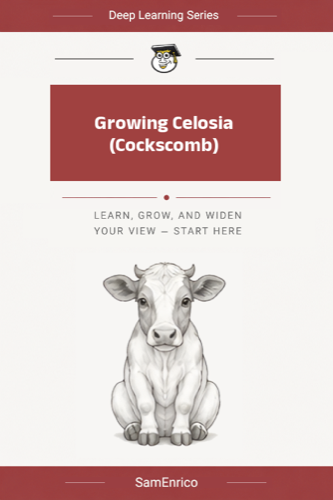
Non-FictionInformativeEducational
Growing Celosia (Cockscomb) Audiobook
This publication, published by SamEnrico, covers G
This publication, published by SamEnrico, covers Growing Celosia (Cockscomb)
Formats
Free sample
Chapter 1: Velvet Fire Defined--What if a flower could look like a flame, feel like velvet, and last longer in a vase than almost anything else you can grow from seed? That is the promise of Celosia, and yet most gardeners have never given it a second thought. They walk past the dusty seed packets at the garden center, dismiss the neon-bright blooms at the farmer's market as "too much," or relegate this extraordinary plant to the category of grandma's garden kitsch. They are making a profound mistake.Celosia is not a subtle plant. It does not whisper or fade into the background.
It shouts from every petal, every plume, every velvety crest. And in an era of predictable perennial borders and safe, beige landscaping, that boldness is exactly what your garden has been missing. This chapter is not merely an introduction to a genus. It is an argument for why Celosia deserves a central place in your garden, your vase, and your imagination.The name itself tells you something about its character. Celosia comes from the ancient Greek word keleos, meaning "burning" or "flame." Even two thousand years ago, observers looked at this plant and saw fire made manifest.
The common name "cockscomb" refers to the crested varieties whose flattened, ruffled heads supposedly resemble a rooster's comb, though many gardeners today think they look more like a brain or a piece of coral washed ashore. The Japanese call it keito, meaning "cockscomb" as well, while in parts of Africa it is known as soko yokoto, which translates roughly to "make husbands fat and happy"—a reference to its use as a nutritious leafy vegetable. One plant, dozens of names, and a personality that refuses to be ignored.The Three Faces of Velvet Fire Before you can grow Celosia with confidence, you need to understand its three distinct forms. They share a botanical identity—all are varieties of Celosia argentea—but they look, behave, and perform so differently that novice gardeners often mistake them for entirely separate species. Think of them as three siblings from the same family: each with a unique temperament, but all sharing the same fiery bloodline.Cristata: The Brain.
This is the showstopper, the one that makes people stop mid-stride and ask, "What is that?" The flowers of Cristata varieties are fused, flattened, and elaborately ruffled into a shape that defies easy description. Some liken it to…
This is the end of the free sample. Get the Audiobook to keep going. Buy now
About this book
Details
- Author
- Zuniga Talisha
- Publisher
- SamEnrico
- Language
- English
- Genre
- Non-Fiction, Informative, Educational
- Released
- 2026-05-25
- Pages (approx.)
- 142
- Available as
- eBook, Audiobook

Listen in the VoxFlicks app
Audiobooks and audio dramas wherever you go. Sign in with your SamEnrico account and press play.
More by Zuniga Talisha
 The Self Hypnosis for Public SpeakingZuniga Talisha$11.99
 Processing End of Life NightmaresZuniga Talisha$11.99
 Departure Knowledge Transfer Emergency KitZuniga Talisha$11.99
 Teenage Girl Confidence GuideZuniga Talisha$11.99
 Immigrant Coffee Roaster SuccessZuniga Talisha$11.99
 Young Widow GuideZuniga Talisha$11.99
 Stevie Wonder VisionZuniga Talisha$11.99
 TRT Therapy GuideZuniga Talisha$11.99
 The Jade Emperor's Celestial Trial: How a Mortal Outwitted the GodsZuniga Talisha$11.99
 Excalibur’s Shadow: The Forgotten Knights of the Round Table’s Darkest SecretZuniga Talisha$11.99
 How to Produce Automotive Plastic ProductsZuniga Talisha$11.99
 How to Produce Occupational and Physical Therapy EquipmentZuniga Talisha$11.99
You may also like
 Hong Kong Handover 1997Dunn Johnnie$11.99
 Zumba For Postnatal Recovery CourseNeal Christian$11.99
 Zumba for BeginnersLadner Nikia$11.99
 YouTube Comment Mining GuideHumes Pandora$12.99
 Worry Box MeditationCarlin Rudy$11.99
 Workplace Stress MeditationNguyen Lynn$11.99
 Workplace Stress and Sleep RepairHawley Ivory$11.99
 Workplace Perfectionism CureDelaney Jeffry$11.99
 Workplace Injustice Anger GuideWallen Isabelle$11.99
 Work Addiction and Burnout LinkGreenwood Ester$11.99
 Women in Yoga and WellnessBeattie Galina$11.99
 Women in Stand Up ComedyChun Evangeline$11.99