
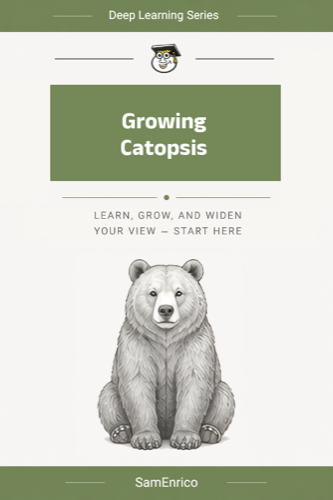
Growing Catopsis eBook
This publication, published by SamEnrico, covers G
This publication, published by SamEnrico, covers Growing Catopsis
Formats
Free sample
Chapter 1: The Accidental Carnivore...--–- It began, as many obsessions do, with a single plant on a single day—a plant that should not have survived where it was found.The year was 1887, and a British botanist named Charles Henry Wright stood on a telephone wire in southern Florida. He had not climbed there for sport. He had climbed there because, from the ground, he had spotted something impossible: a cluster of bright yellow-green rosettes growing on a bare, sun-blasted strand of telegraph copper. No soil. No moss.
No visible moisture. Just open air, salt wind, and a plant that seemed to have decided that trees were too conventional.Wright collected several specimens and sent them back to the Royal Botanic Gardens at Kew, where they promptly baffled every botanist in residence. The plants were bromeliads, yes—but unlike any in cultivation. Their leaves were smooth in some species, powdery in others. Their central urns held water even after weeks without rain.
And when Wright dissected one, he found the tank full of drowned insects: ants, small flies, even a juvenile mosquito. The plant had not trapped them deliberately, but it had certainly benefited from their deaths.He called it Catopsis berteroniana, and he noted in his journal: "A plant of singular indifference to conventional growing conditions. It appears to thrive on neglect, provided the neglect is of a very specific kind."That phrase—"neglect of a very specific kind"—is the key to everything that follows.The Plant That Should Not Exist If you have picked up this book, you are likely one of three people. First, you may be a bromeliad collector who has exhausted the charms of Tillandsia and Guzmania and now seeks something rarer, stranger, and more demanding. Second, you may be a terrarium or vivarium builder looking for a centerpiece plant that will actually thrive in the humid, enclosed world you have created.
Third—and this is the most interesting category—you may be someone who killed a few air plants, felt embarrassed about it, and decided to try again with a plant that is simultaneously harder and easier than anything you have grown before.Welcome to all of you. You have found the right book.Catopsis (pronounced cat-OP-sis) is a genus of epiphytic bromeliads native to the cloud forests and tropical lowlands of Central and South America, with a few species reaching as far north as southern Florida. The name comes from the Greek katopsis, meaning "a sight" or "a view"—a reference to the plant's striking appearance, particularly its erect, candle-like inflorescence that can rise a foot or more above the rosette.But the name could just as easily reference the plant's remarkable ability to survive where other plants cannot. In the wild, Catopsis species colonize bare tree branches, exposed rock faces, and even—as Wright discovered—human-made structures. They do not need soil.
They do not need frequent watering. What they need is a very specific combination of conditions: clean water, bright light (or deep shade, depending on the species), horizontal air movement, and a growing surface that does not stay wet against their bases.Get those conditions right, and Catopsis will reward you with years of growth, spectacular blooms, and a steady supply of pups. Get them wrong, and the plant will die in a matter of weeks—often without any obvious warning until it is too late.This chapter is about why that happens and why, despite the risks, you should want to grow Catopsis anyway.The Misunderstood Genus One of the first things you will discover as a Catopsis grower is that almost no one has heard of your plant. This is simultaneously frustrating and delightful. Frustrating because you cannot walk into a big box store and buy one.
Delightful because, when you successfully bloom a C. berteroniana for the first time, you will be among a very small group of people who have done so.Catopsis sits within the bromeliad family, specifically the subfamily Tillandsioideae, which includes Tillandsia (air plants), Guzmania, and Vriesea. Of these, Tillandsia is by far the most popular in cultivation—and the most frequently killed. The reason is simple: Tillandsia are often sold as "no-care" plants that need only a weekly misting. This is a lie.
Tillandsia need consistent moisture, good air flow, and very specific light conditions. When they die, their owners assume they are incapable of keeping plants alive.Catopsis is different. It requires more attention to detail but is actually more forgiving of certain mistakes. For example, a Tillandsia left in standing water will rot within days. A Catopsis left with water in its tank—provided the water is clean—will be perfectly fine.
In fact, it requires water in its tank to survive.This is the great irony of the genus: Catopsis is simultaneously more demanding and more resilient than its better-known cousins. It demands clean water, proper mounting, and species-appropriate light. But it forgives occasional drying, temperature swings, and even insect infestations better than most bromeliads.That said, there is one thing Catopsis will not forgive: being treated like a terrestrial plant.The Epiphytic Imperative If you take only one lesson from this chapter, let it be this: Catopsis is an epiphyte, and it will die if you plant it in soil.I have seen this happen more times than I can count. A new grower buys a beautiful C. floribunda at a plant show, takes it home, and—because they have only ever grown houseplants in pots—sticks it in a ceramic container filled with potting mix.
The plant looks fine for a week. Then the lower leaves turn yellow. Then the base becomes soft. Then, when the grower tugs gently on the central leaves, the entire rosette pulls out of the base, revealing a black, rotten core.The plant is dead. It has been dead for days.
And the cause is almost always the same: the base was buried.Catopsis roots are not like the roots of a fern or a philodendron. They are primarily anchoring structures, not nutrient-absorbing ones. The plant absorbs water and nutrients through specialized scales called trichomes on its leaves and through the water held in its central urn. If the base of the plant is buried in moist soil or moss, the tissue cannot breathe. Bacteria and fungi multiply.
Rot sets in. Within a week to ten days, the plant is gone.This does not mean Catopsis cannot be grown in containers. It can. But the container must be filled with an extremely coarse, fast-draining medium—typically a mix of fir bark, perlite, and charcoal—and the plant must be positioned so that its base sits on top of the medium, not buried in it. Even then, many growers prefer to mount their Catopsis on wood or cork bark, where the base remains fully exposed to air.The rule is simple: the base of the plant should never be in contact with moisture-retaining material.
If you remember nothing else from this book, remember that.The Accidental Carnivore Now we come to the aspect of Catopsis that fascinates newcomers and confuses botanists in equal measure: the plant's relationship with insects.Several Catopsis species—most notably…
This is the end of the free sample. Get the eBook to keep going. Buy now
About this book
Details
- Author
- Cardenas Anabel
- Publisher
- SamEnrico
- Language
- English
- Genre
- Non-Fiction, Informative, Educational
- Released
- 2026-05-25
- Pages (approx.)
- 127
- Available as
- eBook, Audiobook

Read better in the ZLOADR app
Your eBooks on your phone or tablet. Sign in with your SamEnrico account and start reading.
More by Cardenas Anabel
 Rescripting Nightmares For OCDCardenas Anabel$11.99
 Upwork Talent Badge AcceleratorCardenas Anabel$11.99
 Aretha Franklin RespectCardenas Anabel$11.99
 Public Speaking VisualizationCardenas Anabel$11.99
 Grocery Store To Retail ChainCardenas Anabel$11.99
 The Bedtime Trance InductionCardenas Anabel$11.99
 Widow Bereavement HandbookCardenas Anabel$11.99
 Hormonal IUD GuideCardenas Anabel$11.99
 The Oxford Debates: Scholars Who Shaped the Modern MindCardenas Anabel$11.99
 The Unlikely Bond: Jesse Owens and Luz Long – Berlin 1936Cardenas Anabel$11.99
 How to Produce an Auto BearingCardenas Anabel$11.99
 How to Produce Oboe and English Horn AccessoriesCardenas Anabel$11.99