
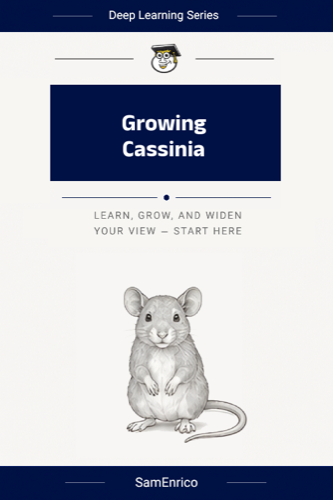
Non-FictionInformativeEducational
Growing Cassinia eBook
This publication, published by SamEnrico, covers G
This publication, published by SamEnrico, covers Growing Cassinia
Formats
Free sample
Chapter 1: The Curry Scent Detective...--–- The first time I watched a seasoned gardener identify a Cassinia shrub from twenty paces, I thought they were performing magic. They didn’t touch the leaves, didn’t crouch down for a closer look, didn’t consult a phone app. They simply walked toward a nondescript green bush growing against a weathered fence, inhaled once, and announced: “Cassinia quinquefaria. Smells like curry, doesn’t it? Fine for screening, but watch the legginess in year three.”That moment changed how I thought about gardening.
It wasn’t about memorizing Latin names or carrying a botanical key everywhere. It was about learning a handful of unbreakable rules—scent, leaf arrangement, flower structure, growth habit—that turn a confusing sea of green into a set of recognizable faces. This chapter will give you those rules. By the time you finish reading, you will be able to walk into any nursery, any botanical garden, or any friend’s overgrown backyard and confidently say: “That’s a Cassinia. And here’s exactly which species it is.”This matters more than you might think.
Misidentification is the single most common reason Cassinia fails in home gardens. I have lost count of how many gardeners have told me, “I grew Cassinia once and it died,” only to discover they had actually planted a look-alike weed with entirely different soil and water needs. Other times, gardeners have unknowingly bought the wrong species—a sprawling groundcover when they needed a tall screen, a frost-tender variety for a climate that freezes hard every winter—and then blamed themselves when the plant struggled.This chapter will prevent that. We will cover three things in precise order. First, you will learn the botanical fingerprint of Cassinia: the leaf shapes, flower clusters, and most importantly, the unmistakable scent that separates this genus from every imposter.
Second, you will meet the three best species for home gardens, each profiled with its height, flower color, bloom time, ideal use, and non-negotiable requirements. Third, you will get a nursery buyer’s guide and a simple botanical key—a series of yes-or-no questions so easy that a beginner can use it with confidence.Let’s begin with the scent. Because once you know what Cassinia smells like, you will never confuse it with anything else again.The Fragrant Fingerprint: Why Scent Is Your First Clue Every plant has a personality, and Cassinia’s is loud. When you brush your hand through its foliage—or simply stand downwind on a warm afternoon—you will notice an immediate, penetrating aroma. The most common description I hear is “curry,” but this is imprecise.
Some species smell more like resin or pine. Others carry a hint of camphor or eucalyptus. A few, when crushed, release something almost medicinal, like sage crossed with thyme.What matters is not the exact comparison but the fact that the smell is always there. Cassinia is one of those rare shrubs that announces itself. The volatile oils responsible for this scent are produced in tiny glandular dots on the leaf surface, visible as small translucent bumps if you hold a leaf up to the light.
These oils serve several purposes in the wild: they deter browsing animals, reduce water loss by creating a micro-layer of humid air around the leaf, and—conveniently for gardeners—act like a botanical nametag.Here is a quick test you can perform right now, even if you are sitting indoors reading this. Imagine you are at a nursery and you see a shrub that you suspect might be Cassinia. Do not pull out your phone. Do not search for a label. Simply pinch one leaf between your thumb and forefinger, roll it gently to crush the surface slightly, and bring it to your nose.
If you smell anything that reminds you of a spice cabinet, a damp forest after rain, or a pine forest on a hot day, you are likely holding a Cassinia. If you smell nothing, or if you smell grass, cucumber, or ordinary “green plant” odor, move on. It is not Cassinia.Of course, scent alone is not enough. A few other shrubs—particularly some Ozothamnus species and certain Helichrysum varieties—produce vaguely similar aromas. That is why we need to combine the smell test with visual clues.Leaf Morphology: Reading the Shape and Arrangement Now we move from smell to sight.
Cassinia leaves follow a consistent pattern that, once learned, becomes instantly recognizable. Most species produce leaves that are small (typically 1 to 4 centimeters long), narrow (often less than 1 centimeter wide), and arranged in one of two ways along the stem: opposite (pairs of leaves emerging from the same point, facing each other like mirrored dancers) or alternate (leaves staggered along the stem, each one slightly higher than the last, like steps on a spiral staircase).The leaf edges are usually rolled under—a botanical feature called revolute margins. This adaptation reduces water loss by minimizing the surface area exposed to sun and wind. If you look at a Cassinia leaf from underneath, you will often see a fuzzy or woolly texture, sometimes white or silver. That fuzz, called tomentum, is another water-saving adaptation.
It traps a thin layer of still air against the leaf surface, slowing evaporation.Let me give you a concrete comparison. Stand a Cassinia shrub next to a common rosemary (Salvia rosmarinus). Both have small, aromatic leaves. Both tolerate drought. But the differences are clear on close inspection.
Rosemary leaves are thicker, more leathery, and have a distinct central vein that is visible from above. Cassinia leaves are thinner, often more flexible, and the veins are less prominent. The fuzz on the underside of a Cassinia leaf is also denser and softer than the sparse hairs on rosemary.If you are trying to distinguish Cassinia from its closest look-alike—the genus Ozothamnus—pay attention to the leaf arrangement and the presence of sticky resin. Ozo thamnus leaves are almost always alternate, and the young stems are often visibly resinous, almost varnished in appearance, with a smell that is more caramel or honey than curry. Cassinia leaves can be opposite or alternate depending on the species, and the resin, when present, is usually less sticky and less shiny.
For the home gardener, the easiest rule of thumb is this: if the plant feels sticky to the touch and smells sweet, it is probably Ozothamnus. If it feels dry and smells like curry or pine, it is probably Cassinia.Flower Structure: The Daisy Connection Cassinia belongs to the Asteraceae family, which means its flowers are not what they appear to be. What looks like a single flower is actually a cluster of dozens or even hundreds of tiny individual flowers, called florets, packed together into a structure that resembles a single bloom. This is the same family that gives us sunflowers, daisies, and dandelions.In Cassinia, the flower clusters are typically small—rarely more than 1 centimeter across—and appear in dense, rounded heads at the tips of branches. The color ranges from white to cream to pale yellow, depending on the species and the light conditions.
Individual florets are tiny tubes, and the overall effect is something like a miniature powder puff.Here is where the identification…
This is the end of the free sample. Get the eBook to keep going. Buy now
About this book
Details
- Author
- Mora Maragaret
- Publisher
- SamEnrico
- Language
- English
- Genre
- Non-Fiction, Informative, Educational
- Released
- 2026-05-09
- Pages (approx.)
- 160
- Available as
- eBook, Audiobook

Read better in the ZLOADR app
Your eBooks on your phone or tablet. Sign in with your SamEnrico account and start reading.
More by Mora Maragaret
 Toastmasters PreparationMora Maragaret$11.99
 Accent And Ambition MemoirMora Maragaret$11.99
 Breast Self ExamMora Maragaret$11.99
 The Fractionation InductionMora Maragaret$11.99
 Fiverr SEO Keyword ResearchMora Maragaret$11.99
 The Rescripting Buddy SystemMora Maragaret$11.99
 Cognitive Flexibility GuideMora Maragaret$11.99
 Unidentified Remains Cold Case GeneticsMora Maragaret$11.99
 The Spice Kings: Portugal’s Golden Trade EmpireMora Maragaret$11.99
 When the Sky Split Open: The Maori Tiki and the Dawn of HumankindMora Maragaret$11.99
 A Collector's Handbook to the Singer TwelveMora Maragaret$11.99
 How to Produce Nut TreesMora Maragaret$11.99
You may also like
 Hong Kong Handover 1997Dunn Johnnie$11.99
 Zumba For Postnatal Recovery CourseNeal Christian$11.99
 Zumba for BeginnersLadner Nikia$11.99
 YouTube Comment Mining GuideHumes Pandora$12.99
 Worry Box MeditationCarlin Rudy$11.99
 Workplace Stress MeditationNguyen Lynn$11.99
 Workplace Stress and Sleep RepairHawley Ivory$11.99
 Workplace Perfectionism CureDelaney Jeffry$11.99
 Workplace Injustice Anger GuideWallen Isabelle$11.99
 Work Addiction and Burnout LinkGreenwood Ester$11.99
 Women in Yoga and WellnessBeattie Galina$11.99
 Women in Stand Up ComedyChun Evangeline$11.99