
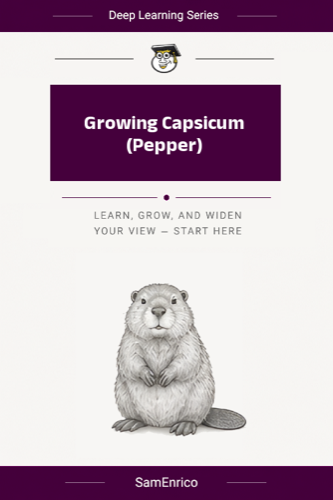
Non-FictionInformativeEducational
Growing Capsicum (Pepper) eBook
This publication, published by SamEnrico, covers G
This publication, published by SamEnrico, covers Growing Capsicum (Pepper)
Formats
Free sample
Chapter 1: Seeds of Obsession...--It begins, as most obsessions do, with a single bite.Not a dramatic bite—no lightning strike, no choir of angels. Just a Tuesday evening in late August, standing over the kitchen sink, juice running down your forearm, eating a pepper you grew yourself for the first time. And in that moment, something shifts. The heat blooms across your tongue not as punishment but as conversation. The sweetness—real sweetness, not the watery echo of grocery store bells—unfolds like a slow secret.
You realize, with the quiet certainty of a convert, that you will never buy a pepper again.This book is for that person. The one standing at the sink. The one who has killed a few plants and is tired of pretending it didn't hurt. The one who suspects that gardening books are written by people who have never actually touched soil. I wrote this book because I was that person, and because the books I found when I started were either too academic to be useful or too simple to be true.Growing capsicum—peppers, in all their glorious, maddening variety—is not difficult.
But it is specific. A tomato will forgive you. A pepper will not. A tomato that gets too much water will taste a little bland but still give you a sandwich. A pepper that gets too much water will drop its flowers, refuse to fruit, and then rot at the stem while looking you dead in the eye.
Peppers demand respect, not worship. They require precision, not perfection. And once you understand the logic that governs them—the handful of non-negotiable rules that separate a fifty-pepper plant from a five-pepper plant—you will wonder why you ever struggled.This chapter is not about soil p H or seed-starting schedules. Those come later. This chapter is about why peppers matter, why they are different from every other plant in your garden, and why the journey you are about to take will change not just your cooking but your relationship with growing food entirely.The Great Misunderstanding Let me clear something up immediately, because every new grower gets this wrong and every gardening book lets them down.Peppers are not tomatoes.
This seems obvious, and yet almost every beginner treats them identically. They use the same soil, the same watering schedule, the same fertilizer, the same planting depth. Then they spend three months wondering why their pepper plants are small, sad, and stingy with fruit while their tomatoes are going berserk.Here is the truth: tomatoes are tropical perennials that have been bred to act like annuals in temperate climates. They are aggressive, thirsty, and hungry. Peppers are also tropical perennials—but they have not been bred to forget it.
A pepper plant remembers. It remembers that it evolved in the highlands of Bolivia, where nights were cool, mornings were dry, and water came in short, intense bursts followed by weeks of drought. It remembers that its ancestors grew slowly, built deep roots, and saved their energy for the right moment.When you treat a pepper like a tomato—consistent moisture, rich soil, frequent feeding—you are not helping it. You are confusing it. The plant thinks, "Something is wrong.
The environment is too perfect. I must be about to die. I will drop my flowers and focus on survival." And it does. Every time.The single biggest mistake new pepper growers make is kindness. Too much water.
Too much nitrogen. Too much shade. Too much protection. Peppers need to struggle a little. They need to feel the sun bake the soil between waterings.
They need to reach for nutrients. They need to believe that if they do not set fruit now, they may never get another chance.This is not cruelty. This is horticulture.Why Peppers? A Brief Confession of Obsession I grew my first pepper plant in a plastic bucket on a fire escape in Philadelphia. It was a jalapeño, because that is what you grow when you do not know what you are doing.
I watered it every day because the internet said to. I fed it every two weeks because the bottle said to. I talked to it because I was lonely and the plant was there.It produced exactly three peppers. One was eaten by a squirrel. One rotted on the plant.
One made it to my kitchen, where I sliced it open to find that it had no heat whatsoever. A jalapeño without heat is not a jalapeño. It is a green lie.I was not discouraged. I was insulted. I am, by nature, a person who takes failure personally.
So I read everything. I bought books that cost more than my weekly grocery budget. I joined forums where people argued about the correct temperature for germinating C. chinense with the fervor of theologians debating the nature of the Trinity. I learned that the squirrel had done me a favor by taking the worst pepper.What I discovered, hidden beneath the academic jargon and the forum flame wars, was a plant unlike any other.
A plant that changes its flavor based on how you treat it. A plant that communicates its needs through the color of its leaves, the angle of its stems, the texture of its fruit. A plant that rewards attention but punishes hovering.Peppers, I realized, are the perfect plant for obsessive people. They require precision without pedantry. They offer immediate feedback.
They forgive mistakes but do not forget them. And when you finally get it right—when you pull a ripe habanero off a plant you started from seed in February and the heat hits exactly as you planned—you feel like a sorcerer.The Five Personalities: Understanding What You Are Growing Before you can grow a pepper well, you need to know which pepper you are growing. This sounds obvious, but most beginners treat all peppers as interchangeable. They are not. The five domesticated species of capsicum have different origins, different preferences, and different temperaments.
Ignoring this is like trying to train a wolf and a Chihuahua the same way. Both are canids. Both will bite you if provoked. But one requires very different handling.Capsicum annuum is the reliable friend. This species includes bell peppers, jalapeños, cayenne, serranos, and most of what you find in a grocery store.
It is the most widely cultivated species for a reason: it is adaptable, predictable, and relatively forgiving. Annuum plants tend to be bushy, produce fruit in 70 to 90 days, and handle moderate stress without collapsing. If you are a beginner, start here. Bell peppers are actually more difficult than hot peppers within this species—they require more consistent conditions to avoid bitterness—but a jalapeño or a cayenne will grow almost anywhere.Capsicum chinense is the dramatic diva. This species includes habaneros, ghost peppers, Scotch bonnets, and the Carolina Reaper.
Despite the name, chinense originated in the Amazon basin and was carried to the Caribbean, where it evolved into the most pungent peppers on earth. These plants are slow—often taking 120 days or more from transplant to ripe fruit—and they demand heat. Not just warmth. Heat.…
This is the end of the free sample. Get the eBook to keep going. Buy now
About this book
Details
- Author
- Starling Elina
- Publisher
- SamEnrico
- Language
- English
- Genre
- Non-Fiction, Informative, Educational
- Released
- 2026-05-18
- Pages (approx.)
- 147
- Available as
- eBook, Audiobook

Read better in the ZLOADR app
Your eBooks on your phone or tablet. Sign in with your SamEnrico account and start reading.
More by Starling Elina
 The Progressive Relaxation MethodStarling Elina$11.99
 Processing Sleep ParalysisStarling Elina$11.99
 Alcohol Fueled Anger ThoughtsStarling Elina$11.99
 Upwork Skill Certification PathStarling Elina$11.99
 Bulgarian Software Engineer RemoteStarling Elina$11.99
 Peg System For AppointmentsStarling Elina$11.99
 Panel Discussion SkillsStarling Elina$11.99
 Period Pain ReliefStarling Elina$11.99
 The Star Maps of the Dogon: Astronomy's Forgotten GeniusesStarling Elina$11.99
 A Collector's Handbook to the Singer IiiStarling Elina$11.99
 How to Produce a Noise DampenerStarling Elina$11.99
 Franchise Territory Mapping GuideStarling Elina$12.99
You may also like
 Hong Kong Handover 1997Dunn Johnnie$11.99
 Zumba For Postnatal Recovery CourseNeal Christian$11.99
 Zumba for BeginnersLadner Nikia$11.99
 YouTube Comment Mining GuideHumes Pandora$12.99
 Worry Box MeditationCarlin Rudy$11.99
 Workplace Stress MeditationNguyen Lynn$11.99
 Workplace Stress and Sleep RepairHawley Ivory$11.99
 Workplace Perfectionism CureDelaney Jeffry$11.99
 Workplace Injustice Anger GuideWallen Isabelle$11.99
 Work Addiction and Burnout LinkGreenwood Ester$11.99
 Women in Yoga and WellnessBeattie Galina$11.99
 Women in Stand Up ComedyChun Evangeline$11.99