
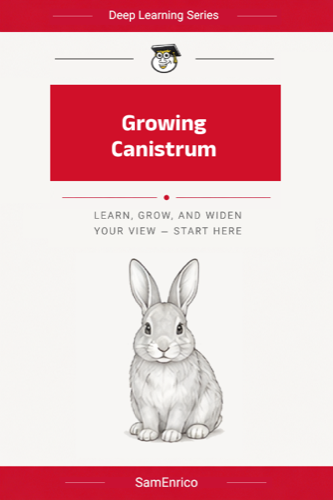
Non-FictionInformativeEducational
Growing Canistrum eBook
This publication, published by SamEnrico, covers G
This publication, published by SamEnrico, covers Growing Canistrum
Formats
Free sample
Chapter 1: The Bronze Starburst--Every great journey into a new genus begins with a single question: what makes this plant worth my time, my space, and my care? For those who have wandered through botanical gardens or scrolled past endless photographs of aroids and orchids, the bromeliad family often appears as a footnote—beautiful but somehow secondary. Yet within that family lies a genus so refined, so architecturally perfect, and so forgiving that it deserves to step out of the shadow of its more famous cousins. That genus is Canistrum, and this chapter exists for one reason: to convince you that your collection is incomplete without it.The name itself carries a quiet elegance. Canistrum derives from the Latin canistrum, meaning wicker basket—a reference to the way the leaves cradle the central urn much like woven reeds form a container.
Unlike the spiny, aggressive margins of many bromeliads (looking at you, Aechmea), Canistrum leaves are smooth, spineless, and often polished to a glossy sheen that catches light like wet glass. When the plant matures, it forms a perfect radial symmetry—a starburst of green, bronze, or red-blushed foliage that demands to be viewed from above. This is a plant designed by evolution to be looked down upon, which makes it the ideal candidate for tabletop displays, low pedestals, or the foreground of a shaded garden bed.But aesthetics alone do not justify an entire book. What elevates Canistrum from pretty to indispensable is its adaptability. In an era where indoor gardeners struggle with finicky calatheas and light-hungry succulents, Canistrum offers something rare: resilience without boredom.
It tolerates lower light than most flowering houseplants. It forgives missed waterings better than ferns. It rarely attracts pests when given basic care. And yet, when you dial in its environment correctly, it rewards you with a bloom that transforms the entire rosette into a torch of orange, red, or yellow bracts—a finale so dramatic that the plant's subsequent death (more on that later) feels less like loss and more like a completed masterpiece.The journey of this book is not merely to teach you how to keep Canistrum alive. Any two-page internet article can do that.
The purpose here is to help you thrive with it, to understand why a plant that evolved in the dappled gloom of Brazil's Atlantic Forest behaves the way it does, and to anticipate its needs before it broadcasts distress signals through yellowing leaves or stalled growth. By the time you finish this chapter, you will not only recognize a Canistrum when you see one—you will understand why generations of bromeliad collectors have guarded their specimens like state secrets.What Makes Canistrum Unique Among Bromeliads To appreciate Canistrum, one must first understand the broader bromeliad family. Bromeliaceae contains roughly 3,500 species spread across 75 genera, ranging from the terrestrial pineapple (Ananas comosus) to the air plants of Tillandsia that need no soil at all. Within this vast family, bromeliads have evolved two primary growth forms: tank-forming and atmospheric. Tank-forming bromeliads—the group that includes Canistrum, Neoregelia, Aechmea, and Nidularium—create a central reservoir by overlapping their leaf bases tightly.
Water and organic debris collect in this tank, providing both hydration and nutrition to the plant through specialized absorbing scales called trichomes.Here is where Canistrum distinguishes itself. Most tank bromeliads possess marginal spines—small teeth along leaf edges that evolved to deter herbivores. Aechmea can draw blood if brushed carelessly. Neoregelia leaves often feel like fine sandpaper. But Canistrum is spineless.
Run your finger along the edge of a healthy leaf, and you will feel nothing but smooth, cool tissue. This single characteristic has profound implications for cultivation. It means Canistrum can be placed in high-traffic areas, handled during repotting without gloves, and integrated into living spaces where children or pets might brush against it. It also suggests a different evolutionary strategy: rather than defending itself with physical armor, Canistrum likely relies on camouflage and its relatively inaccessible tank environment to avoid predators.The tank itself is another point of distinction. Canistrum's urn is shallower and wider than that of Aechmea or Billbergia, more like a cereal bowl than a vase.
This geometry affects how water evaporates, how debris accumulates, and how light penetrates the center of the rosette. A shallow tank dries more quickly, which reduces the risk of fungal rot but requires more attentive watering in arid climates. The wide opening also makes Canistrum remarkably easy to clean, flush, and inspect for pests—a maintenance advantage that becomes increasingly valuable as your collection grows.Leaf texture sets Canistrum apart from its closest relative, Nidularium. While both genera share a similar rosette form, Nidularium leaves tend to be leathery and dull, often with a purplish underside. Canistrum leaves are thinner, glossier, and frequently exhibit a metallic sheen that breeders have amplified in modern hybrids.
Some species, such as Canistrum giganteum, produce leaves that shimmer with an almost olive-bronze iridescence—a trait that plant hunters describe as "burnished copper under a forest canopy."Native Habitat: The Atlantic Forest and Restinga Understanding where a plant comes from is not merely botanical trivia. The conditions of its native habitat are a cheat sheet for its care requirements. Canistrum is endemic to Brazil, with its distribution centered on the Atlantic Forest (Mata Atlântica), one of the most biodiverse and endangered ecosystems on Earth. This is not the Amazon. The Atlantic Forest is a coastal tropical and subtropical moist forest that stretches along Brazil's eastern seaboard, from Rio Grande do Norte down to Rio Grande do Sul.
It experiences high rainfall (1,200 to 2,000 millimeters annually), stable temperatures, and—crucially—a dense canopy that filters sunlight into a shifting mosaic of light and shadow.Within this forest, Canistrum occupies two specific niches. The first is the restinga, a coastal sandy plain ecosystem characterized by nutrient-poor, well-draining soils and scrubby vegetation. Here, Canistrum grows terrestrially or lithophytically (on rocks), exposed to more light but also more wind and salt spray. The second niche is the dense shaded understory of the interior forest, where Canistrum grows epiphytically on tree trunks and branches, receiving highly filtered light and consistent humidity.This dual habitat preference explains something that confuses many new growers: Canistrum can adapt to both potting mix and mounting, as long as the medium provides exceptional drainage and aeration. In the restinga, the plant evolved to handle sandy soils that never stay wet.
In the forest understory, it evolved to have roots that function primarily as anchors rather than absorbers. The common thread is oxygen at the root zone. Soggy, compacted soil is death. Epiphytic, airy mixes are life.Temperature in the Atlantic Forest is remarkably stable, with average annual temperatures ranging from 18°C to 28°C (64°F to 82°F). Frost is nonexistent.
This means Canistrum has no genetic tolerance for cold. Exposure to temperatures below 10°C (50°F) causes cellular damage that may not appear for weeks, manifesting as blackened leaf bases and eventual collapse. If you live in a climate where winter temperatures drop below this threshold, Canistrum must be grown in containers and moved indoors seasonally—a non-negotiable requirement that Chapter 3 will explore in depth.Humidity in the Atlantic Forest typically ranges from 70% to 90%…
This is the end of the free sample. Get the eBook to keep going. Buy now
About this book
Details
- Author
- Davidson Fred
- Publisher
- SamEnrico
- Language
- English
- Genre
- Non-Fiction, Informative, Educational
- Released
- 2026-05-06
- Pages (approx.)
- 158
- Available as
- eBook, Audiobook

Read better in the ZLOADR app
Your eBooks on your phone or tablet. Sign in with your SamEnrico account and start reading.
More by Davidson Fred
 The Morning After ProtocolDavidson Fred$11.99
 Infertility Anger RestructuringDavidson Fred$11.99
 Fiverr Package Pricing StrategyDavidson Fred$11.99
 HAES Master GuideDavidson Fred$11.99
 Elevator Pitch PerfectionDavidson Fred$11.99
 Nepalese Hotel Worker To ManagerDavidson Fred$11.99
 Kamchatka Volcano ExpeditionDavidson Fred$11.99
 Loci Method For Foreign WordsDavidson Fred$11.99
 Midnight Reset: The Last Broadcast of 1999Davidson Fred$11.99
 The Frozen Rebellion: How a Bolivian Ski Pioneer Defied the AndesDavidson Fred$11.99
 How to Produce Aluminum Wire MeshDavidson Fred$11.99
 A Collector's Handbook to the Singer Gazelle VDavidson Fred$11.99
You may also like
 Hong Kong Handover 1997Dunn Johnnie$11.99
 Zumba For Postnatal Recovery CourseNeal Christian$11.99
 Zumba for BeginnersLadner Nikia$11.99
 YouTube Comment Mining GuideHumes Pandora$12.99
 Worry Box MeditationCarlin Rudy$11.99
 Workplace Stress MeditationNguyen Lynn$11.99
 Workplace Stress and Sleep RepairHawley Ivory$11.99
 Workplace Perfectionism CureDelaney Jeffry$11.99
 Workplace Injustice Anger GuideWallen Isabelle$11.99
 Work Addiction and Burnout LinkGreenwood Ester$11.99
 Women in Yoga and WellnessBeattie Galina$11.99
 Women in Stand Up ComedyChun Evangeline$11.99