
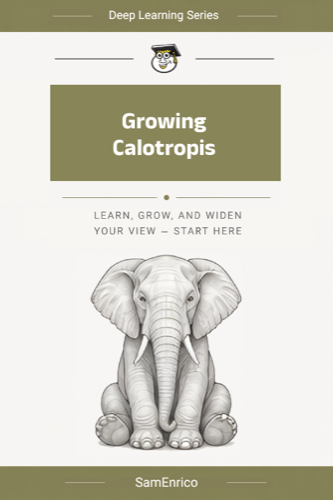
Non-FictionInformativeEducational
Growing Calotropis eBook
This publication, published by SamEnrico, covers G
This publication, published by SamEnrico, covers Growing Calotropis
Formats
Free sample
Chapter 1: The Sacred Scourge...--–- On a sun-baked hillside in southern India, a woman places a garland of crown flowers at the feet of a stone Shiva lingam. Three thousand miles away, a rancher in Texas loads a sprayer with herbicide to kill the same plant choking his pasture. And in a suburban backyard in Florida, a grandmother watches in wonder as a Monarch caterpillar strips leaves from a stem she grew from a cutting she bought online. No other plant inspires such reverence, rage, and hope. This is the paradox of Calotropis.
It is a botanical outlaw and an ecological savior. It is a poison that heals. It is a weed that could save the world.The first time most people encounter Calotropis, they do not know what they are looking at. The plant presents itself with deceptive simplicity—a cluster of thick, silvery-green leaves emerging from a stout stem, perhaps three feet tall in its first year, reaching twelve or fifteen feet if left unbothered in warm ground for a decade. The leaves are fleshy, almost succulent, coated with a waxy bloom that makes them feel like chamois leather.
When you brush against them, nothing seems extraordinary. But break a leaf, and the plant reveals its secret weapon: a thick, milky latex that oozes from the wound like white blood. Touch that sap to your lips, and you will taste bitterness so profound it triggers an instinctual gag reflex. Get it in your eyes, and you will understand the meaning of chemical warfare. And yet, that same toxic milk is the reason Monarch butterflies exist, the reason desert nomads have treated snakebites for centuries, and the reason textile artists are now paying sixty dollars a pound for spun fiber.Before you plant a single seed, before you dig a hole or fill a pot, you must understand what you are inviting into your life.
Calotropis is not a petunia. It will not thank you for compost tea. It will not die quietly if you neglect it. And it will absolutely escape your yard if you let it. This chapter is not about technique.
It is about truth. Who is this plant? Where did it come from? Why does it have two faces—one beneficent, one belligerent? And most importantly, what kind of grower do you need to become to handle it responsibly?The Two Faces: Introducing C.
procera and C. gigantea The genus Calotropis contains only three species, but only two matter to gardeners. The first is Calotropis procera, known colloquially as the Apple of Sodom, rooster tree, or simply the small crown flower. Its name gives away its character: procera means tall in Latin, but this is the shorter of the two, typically reaching four to eight feet in Mediterranean climates. Its leaves are narrow, lance-shaped, and grey-green, with a subtle purple tinge along the veins when young.
Its flowers are smaller than its cousin's, about three-quarters of an inch across, white with dramatic purple tips that make each bloom look like a tiny star exploding. The seed pods are plump, inflated, and spherical, resembling small apples—hence the biblical nickname. This is the species that has naturalized most aggressively around the world. If you see Calotropis growing wild in Hawaii, the Caribbean, or northern Australia, you are almost certainly looking at procera.The second species is Calotropis gigantea, the giant crown flower. Gigantea does exactly what it says on the tin.
It grows taller, reaching eight to fifteen feet in good conditions, with some specimens in its native Southeast Asia pushing twenty feet. Its leaves are broad, oval, and dramatically thick—sometimes as wide as a dinner plate. The flowers are larger as well, one to one and a half inches across, and typically pure white or soft lavender without the purple tips of procera. The overall impression is of a more generous, more ornamental plant. The seed pods are also larger, shaped like teardrops rather than apples, and produce more floss per pod.
If you see Calotropis planted deliberately in a garden, especially one designed for butterflies, it is likely gigantea.The differences matter because they predict different behaviors. Procera is the escape artist. It produces more seeds per plant, grows faster from seed, and tolerates a wider range of soil conditions. If you live in a dry, Mediterranean climate—coastal California, inland Australia, the Mediterranean basin itself—procera will try to conquer your neighborhood. Gigantea is slightly more restrained.
It prefers more consistent moisture and warmer winters, and its larger seeds are less likely to blow vast distances. But make no mistake: both species are invasive outside their native ranges. The distinction is between a Category 5 hurricane and a Category 4. Both will flood your basement.The native range of Calotropis stretches from tropical Africa across the Arabian Peninsula through India and into Southeast Asia. Within this vast territory, the plant plays multiple roles.
In the scorched lowlands of Ethiopia, it is one of the few perennials that survives the six-month dry season, its deep roots tapping water that other plants cannot reach. In the Thar Desert of India, it grows alongside acacia and cactus, providing the only green forage for goats during droughts (the animals have learned to eat around the toxic latex). In the rice paddies of Thailand, it is a weed that farmers yank out by hand, cursing the sap that blisters their forearms. The plant does not recognize these human categories. It simply grows wherever the temperature stays above freezing and the soil drains.The Sacred History: From Shiva’s Garlands to Ayurvedic Medicine Human beings have a long history of fearing what they cannot control and worshipping what they cannot kill.
Calotropis is both.The earliest written records of Calotropis appear in the Sanskrit texts of ancient India, where the plant is called arka. The Atharvaveda, a sacred text dating to approximately 1000 BCE, lists arka among the most powerful medicinal plants, prescribing its latex for skin diseases, its root bark for digestive complaints, and its flowers for mental clarity. The plant is associated with Surya, the sun god, because its flowers open fully only in direct sunlight and close at dusk. But the most enduring religious connection is to Shiva, the destroyer and transformer. Crown flower garlands are among the most sacred offerings in Shiva temples across South India.
The flowers do not wilt for days, even without water, and their five-petaled structure is said to represent the panchakshara—the five syllables of Shiva's mantra: Na Ma Shi Va Ya.In Ayurvedic medicine, every part of the Calotropis plant has a use. The latex is collected drop by drop and heated to reduce its toxicity before being applied to warts, corns, and fungal infections. The leaves are warmed over a flame and applied as poultices to reduce joint inflammation. The root bark is powdered and administered in tiny doses for asthma and bronchitis. The flowers are infused in oil to create a calming massage blend.
Modern pharmacology has validated some of these uses. Calotropin, the primary cardenolide in the latex, has demonstrated anti-inflammatory effects comparable to diclofenac in animal studies. The proteolytic enzymes in the latex dissolve necrotic tissue…
This is the end of the free sample. Get the eBook to keep going. Buy now
About this book
Details
- Author
- Taggart Carmon
- Publisher
- SamEnrico
- Language
- English
- Genre
- Non-Fiction, Informative, Educational
- Released
- 2026-05-11
- Pages (approx.)
- 144
- Available as
- eBook, Audiobook

Read better in the ZLOADR app
Your eBooks on your phone or tablet. Sign in with your SamEnrico account and start reading.
More by Taggart Carmon
 South African IT Consultant In UKTaggart Carmon$11.99
 Time Blocking for TickTick UsersTaggart Carmon$11.99
 Siberian Winter Survival TripTaggart Carmon$11.99
 Online Anger Thought RecordsTaggart Carmon$11.99
 Body Scan for Better BreathingTaggart Carmon$11.99
 Atomic Habits For Habit AuditTaggart Carmon$11.99
 Lifestyle Over DietTaggart Carmon$11.99
 Doe Network Amnesia CasesTaggart Carmon$11.99
 Cú Chulainn’s Forgotten Oath: The Blood-Sworn Warrior of UlsterTaggart Carmon$11.99
 Shadows Over Peking: The Boxer Uprising and the Birth of Modern EspionageTaggart Carmon$11.99
 How to Produce Network CabinetsTaggart Carmon$11.99
 A Collector's Handbook to the Singer 2-litreTaggart Carmon$11.99
You may also like
 Hong Kong Handover 1997Dunn Johnnie$11.99
 Zumba For Postnatal Recovery CourseNeal Christian$11.99
 Zumba for BeginnersLadner Nikia$11.99
 YouTube Comment Mining GuideHumes Pandora$12.99
 Worry Box MeditationCarlin Rudy$11.99
 Workplace Stress MeditationNguyen Lynn$11.99
 Workplace Stress and Sleep RepairHawley Ivory$11.99
 Workplace Perfectionism CureDelaney Jeffry$11.99
 Workplace Injustice Anger GuideWallen Isabelle$11.99
 Work Addiction and Burnout LinkGreenwood Ester$11.99
 Women in Yoga and WellnessBeattie Galina$11.99
 Women in Stand Up ComedyChun Evangeline$11.99