
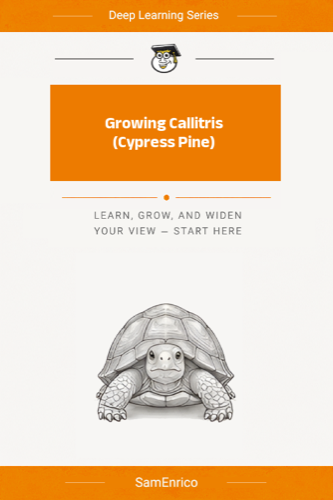
Non-FictionInformativeEducational
Growing Callitris (Cypress Pine)
This publication, published by SamEnrico, covers G
by Soares Raisa
This publication, published by SamEnrico, covers Growing Callitris (Cypress Pine)
Formats
About this book
Free sample
Chapter 1: The Living Fossil...--–- On a scorched ridge in western New South Wales, where summer temperatures regularly exceed 40 degrees Celsius and rain falls only in fits of desperation, a tree stands alone. Its foliage is a muted grey-green, its bark is furrowed like weathered leather, and its cones – small, woody, and stubbornly sealed – have clung to its branches for years, waiting for a fire that may never come. This is Callitris glaucophylla, the White Cypress Pine. To the casual observer, it looks like nothing more than a hardy, unremarkable conifer. But to those who understand its story, this tree is a living fossil, a botanical survivor that has witnessed the drying of a continent, the rise and fall of ancient megafauna, and the adaptation of Australia’s First Peoples.
It is not a true pine, despite its common name. It is something far more interesting: a unique Australian genus that has mastered the art of thriving where other trees simply perish. This book is about that mastery. It is about understanding, cultivating, and ultimately benefiting from one of the most resilient, useful, and underappreciated trees on Earth.The Misunderstood Conifer Before any grower places a seed in the ground or selects a planting site, they must first unlearn a fundamental assumption. Despite being called "Cypress Pine" in common parlance, Callitris is neither a true pine (Pinus) nor a true cypress (Cupressus), though it shares the Cupressaceae family with the latter.
This distinction is not merely botanical pedantry. It matters because the ecological strategies, growth habits, and cultivation requirements of Callitris differ significantly from those of the northern hemisphere conifers that dominate commercial forestry textbooks.True pines (genus Pinus) evolved in the northern hemisphere, spread widely across cold and temperate zones, and typically produce long needles in bundles of two to five. They are adapted to seasonal cold, heavy snow loads, and acidic forest soils. True cypresses (genus Cupressus), also northern hemisphere natives, produce scale-like foliage similar to Callitris but generally require more consistent moisture and are highly susceptible to canker diseases when planted outside their narrow native ranges. Callitris…
This is the end of the free sample. Get the eBook to keep going. Buy now
Contents
- Chapter 1
- Chapter 2
- Chapter 3
- Chapter 4
- Chapter 5
- Chapter 6
- Chapter 7
- Chapter 8
- Chapter 9
- Chapter 10
- Chapter 11
- Chapter 12
Details
- Author
- Soares Raisa
- Publisher
- SamEnrico
- Language
- English
- Genre
- Non-Fiction, Informative, Educational
- Released
- 2026-05-07
- Pages (approx.)
- 151
- Available as
- eBook, Audiobook

Read better in the ZLOADR app
Your eBooks on your phone or tablet. Sign in with your SamEnrico account and start reading.
More by Soares Raisa
 Deep Work Scheduling StrategiesSoares Raisa$11.99
 Reframing Injustice BeliefsSoares Raisa$11.99
 Body Scan Meditation CardsSoares Raisa$11.99
 Video Surveillance FailSoares Raisa$11.99
 Stress Eating CopingSoares Raisa$11.99
 Stage Presence HandbookSoares Raisa$11.99
 Doe Network Interstate CompactsSoares Raisa$11.99
 Brazilian Entrepreneur In MiamiSoares Raisa$11.99
 The Aztec Wheelmen: How Ancient Inventors Defied Empires with the First BMX-Like SportSoares Raisa$11.99
 The Maestro's Code: How Hans Zimmer and John Powell Revolutionized Film ScoringSoares Raisa$11.99
 How to Produce Agrochemicals and PesticidesSoares Raisa$11.99
 How to Start a Hobby in Role-playing gamesSoares Raisa$11.99
You may also like
 Hong Kong Handover 1997Dunn Johnnie$11.99
 Zumba For Postnatal Recovery CourseNeal Christian$11.99
 Zumba for BeginnersLadner Nikia$11.99
 YouTube Comment Mining GuideHumes Pandora$12.99
 Worry Box MeditationCarlin Rudy$11.99
 Workplace Stress MeditationNguyen Lynn$11.99
 Workplace Stress and Sleep RepairHawley Ivory$11.99
 Workplace Perfectionism CureDelaney Jeffry$11.99
 Workplace Injustice Anger GuideWallen Isabelle$11.99
 Work Addiction and Burnout LinkGreenwood Ester$11.99
 Women in Yoga and WellnessBeattie Galina$11.99
 Women in Stand Up ComedyChun Evangeline$11.99