
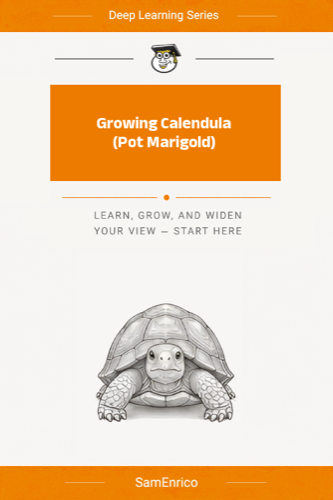
Non-FictionInformativeEducational
Growing Calendula (Pot Marigold)
This publication, published by SamEnrico, covers G
by Silva Kari
This publication, published by SamEnrico, covers Growing Calendula (Pot Marigold)
Formats
About this book
Free sample
Chapter 1: Mary’s Gold...--–- Every great garden begins with a single seed, but every great gardener begins with a story. This one starts not in a nursery or a greenhouse, but in a medieval monastery garden, where a nameless monk bent over a bed of orange flowers, watching them close their petals as the sun set and open them again at dawn. He called them solsequium—the sun-follower—and he believed they held the power to ward off plague, purify the air, and protect the soul from evil spirits. He was wrong about the plague, mostly right about the purification, and entirely correct about the protection, though not in any way he could have imagined. The flower that monk tended was Calendula officinalis, known to his contemporaries as Mary's Gold, and to us today as Pot Marigold.
It is not a marigold at all, at least not the kind you buy in six-packs at the garden center every spring. It is something older, stranger, and far more useful.The first thing you need to know—the thing that separates successful Calendula growers from those who give up in frustration—is that Calendula officinalis has almost nothing in common with the French and African marigolds (Tagetes) that dominate nursery shelves. This is not a minor botanical quibble. It is the difference between growing a medicinal, culinary, skin-healing powerhouse and growing a pretty but largely ornamental flower that repels mosquitoes. The confusion is understandable.
Both are called marigolds. Both are orange and yellow. Both bloom their heads off all summer. But Tagetes are New World plants, native to the Americas, with a pungent smell that deters pests and a chemical profile that makes them mildly toxic if consumed in large quantities. Calendula is an Old World herb, native to the Mediterranean, with no significant pest-repelling properties, a mild pleasant taste, and a remarkable safety profile that has made it a staple of herbal medicine for two thousand years.
You can eat Calendula petals by the handful. You should not eat Tagetes. That distinction alone justifies the confusion, and it justifies…
This is the end of the free sample. Get the eBook to keep going. Buy now
Contents
- Chapter 1
- Chapter 2
- Chapter 3
- Chapter 4
- Chapter 5
- Chapter 6
- Chapter 7
- Chapter 8
- Chapter 9
- Chapter 10
- Chapter 11
- Chapter 12
Details
- Author
- Silva Kari
- Publisher
- SamEnrico
- Language
- English
- Genre
- Non-Fiction, Informative, Educational
- Released
- 2026-05-18
- Pages (approx.)
- 150
- Available as
- eBook, Audiobook

Read better in the ZLOADR app
Your eBooks on your phone or tablet. Sign in with your SamEnrico account and start reading.
More by Silva Kari
 Diamond Cutting SecretsSilva Kari$11.99
 Sports Coach Nonverbal SidelinesSilva Kari$11.99
 Shein Fast Fashion CompulsionSilva Kari$11.99
 Homicide and Social MediaSilva Kari$11.99
 Healing Body Scan VisualisationSilva Kari$11.99
 Public Speaking Confidence GuideSilva Kari$11.99
 Memory Palace For History DatesSilva Kari$11.99
 Sleep Cycle App GuideSilva Kari$11.99
 The Leviathan's Spine: A Maori Deep-Sea LegendSilva Kari$11.99
 The Silk & Silver Curse: Mexico's Forgotten Fashion RevolutionSilva Kari$11.99
 How to Produce Napkin RingsSilva Kari$11.99
 How to Start a Hobby in Collecting Comic booksSilva Kari$11.99
You may also like
 Hong Kong Handover 1997Dunn Johnnie$11.99
 Zumba For Postnatal Recovery CourseNeal Christian$11.99
 Zumba for BeginnersLadner Nikia$11.99
 YouTube Comment Mining GuideHumes Pandora$12.99
 Worry Box MeditationCarlin Rudy$11.99
 Workplace Stress MeditationNguyen Lynn$11.99
 Workplace Stress and Sleep RepairHawley Ivory$11.99
 Workplace Perfectionism CureDelaney Jeffry$11.99
 Workplace Injustice Anger GuideWallen Isabelle$11.99
 Work Addiction and Burnout LinkGreenwood Ester$11.99
 Women in Yoga and WellnessBeattie Galina$11.99
 Women in Stand Up ComedyChun Evangeline$11.99