
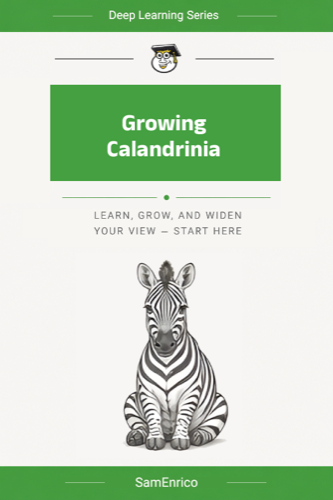
Non-FictionInformativeEducational
Growing Calandrinia
This publication, published by SamEnrico, covers G
by Erinn Palma
This publication, published by SamEnrico, covers Growing Calandrinia
Formats
About this book
Free sample
Chapter 1: The Forgotten Survivor...–- Every garden has its divas—the orchids that demand humidity tents, the roses that require precise pruning schedules, the fiddle-leaf figs that drop leaves if you look at them wrong. This book is not about those plants. This book is about the opposite: a plant so resilient, so adapted to hardship, that it has spent most of its horticultural career being completely ignored. Welcome to Calandrinia, the genus of flowering succulents that thrives on the very neglect that kills everything else.If you have ever killed a succulent by overwatering—and according to a 2022 survey by the National Gardening Association, approximately 67% of new succulent owners have—then you are exactly the right audience for this chapter. The problem is rarely that you lack a "green thumb." The problem is that you have been applying the rules of conventional gardening to plants that evolved under radically different conditions.
Calandrinia did not evolve in your climate-controlled living room or your lovingly amended garden bed. It evolved in the rocky outcrops of the Andes, the sun-baked plains of Western Australia, and the fire-scarred hillsides of California's chaparral. Understanding where this plant came from is not merely botanical trivia; it is the key to unlocking its care.The Family Portrait: Portulacaceae and Its Famous Relatives To understand Calandrinia, you must first understand its family. The Portulacaceae family, commonly known as the purslane family, is a group of approximately 500 species spread across 20 genera. Its most famous members include Portulaca oleracea (common purslane), which most gardeners know as a nutritious weed that can survive being run over by a lawnmower, and Lewisia, a beloved rock garden plant named after explorer Meriwether Lewis.What unites this family is a set of survival adaptations so elegant that plant physiologists still study them with admiration.
All Portulacaceae species possess a specialized form of photosynthesis called Crassulacean Acid Metabolism, or CAM photosynthesis. Unlike most plants, which open their stomata (the tiny pores on leaves) during the heat of the day to take in carbon dioxide, CAM plants open their stomata at night. This seemingly backward…
This is the end of the free sample. Get the eBook to keep going. Buy now
Contents
- Chapter 1
- Chapter 2
- Chapter 3
- Chapter 4
- Chapter 5
- Chapter 6
- Chapter 7
- Chapter 8
- Chapter 9
- Chapter 10
- Chapter 11
- Chapter 12
Details
- Author
- Erinn Palma
- Publisher
- SamEnrico
- Language
- English
- Genre
- Non-Fiction, Informative, Educational
- Released
- 2026-06-02
- Pages (approx.)
- 130
- Available as
- eBook, Audiobook

Read better in the ZLOADR app
Your eBooks on your phone or tablet. Sign in with your SamEnrico account and start reading.
More by Erinn Palma
 Atomic Habits For PlanningErinn Palma$11.99
 Hulu Commercial Break ControlErinn Palma$11.99
 Progressive Body Relaxation GuideErinn Palma$11.99
 Cat Nonverbal Feline CuesErinn Palma$11.99
 Notarbartolo Prison InterviewsErinn Palma$11.99
 Apple Watch SleepErinn Palma$11.99
 Homicide Squad LeadershipErinn Palma$11.99
 Mnemonic Shape SystemErinn Palma$11.99
 The Trial of the Maori War Chants: A Legal Battle for Cultural HeritageErinn Palma$11.99
 The Ship of Healing: John Snow and the Birth of EpidemiologyErinn Palma$11.99
 A Collector's Handbook to the Salmson S4eErinn Palma$11.99
 LLC vs C Corp for Non ResidentsErinn Palma$12.99
You may also like
 Hong Kong Handover 1997Dunn Johnnie$11.99
 Zumba For Postnatal Recovery CourseNeal Christian$11.99
 Zumba for BeginnersLadner Nikia$11.99
 YouTube Comment Mining GuideHumes Pandora$12.99
 Worry Box MeditationCarlin Rudy$11.99
 Workplace Stress MeditationNguyen Lynn$11.99
 Workplace Stress and Sleep RepairHawley Ivory$11.99
 Workplace Perfectionism CureDelaney Jeffry$11.99
 Workplace Injustice Anger GuideWallen Isabelle$11.99
 Work Addiction and Burnout LinkGreenwood Ester$11.99
 Women in Yoga and WellnessBeattie Galina$11.99
 Women in Stand Up ComedyChun Evangeline$11.99