
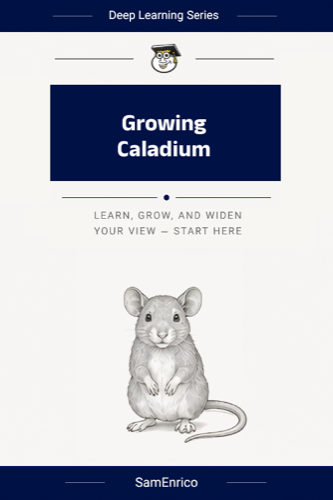
Non-FictionInformativeEducational
Growing Caladium eBook
This publication, published by SamEnrico, covers G
This publication, published by SamEnrico, covers Growing Caladium
Formats
Free sample
Chapter 1: The Living Canvas...–- In the humid, dappled twilight of the Amazon Basin, where the canopy filters sunlight into shifting mosaics of gold and green, a quiet evolutionary masterpiece unfolded over millennia. Hidden among the leaf litter of the forest floor, a genus of plants developed a secret language not of flowers or fragrance, but of color. These were the original caladiums—unassuming, shade-dwelling perennials whose leaves bore patterns so intricate, so vividly contrasted, that they resembled abstract paintings more than living tissue. For centuries, they remained unknown to the outside world, painted in nature's palette of soft greens, muted whites, and occasional blushes of pink, waiting for human eyes to recognize their potential.The journey of the caladium from obscure jungle understory plant to coveted ornamental treasure is a story of botanical obsession, Victorian rivalry, and the relentless human desire to capture beauty and bend it to our will. Unlike the rose, which has been celebrated in poetry and song for thousands of years, or the orchid, whose exotic blooms have symbolized wealth and power across civilizations, the caladium emerged as a horticultural star only in the last two centuries.
Its ascent is uniquely modern, tied to the rise of greenhouse technology, global plant collection, and a 19th-century European obsession with exotic foliage that bordered on mania.Today, the caladium has shed its obscure origins entirely. It has become a mainstay of shaded gardens from Atlanta to Amsterdam, a staple of interior design in apartments from Tokyo to Toronto, and a canvas for hybridizers who have pushed its color range far beyond anything nature ever intended. From leaves the size of dinner plates to compact varieties that fit on a windowsill, from the deepest burgundy that appears almost black to translucent whites veined with crimson like stained glass, the modern caladium is a testament to what happens when nature's raw material meets human artistry.But for all its popularity, the caladium remains deeply misunderstood. Walk into any garden center in spring, and you will find racks of dormant tubers—brown, knobby, unimpressive lumps that resemble nothing so much as dried ginger root. Most shoppers pass them by, confused by what they see.
Those who do buy them often plant them upside down, drown them in heavy soil, or scorch them in full sun, only to declare the plant "difficult" when it fails to perform. The truth is far simpler and far more encouraging: caladiums are not difficult; they are simply different. They operate on their own schedule, speak their own language of light and moisture, and reward those who take the time to learn their vocabulary with a display that no other plant can match.This chapter is the first step in learning that language. Before we discuss soil blends, fertilization schedules, or the intricacies of overwintering, we must understand what a caladium is—not just botanically, but historically, aesthetically, and functionally. Where did it come from?
How did it evolve its extraordinary leaf patterns? Why do some varieties thrive in sun while others collapse at the first direct ray? And most importantly, how do you look at a dormant tuber and envision the explosion of color that lies dormant within?The answers to these questions form the foundation upon which everything else in this book rests. A gardener who understands the caladium's evolutionary heritage will never again plant a shade-loving 'White Queen' in a sun-baked border. A designer who knows the difference between fancy-leaf and strap-leaf growth habits will create compositions that sing rather than clash.
And a grower who appreciates the caladium's journey from Amazonian obscurity to global stardom will approach each tuber not as a chore to be managed, but as a living canvas waiting to be unfurled.Let us begin, then, where the caladium itself began: in the heat, the humidity, and the half-light of the world's greatest rainforest.The Birthplace of Brilliance: Amazonian Origins The genus Caladium belongs to the family Araceae, the same family that includes the familiar houseplants Philodendron, Monstera, and Dieffenbachia, as well as the edible but infamous Colocasia (taro). This family is characterized by a distinctive flower structure called a spadix (a fleshy spike of tiny flowers) surrounded by a spathe (a modified leaf that often resembles a petal). In caladiums, however, the flowers are almost incidental—small, pale, and unremarkable compared to the explosion of color in the leaves. This is the first clue to understanding the plant's priorities: caladiums put their energy into foliage, not blooms.The natural range of the genus is surprisingly limited. Wild caladium species are found only in the tropical regions of South America, primarily in Brazil, but also extending into parts of Peru, Colombia, Venezuela, and the three Guianas.
They are not plants of the open forest or the river's edge; rather, they occupy a very specific ecological niche: the shaded, well-drained slopes of the forest understory, where organic matter accumulates in deep, friable layers and where direct sunlight rarely penetrates.This niche shaped everything about the caladium's evolutionary strategy. Unlike plants that compete for sunlight by growing tall, caladiums stayed low to the ground, rarely exceeding 18 inches in their wild form. Their energy went not into height or woody stems, but into capturing what light did filter through the canopy as efficiently as possible. And here lies the evolutionary puzzle that has fascinated botanists for generations: why would a plant that needs light to photosynthesize evolve leaves with less chlorophyll—with white, pink, and red patches that actually reduce its ability to capture sunlight?The leading theory, supported by a growing body of research, suggests that caladiums' variegation evolved as a defense mechanism. In the dim understory of the rainforest, herbivorous insects are a constant threat.
Young leaves, in particular, are soft, nutritious, and vulnerable. By evolving patterns that break up the outline of the leaf, and by incorporating pigments (like anthocyanins that produce red and pink colors) that are unpalatable or even toxic to certain insects, caladiums gained a survival advantage. The white areas lack chlorophyll entirely, while the colored areas produce secondary compounds that deter feeding. In essence, the caladium's beauty is a form of chemical warfare.This evolutionary history has direct, practical implications for the modern gardener. Because wild caladiums evolved in shaded conditions, most modern varieties retain a preference for protection from intense sun.
Their leaves, particularly the large, thin tissue of fancy-leaf types, are not built to handle the desiccating power of midday UV radiation. When exposed to too much light, they curl, bleach, and burn—not because the plant is "weak," but because it is faithfully following an evolutionary script written over millions of years in the dim light of the jungle floor.At the same time, the caladium's adaptability should never be underestimated. The genus has demonstrated a remarkable capacity for variation, and modern breeding has produced varieties that can tolerate conditions their ancestors would have found uninhabitable. Sun-tolerant strap-leaf caladiums, for example, have thicker cuticles and more robust cellular structures, allowing them to thrive in locations that would reduce a fancy-leaf 'White Queen' to a pile of crispy, brown debris. Understanding these distinctions—not as fixed rules but as guidelines shaped by deep time—is the first…
This is the end of the free sample. Get the eBook to keep going. Buy now
About this book
Details
- Author
- Filomena Deal
- Publisher
- SamEnrico
- Language
- English
- Genre
- Non-Fiction, Informative, Educational
- Released
- 2026-05-11
- Pages (approx.)
- 153
- Available as
- eBook, Audiobook

Read better in the ZLOADR app
Your eBooks on your phone or tablet. Sign in with your SamEnrico account and start reading.
More by Filomena Deal
 Discord Server Hopping AddictionFilomena Deal$11.99
 Peg System For Grocery ListsFilomena Deal$11.99
 Full Body Scan Meditation GuideFilomena Deal$11.99
 Antwerp Diamond MuseumFilomena Deal$11.99
 Nonverbal Pain AssessmentFilomena Deal$11.99
 Gang Related Homicide GuideFilomena Deal$11.99
 Coffee Nap StrategyFilomena Deal$11.99
 Atomic Habits For CelebrationFilomena Deal$11.99
 The Siege of Algiers: Barbary Pirates vs. the Christian Powers (1679-1683)Filomena Deal$11.99
 The Matildas' Fight: Breaking the Pay Gap in Women's Football (1990s)Filomena Deal$11.99
 A Collector's Handbook to the Saab SportFilomena Deal$11.99
 Annual Compliance for Foreign LLCsFilomena Deal$12.99
You may also like
 Hong Kong Handover 1997Dunn Johnnie$11.99
 Zumba For Postnatal Recovery CourseNeal Christian$11.99
 Zumba for BeginnersLadner Nikia$11.99
 YouTube Comment Mining GuideHumes Pandora$12.99
 Worry Box MeditationCarlin Rudy$11.99
 Workplace Stress MeditationNguyen Lynn$11.99
 Workplace Stress and Sleep RepairHawley Ivory$11.99
 Workplace Perfectionism CureDelaney Jeffry$11.99
 Workplace Injustice Anger GuideWallen Isabelle$11.99
 Work Addiction and Burnout LinkGreenwood Ester$11.99
 Women in Yoga and WellnessBeattie Galina$11.99
 Women in Stand Up ComedyChun Evangeline$11.99