
Non-FictionInformativeEducational
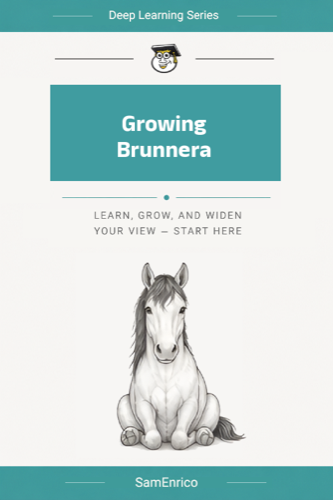
Growing Brunnera eBook
This publication, published by SamEnrico, covers G
by Britt Leonie
This publication, published by SamEnrico, covers Growing Brunnera
Formats
Free sample
Chapter 1: The Caucasus Secret--–- In the damp, dappled forests of the Caucasus Mountains, where the borders of Georgia, Armenia, Azerbaijan, and Russia converge, grows a plant that has quietly waited for its moment in the global garden. For centuries, Brunnera macrophylla tucked itself into the understory of beech and hornbeam forests, emerging each spring with clusters of brilliant blue flowers that pollinators adored, followed by broad, heart-shaped leaves that caught every stray ray of filtered sunlight. Western botanists first described the genus in the mid-19th century, naming it after Swiss botanist Samuel Brunner, but the plant remained a botanical curiosity—a wildflower appreciated by specialists, ignored by everyone else. That silence has now been shattered. In the past two decades, Brunnera has undergone a transformation as dramatic as any in horticultural history, evolving from a humble woodland native into one of the most sought-after shade garden plants on the planet.
The secret that the Caucasus mountains held for centuries has finally been unlocked, and it is changing the way we think about shade gardening forever.The story of Brunnera’s rise is not merely a tale of a single plant. It is a story about what happens when breeders, gardeners, and designers collectively realize that the old rules of shade gardening—hostas, ferns, and more hostas—no longer apply. It is a story about a plant that does what almost no other shade perennial can do: it glows. The silver-veined and fully silver cultivars that have emerged in recent years do not simply reflect light; they seem to generate their own illumination, transforming the darkest corners of a garden into luminous, ethereal spaces. And yet, for all its newfound fame, Brunnera remains misunderstood.
Gardeners confuse its tolerance for dry shade with a preference for it. They plant it in deep, dry soil under maple trees and wonder why it struggles. They mistake its easy-going nature for indestructibility, then blame the plant when it fails to perform. This chapter exists to correct those misconceptions from the very beginning, to give you a complete portrait of Brunnera macrophylla—where it came from, what it needs, and why it has become the most exciting development in shade gardening since the hosta explosion of the 1980s.The Botanical Identity: More Than a Pretty Face Before we discuss cultivation, we must understand the plant itself. Brunnera macrophylla belongs to the Boraginaceae family, the borage tribe, which includes familiar garden plants like forget-me-nots (Myosotis), lungwort (Pulmonaria), and the vegetable borage (Borago officinalis).
The family connection explains two of Brunnera's most endearing features: its true-blue flowers (a rarity in the plant kingdom, where true blue appears in only a handful of families) and its hairy, somewhat rough leaves, a trait shared with its borage cousins. The genus name honors Samuel Brunner (1790-1844), a Swiss physician and botanist who made significant contributions to the study of Alpine flora. The species epithet macrophylla derives from Greek roots—makros meaning "large" and phyllon meaning "leaf"—a nod to the plant's generous, heart-shaped foliage that can reach four to six inches across in healthy specimens.The common name "Siberian bugloss" is something of a misnomer. Brunnera is not native to Siberia (though it survives there as an introduced plant), and "bugloss" comes from the Greek bouglossos, meaning "ox-tongue," referring to the rough, tongue-shaped leaves of related plants. More accurate and more charming is the nickname "false forget-me-not," which captures the close visual resemblance between Brunnera's spring flowers and those of Myosotis.
The difference, and it is a significant one for gardeners, lies in the foliage: Myosotis produces small, inconspicuous leaves and is often grown as an annual or biennial, while Brunnera's substantial, long-lasting leaves provide structural interest from early spring until hard frost.Taxonomically, the genus Brunnera contains only three species: B. macrophylla (the subject of this book), B. orientalis (a closely related species from the eastern Caucasus and Turkey, rarely cultivated), and B. sibirica (which some authorities consider a subspecies of B. macrophylla).
For all practical gardening purposes, B. macrophylla is the sole player, and virtually every cultivar on the market today is a selected form of this single species. This narrow genetic base makes the diversity of available cultivars—from nearly solid silver to cream-edged to white-flowered—all the more remarkable. All of that diversity emerged from a single, relatively limited wild population, a testament to the genetic plasticity of the species and the skill of the breeders who coaxed out its hidden potential.The Native Habitat: Reading the Landscape To understand how to grow Brunnera successfully, you must first understand where it comes from. The Caucasus Mountains are not a single, uniform environment but a mosaic of microclimates, elevation zones, and forest types.
Brunnera macrophylla occupies a specific niche within this mosaic: the moist, deciduous woodland understory at elevations ranging from sea level to approximately 6,000 feet. These forests are dominated by trees such as Oriental beech (Fagus orientalis), hornbeam (Carpinus betulus), and various oaks, which create a canopy that filters sunlight rather than blocking it entirely. The forest floor receives what horticulturists call "dappled light"—patches of sun and shade that shift throughout the day as the sun moves across the sky and as breezes rustle the canopy leaves.The soil in these forests is rich, dark, and alive. Centuries of falling leaves have decomposed into a deep layer of humus, perhaps six to twelve inches thick, that feels spongy underfoot. This organic matter holds moisture like a sponge but drains freely—rainwater percolates through the humus layer rather than pooling on top.
Below the humus, the mineral soil tends toward loam or clay-loam, neutral to slightly acidic in p H. Importantly for Brunnera's preferences, these soils never dry out completely during the growing season, but they also never become waterlogged. The forest canopy moderates rainfall, slowing its descent and reducing the erosive impact of heavy storms, while the deep root systems of the trees draw excess water downward.The climate of the Caucasus region is temperate and relatively mild, with distinct seasons. Winters are cold but not extreme—average January temperatures in the lower elevations hover around freezing—with snow cover that insulates the ground. Springs are cool and wet, with rain falling steadily as the snow melts.
Summers are warm but not hot, with average July temperatures in the 65-75°F range, and humidity levels remain moderate. Autumn brings cooling temperatures and often a second period of gentle rainfall before the winter freeze. Critically, the Caucasus region does not experience the prolonged, intense summer heat that characterizes much of North America south of Zone 6. This is why Brunnera requires afternoon shade in warmer climates: it evolved in a place where extreme heat was not a selective pressure.What can we learn from this habitat profile? First, Brunnera is not a plant of deep, dark shade.
The forests where it grows receive substantial dappled light—enough to support vigorous leaf growth and abundant flowering. Second, Brunnera is not a plant of dry soils. The forest floor remains consistently moist throughout the growing season. Third, Brunnera is not a plant of poor soils. It demands the rich organic matter of a forest floor, not the thin, exhausted…
This is the end of the free sample. Get the eBook to keep going. Buy now
About this book
Details
- Author
- Britt Leonie
- Publisher
- SamEnrico
- Language
- English
- Genre
- Non-Fiction, Informative, Educational
- Released
- 2026-06-02
- Pages (approx.)
- 152
- Available as
- eBook, Audiobook

Read better in the ZLOADR app
Your eBooks on your phone or tablet. Sign in with your SamEnrico account and start reading.
More by Britt Leonie
 Facebook Detox Recovery PlanBritt Leonie$11.99
 Delayed Sleep PhaseBritt Leonie$11.99
 Anxiety Body Language SignsBritt Leonie$11.99
 Wound Cleaning and IrrigationBritt Leonie$11.99
 Asana Project Template LibraryBritt Leonie$11.99
 Remote Work Cloud StorageBritt Leonie$11.99
 NamUs Database Cold CasesBritt Leonie$11.99
 Financial Enabling StressBritt Leonie$11.99
 The Silk Road’s Phantom: The Rise and Fall of the Silk QueenBritt Leonie$11.99
 The Poet of Concrete: Zaha Hadid and the Bridge That Defied GravityBritt Leonie$11.99
 How to Produce 100% Acrylic FabricBritt Leonie$11.99
 How to Become a Signal MaintainerBritt Leonie$11.99
You may also like
 Hong Kong Handover 1997Dunn Johnnie$11.99
 Zumba For Postnatal Recovery CourseNeal Christian$11.99
 Zumba for BeginnersLadner Nikia$11.99
 YouTube Comment Mining GuideHumes Pandora$12.99
 Worry Box MeditationCarlin Rudy$11.99
 Workplace Stress MeditationNguyen Lynn$11.99
 Workplace Stress and Sleep RepairHawley Ivory$11.99
 Workplace Perfectionism CureDelaney Jeffry$11.99
 Workplace Injustice Anger GuideWallen Isabelle$11.99
 Work Addiction and Burnout LinkGreenwood Ester$11.99
 Women in Yoga and WellnessBeattie Galina$11.99
 Women in Stand Up ComedyChun Evangeline$11.99