
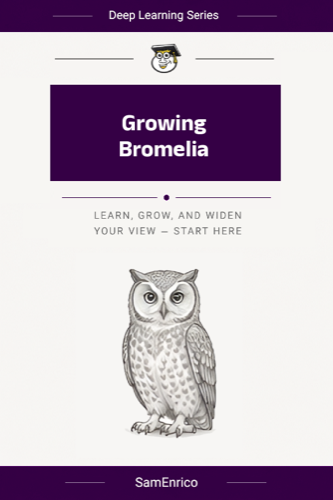
Growing Bromelia
This publication, published by SamEnrico, covers G
This publication, published by SamEnrico, covers Growing Bromelia
Formats
About this book
Free sample
Chapter 1: The Pineapple’s Secret Cousin--–- Let me tell you about the plant that broke me. Not in a dramatic, plant-tombstone kind of way—I’ve killed my share of succulents, drowned more ferns than I care to admit, and once managed to turn a peace lily into something that looked like fried lettuce. No, this was different. This was a Guzmania lingulata, a bromeliad I bought on a whim at a grocery store because its red star-shaped bract looked like something from another planet. I brought it home, put it on a coffee table, and proceeded to ignore it for three weeks.
When I finally looked at it again, expecting the usual crispy-leaf disaster, it had grown. Not just survived—thrived. New leaves. Deeper color. A pup pushing up from the side like a tiny clone saying hello.
I had done nothing. Absolutely nothing. And that’s when I realized: everything I thought I knew about houseplants was backwards.Welcome to the world of bromeliads, where the most dramatic, sculptural, alien-looking plants are often the easiest to keep alive. This is the Bromeliad Paradox, and it is the single most important idea in this entire book. The plants that look like they require a greenhouse, a horticulture degree, and a personal humidity attendant are actually the ones that tolerate your forgetfulness, your tap water, your dark apartment corner.
They have evolved a secret weapon—a biological tank—that makes them more resilient than almost any other houseplant family. And once you understand how that tank works, you will never look at a pineapple the same way again.The Grocery Store Revelation Let’s start with the pineapple. Ananas comosus is the most famous bromeliad on earth, and you have probably eaten one in the last month. But have you ever looked at a pineapple and noticed the rough, scaly texture of its skin? Those are modified leaves.
The spiky crown on top? Those are leaves, too. The entire fruit is actually a fusion of hundreds of individual flowers that have swelled together around a central core. When you…
This is the end of the free sample. Get the eBook to keep going. Buy now
Contents
- Chapter 1
- Chapter 2
- Chapter 3
- Chapter 4
- Chapter 5
- Chapter 6
- Chapter 7
- Chapter 8
- Chapter 9
- Chapter 10
- Chapter 11
- Chapter 12
Details
- Author
- Calabrese Augustine
- Publisher
- SamEnrico
- Language
- English
- Genre
- Non-Fiction, Informative, Educational
- Released
- 2026-05-25
- Pages (approx.)
- 149
- Available as
- eBook, Audiobook

Read better in the ZLOADR app
Your eBooks on your phone or tablet. Sign in with your SamEnrico account and start reading.
More by Calabrese Augustine
 Hoffa Disappearance Podcast Investigative GuideCalabrese Augustine$11.99
 Reading People Body Language GuideCalabrese Augustine$11.99
 Housing Market StressCalabrese Augustine$11.99
 Remote Work Week PlanningCalabrese Augustine$11.99
 Goal Framework ResearchCalabrese Augustine$11.99
 Fitbit Step Count EnvyCalabrese Augustine$11.99
 Recovering From Being Fired GuideCalabrese Augustine$11.99
 Stimulus Control GuideCalabrese Augustine$11.99
 The Battle of the Java Sea: The Pacific's Forgotten Cataclysm (1942)Calabrese Augustine$11.99
 The Iron Poet: Brunel and the Birth of Modern EngineeringCalabrese Augustine$11.99
 How to Produce Textile Machinery PartsCalabrese Augustine$11.99
 AI for Bad Debt Provision CalculationCalabrese Augustine$12.99