
Non-FictionInformativeEducational
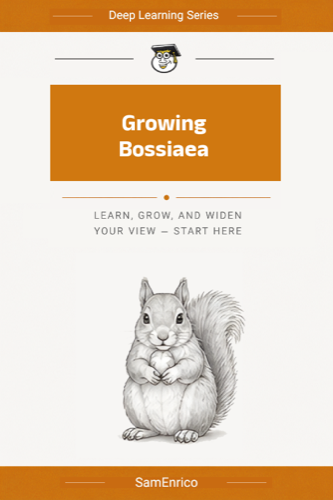
Growing Bossiaea eBook
This publication, published by SamEnrico, covers G
This publication, published by SamEnrico, covers Growing Bossiaea
Formats
Free sample
Chapter 1: The Golden Discovery--– It began, as many great horticultural obsessions do, with a moment of quiet failure. I had just killed my fortieth succulent—a tragic end for what was supposed to be an “unkillable” Echeveria—and I was ready to abandon houseplants entirely. The soil was too wet, then too dry. The light was too direct, then not direct enough. I had followed every online tutorial, every well-meaning advice thread, and still, my windowsill resembled a botanical graveyard.
It was in this state of defeated resignation that I first encountered Bossiaea, tucked away in a forgotten corner of a regional botanical garden in Western Australia. The plant was unassuming at first glance: a modest shrub with small, leathery leaves and a slightly disheveled appearance that suggested it had survived years of benign neglect. But then I noticed the flowers. Scattered across the branches like scattered gold coins were the most extraordinary blossoms I had ever seen—pea-shaped, bi-colored, with rich golden yellow standards and deep maroon keels that seemed to glow against the muted green foliage. I knelt down to examine them more closely, and in that moment, something shifted.
This was not a plant that demanded perfection. This was a plant that had thrived without anyone fussing over it, without humidity trays or grow lights or complicated fertilizer schedules. It had survived on nothing but sunlight, sandy soil, and the occasional passing rain shower. And it was stunning.The horticulturist on duty that day—a weathered woman with dirt permanently embedded under her fingernails—noticed my fascination and walked over. “That one,” she said, pointing to the shrub, “is Bossiaea.
Most people walk right past it. They want the showy Grevilleas or the dramatic Kangaroo Paws. But this little fellow? It’s the toughest plant in this garden.” She went on to explain that the specimen before me had been planted fifteen years earlier as a six-inch seedling and had never received supplemental water after its first summer. It had never been fertilized.
It had been pruned exactly twice in its entire life, both times with hedge trimmers that were far too dull for the task. And yet, year after year, it produced hundreds of flowers that attracted native bees by the dozen. “The secret,” she said, “is that Bossiaea doesn’t want your help. It wants you to leave it alone.” That counterintuitive wisdom—that neglect could be a form of skill, that doing less could produce more—lodged itself in my mind like a splinter. I bought three seedlings from the garden’s nursery that afternoon, carried them home in a paper bag, and proceeded to do exactly as I had been instructed: I planted them in terrible soil, placed them in full sun, and ignored them.They thrived.That was twelve years ago.
Since then, I have grown Bossiaea in containers on Balinese balconies, in rocky hillside gardens in California, in overheated conservatories in England, and in the heavy clay soils of the American Southeast (with appropriate amendments, which we will discuss in Chapter 3). I have propagated hundreds of plants from seed, from cuttings, and by layering. I have watched them survive droughts that killed neighboring shrubs, frosts that blackened less hardy specimens, and the casual neglect of absent-minded plant owners who forgot they existed for months at a time. I have also watched them fail—spectacularly, mysteriously, and instructively. Every failure taught me something.
Every wilted leaf, every flowerless season, every plant that rotted despite my best intentions added another piece to the puzzle. This book is the sum of those twelve years of successes, failures, and the quiet, persistent curiosity that drives every true gardener.Why This Plant, Why This Book, Why Now Before we dive into the practical details of cultivation—and we will, extensively—it is worth pausing to consider the broader context. The global horticultural world is in the midst of a quiet revolution. For decades, gardeners were taught that a beautiful garden required constant intervention: daily watering, weekly fertilizing, meticulous deadheading, and a chemical arsenal to combat every perceived threat. The dominant aesthetic was one of control: manicured lawns, regimented flower beds, and plants forced to perform under conditions that bore little resemblance to their native habitats.
But that paradigm is shifting. Climate change has made water scarcity a pressing concern in regions that once took rainfall for granted. Rising temperatures have pushed many traditional garden plants beyond their physiological limits. And a new generation of gardeners—younger, more environmentally conscious, more skeptical of intensive resource use—is asking a different question: what if we worked with nature instead of against it?This is where Bossiaea enters the conversation. As a genus endemic to Australia, Bossiaea has evolved over millions of years to thrive in some of the harshest conditions on Earth.
It has adapted to nutrient-poor soils, prolonged dry periods, and the occasional wildfire that sweeps through its native heathlands. It has developed symbiotic relationships with native pollinators and a remarkable ability to fix its own nitrogen through root nodules—a trait shared with other members of the Fabaceae (pea) family. In short, Bossiaea is a plant built for resilience, not pampering. And in an era where gardeners are increasingly seeking low-input, high-impact plants, Bossiaea deserves a place at the center of the conversation.Yet remarkably, it remains obscure. Walk into any mainstream nursery in North America or Europe—or even in Australia, where it is native—and you are unlikely to find Bossiaea among the offerings.
The reasons for this are varied, and we will explore them throughout this book, but they include: confusion with similar-looking genera (particularly Pultenaea and Gompholobium), a persistent myth that Australian natives are difficult to grow outside their home continent, and the simple fact that Bossiaea is not flashy enough to compete with the horticultural blockbusters of the moment. The Monstera deliciosa has its moment. The fiddle-leaf fig has its moment. Even the lowly succulent had its moment, propelled by Instagram and Etsy and the relentless churn of plant influencer culture. Bossiaea, by contrast, is a plant for people who have moved beyond trends—for gardeners who value substance over spectacle, resilience over rarity, and the quiet satisfaction of watching a plant thrive on its own terms.What This Chapter Will Teach You Before we proceed, let me be explicit about what this opening chapter aims to accomplish.
We will cover five foundational topics:First, a comprehensive introduction to the genus Bossiaea—its botanical classification, its evolutionary history, and the characteristics that distinguish it from similar plants. You will learn why the "fuzzy" calyxes matter, what the bi-colored flowers signal to pollinators, and how to identify a Bossiaea at fifty paces.Second, an explanation of why Bossiaea has been overlooked by mainstream horticulture and why this moment—right now—is the perfect time to rediscover it. We will discuss the cultural shifts, environmental pressures, and changing aesthetics that have created an opening for plants like Bossiaea to finally receive the attention they deserve.Third, a preview of the growing conditions that make Bossiaea unique among ornamental shrubs. We will introduce the concept of "benign neglect" as a cultivation philosophy, explain why traditional gardening wisdom often fails with…
This is the end of the free sample. Get the eBook to keep going. Buy now
About this book
Details
- Author
- Alonso Annetta
- Publisher
- SamEnrico
- Language
- English
- Genre
- Non-Fiction, Informative, Educational
- Released
- 2026-05-06
- Pages (approx.)
- 136
- Available as
- eBook, Audiobook

Read better in the ZLOADR app
Your eBooks on your phone or tablet. Sign in with your SamEnrico account and start reading.
More by Alonso Annetta
 Teamster Boss Hoffa Union Empire ManualAlonso Annetta$11.99
 Trello Search Operators ReferenceAlonso Annetta$11.99
 SMART Specific CriteriaAlonso Annetta$11.99
 Financial Secrets in RelationshipsAlonso Annetta$11.99
 Bridge and Tunnel AnxietyAlonso Annetta$11.99
 YouTube Lifestyle Vlogger EnvyAlonso Annetta$11.99
 War Profiteering Investigator MemoirAlonso Annetta$11.99
 Job Loss for Single ParentsAlonso Annetta$11.99
 Shadows of the Silk RoadAlonso Annetta$11.99
 Letters Across the Bridge: The Love and Logic of a Renaissance EngineerAlonso Annetta$11.99
 How to Produce Pneumatic PartsAlonso Annetta$11.99
 Boss Request Documentation Cheat SheetAlonso Annetta$12.99
You may also like
 Hong Kong Handover 1997Dunn Johnnie$11.99
 Zumba For Postnatal Recovery CourseNeal Christian$11.99
 Zumba for BeginnersLadner Nikia$11.99
 YouTube Comment Mining GuideHumes Pandora$12.99
 Worry Box MeditationCarlin Rudy$11.99
 Workplace Stress MeditationNguyen Lynn$11.99
 Workplace Stress and Sleep RepairHawley Ivory$11.99
 Workplace Perfectionism CureDelaney Jeffry$11.99
 Workplace Injustice Anger GuideWallen Isabelle$11.99
 Work Addiction and Burnout LinkGreenwood Ester$11.99
 Women in Yoga and WellnessBeattie Galina$11.99
 Women in Stand Up ComedyChun Evangeline$11.99