
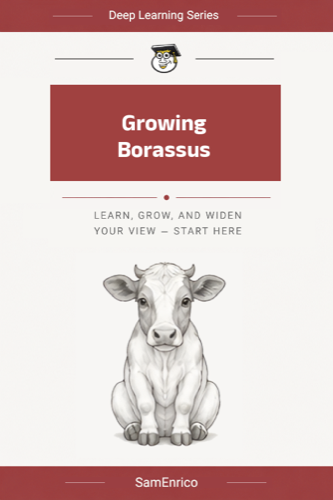
Non-FictionInformativeEducational
Growing Borassus eBook
This publication, published by SamEnrico, covers G
This publication, published by SamEnrico, covers Growing Borassus
Formats
Free sample
Chapter 1: The Seed That Changed Everything--–- I did not set out to become a palm grower. In fact, for the first forty-three years of my life, I could barely keep a basil plant alive on a sunny windowsill. My garden, if it could be called that, consisted of a sad patch of St. Augustine grass that turned brown every summer despite my best efforts with sprinklers and promises. I lived in a modest house in coastal Florida, Zone 10a, where the heat was relentless and the rain came in unpredictable bursts.
Like most of my neighbors, I had accepted that a "nice yard" meant a green lawn, a few crepe myrtles, and perhaps a bougainvillea if you were feeling ambitious. The idea of planting a tree that would outlive me—that might one day tower a hundred feet into the air and produce food for generations—had never crossed my mind.Then I went to Cambodia.It was not a vacation in the traditional sense. I had been hired to consult on a small architectural project near Siem Reap, a school designed to withstand the monsoon season using local materials. On my third day, jet-lagged and overwhelmed by the humidity, I wandered away from the construction site and found myself walking down a dirt path lined with rice paddies. The sun was beginning to set, casting a golden light over everything, and in the distance I saw what I initially mistook for a strange building—a massive, dark shape rising from the flat landscape like a monument.
As I drew closer, I realized it was a tree.Not just any tree. This was a Borassus flabellifer, an Asian Palmyra palm, and it was easily eighty feet tall. Its trunk was unlike anything I had ever seen: thick in the middle, tapering slightly at both ends, covered in a diamond pattern of old leaf scars that looked like the skin of some prehistoric reptile. The crown of fan-shaped leaves spread out at the top like an enormous umbrella, each leaf easily ten feet across. Beneath it, the ground was cool and shaded, protected from the fierce afternoon sun.
And there, sitting in the tree's shadow, was an old man.He was perhaps seventy or eighty years old, with skin like leather and eyes that crinkled when he smiled. He wore a simple cotton krama wrapped around his shoulders and held a curved knife in one hand. Beside him sat a clay pot covered with a cloth. He gestured for me to sit. I did.
Then, without a word, he reached into the pot, pulled out a gourd dipper, and handed me a drink.The liquid was milky white, slightly sweet, and faintly effervescent. It tasted like nothing I had ever experienced—a combination of coconut water, honey, and something else I could not name. I drank it all. The old man laughed, then pointed up at the tree and said a single word in Khmer. My translator later told me what it meant: "Toddy." Palm wine.
The sap of the Borassus, collected twice daily from a cut in the male inflorescence, fermented naturally within hours.That night, I could not sleep. Not because of the jet lag, but because I could not stop thinking about that tree. I had spent my entire adult life designing buildings—structures that required concrete, steel, permits, and teams of workers. Yet here was a single living organism that provided shade, food, drink, timber, thatch, sugar, and medicine. It required no foundation, no electrical wiring, no plumbing.
It asked only for sun, water, and time. And it would continue giving for a hundred years or more.The next morning, I returned to the tree with my translator. The old man was there again, and this time he was willing to talk. His name was Arjun, and he had been tapping this particular Borassus for forty-two years. His father had tapped it before him.
His grandfather had planted it, sometime in the 1940s, during the French colonial period. Three generations of a single family had lived under this tree's generosity. Arjun showed me how he climbed using only a rope and his bare feet, how he shaved a thin slice from the flower stalk each morning, how he coated the collecting pot with lime to prevent fermentation when he wanted fresh sap instead of wine. He showed me the fruit—large, purple-black spheres the size of a human head—and cracked one open with his knife to reveal three translucent, jelly-like "ice apples" inside. He handed me one.
It was cool, sweet, and melted on my tongue like a tropical dessert.Before I left Cambodia, I made a decision. I would grow a Borassus. Not because I needed another project—I had plenty of those—but because I wanted to participate in something larger than myself. I wanted to plant a tree that my grandchildren might climb. I wanted to taste sap from a tree I had grown with my own hands.
I wanted, in some small way, to become like Arjun.That was twelve years ago. Today, I have seven Borassus trees growing on my property in Florida. The oldest is now fifteen feet tall, its trunk finally beginning to take on that characteristic bottle shape. It has not yet flowered—that will likely take another five to eight years—but every morning I walk out to look at it, and every morning I am reminded of that evening in Cambodia. I have failed more times than I care to admit.
I have lost seeds to rot, seedlings to fungus, and one young tree to a surprise frost that caught me unprepared. I have learned more about soil chemistry, taproot physiology, and palm weevils than I ever wanted to know. But I have also succeeded. And what I have learned, I want to share with you.This book is not a dry botanical treatise. It is not a collection of academic papers dressed up with photographs.
It is a practical, hands-on guide written by someone who has made every mistake you are about to make and survived to tell the tale. Whether you are a tropical gardener in South Florida, a permaculture enthusiast in coastal Australia, or a dreamer in a Zone 9b microclimate with a greenhouse and too much ambition, this book will give you the tools you need to grow Borassus—the "Tree of Life"—from seed to maturity.But before we get to soil mixes and germination techniques, we need to understand what we are dealing with. Because Borassus is not like other palms. It is not a coconut palm that fruits in five years. It is not a date palm that thrives in desert heat.
It is something older, stranger, and more demanding. And that is precisely what makes it worth growing.The Eight Faces of Borassus Most people, if they have heard of Borassus at all, assume it is a single species. In fact, the genus contains eight recognized species, each adapted to a different region of the tropics. Understanding the differences between them is not merely academic—it will determine whether your tree thrives or dies.The genus Borassus belongs to the…
This is the end of the free sample. Get the eBook to keep going. Buy now
About this book
Details
- Author
- Barrera Lucina
- Publisher
- SamEnrico
- Language
- English
- Genre
- Non-Fiction, Informative, Educational
- Released
- 2026-06-02
- Pages (approx.)
- 145
- Available as
- eBook, Audiobook

Read better in the ZLOADR app
Your eBooks on your phone or tablet. Sign in with your SamEnrico account and start reading.
More by Barrera Lucina
 Holiday Family AnxietyBarrera Lucina$11.99
 Car Payment Financial StressBarrera Lucina$11.99
 Grief And Guilt OverlapBarrera Lucina$11.99
 Key Results DefinitionBarrera Lucina$11.99
 War Resister Deportation FightBarrera Lucina$11.99
 Job Loss for Remote WorkersBarrera Lucina$11.99
 The Stolen Olympic Torch: A Heist That Sparked a RevolutionBarrera Lucina$11.99
 How to Start a Clutch (not for Motor Vehicle) Business (Beginners Guide)Barrera Lucina$11.99
 Cross Cultural Boss GuideBarrera Lucina$12.99
 Missing Citation Information GuideBarrera Lucina$12.99
 How to Produce Plastic Processing Machinery PartsBarrera Lucina$11.99
 How to Produce Muffin and Cupcake MakersBarrera Lucina$11.99
You may also like
 Hong Kong Handover 1997Dunn Johnnie$11.99
 Zumba For Postnatal Recovery CourseNeal Christian$11.99
 Zumba for BeginnersLadner Nikia$11.99
 YouTube Comment Mining GuideHumes Pandora$12.99
 Worry Box MeditationCarlin Rudy$11.99
 Workplace Stress MeditationNguyen Lynn$11.99
 Workplace Stress and Sleep RepairHawley Ivory$11.99
 Workplace Perfectionism CureDelaney Jeffry$11.99
 Workplace Injustice Anger GuideWallen Isabelle$11.99
 Work Addiction and Burnout LinkGreenwood Ester$11.99
 Women in Yoga and WellnessBeattie Galina$11.99
 Women in Stand Up ComedyChun Evangeline$11.99