
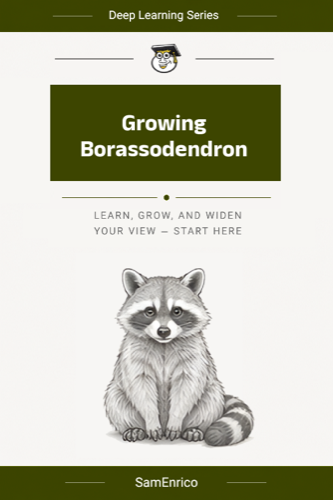
Non-FictionInformativeEducational
Growing Borassodendron eBook
This publication, published by SamEnrico, covers G
by Dumas Marcie
This publication, published by SamEnrico, covers Growing Borassodendron
Formats
Free sample
Chapter 1: The Sawtooth Monarch--–- The first time I saw a mature Borassodendron machadonis in the wild, I nearly lost a finger. I had traveled to southern Thailand on a tip from a retired botanist in Chiang Mai, a man who spoke of a palm so magnificent and so dangerous that he had watched a fellow collector require seventeen stitches after brushing past a leaf. I dismissed his warning as the exaggerated nostalgia of an old man. Three hours into the trailhead, my guide stopped suddenly and pointed upward. There, rising from a tangled mess of dipterocarp forest, was a trunk like gray elephant hide, and above it, a crown of massive fan leaves that seemed to defy physics—each one split into deep segments, drooping like the ribs of a broken umbrella, backlit by the afternoon sun so that every serrated edge along the petioles glowed like a row of curved knives.
I stepped closer, mesmerized. The guide grabbed my collar and yanked me backward just as a falling leaflet, dislodged by a passing hornbill, sliced through the air where my forearm had been. On the forest floor, the leaflet had cut a clean furrow in the damp soil. I looked at my guide. He did not say a word.
He simply pointed to a faded scar running the length of his left hand.That was the moment I understood that Borassodendron is not a palm for the casual gardener. It is not a palm for the impatient, the careless, or the faint-hearted. It is a palm that demands respect, preparation, and a willingness to accept that you are sharing your garden with something that is, in a very real sense, armed.This book is the result of fifteen years of studying, growing, and occasionally bleeding for this genus. It is also, I hope, a call to action. Borassodendron is one of the least understood and most threatened groups of fan palms in the world, and yet it is also one of the most spectacular.
In the following pages, I will teach you everything I have learned about germinating its stubborn seeds, raising its vulnerable seedlings, navigating its dangerous adolescence, and finally, standing beneath the canopy of a mature specimen that you brought into this world. But before we talk about soil mixes and fertilizer ratios, we need to talk about why this palm matters—and why growing it might be one of the most important things you ever do with a piece of land.The Two Faces of Borassodendron Let us begin with taxonomy, because names carry weight. Borassodendron belongs to the tribe Borasseae, a group that includes some of the most iconic palms on earth: the Palmyra palm (Borassus flabellifer), the source of palm sugar and toddy; the Lontar palm (Borassus aethiopum), whose leaves were used for ancient manuscripts; and the legendary Coco de Mer (Lodoicea maldivica), which produces the largest and heaviest seeds of any plant. Borassodendron sits between these giants, sharing characteristics with both but belonging to neither.There are two recognized species, and understanding the difference between them is not merely an academic exercise—it will determine where and how you can grow them successfully.Borassodendron machadonis is the more widely distributed of the two, found in peninsular Malaysia, southern Thailand, and possibly parts of Sumatra. It was first described in 1905 by the Italian botanist Odoardo Beccari, who named it after a Portuguese naturalist whose records have since been lost to history.
This species is the larger of the two, reaching heights of fifteen to twenty meters (fifty to sixty-five feet) in the wild, with a trunk diameter of up to forty-five centimeters (eighteen inches). Its leaves are deeply costapalmate—meaning they have a central rib that extends partway into the blade, causing the leaf to droop rather than stand flat—and each leaf can span three to four meters (ten to thirteen feet) from petiole base to leaf tip. The petioles themselves are lined with two rows of curved, backward-pointing spines that can reach two and a half centimeters (one inch) in length. These are not soft, flexible spines like those on a rose bush. They are hard, woody, and sharp enough to pierce leather boots.
I have seen them go through a pair of leather gardening gloves as if the gloves were made of tissue paper.Borassodendron borneense is the rarer and more enigmatic species, endemic to the island of Borneo and restricted to a handful of lowland forest fragments in Sarawak, Sabah, and East Kalimantan. It was described much later, in 1972, by the British palm specialist John Dransfield, who found it growing along riverbanks in secondary forest. This species is smaller overall—reaching perhaps twelve meters (forty feet) at most—but its leaves are even more deeply split, giving the canopy a shaggier, more weeping appearance. The fruit is also different: B. machadonis produces globose fruits that turn a dull brown when ripe, while B.
borneense produces slightly smaller, ellipsoid fruits that retain a greenish tinge even at maturity. For the grower, the practical differences are minor: both species require identical care, though B. borneense may be slightly more tolerant of moderate shade in its juvenile years, a point we will return to in Chapter 6.A Palm Between Worlds Why does taxonomy matter to someone who just wants to grow a beautiful palm in their backyard? Because understanding where a plant sits in the evolutionary tree tells you what it needs to survive. Borassodendron is a relic of an ancient lineage, one that thrived when the continents were arranged differently and the climate of Southeast Asia was even wetter and more stable than it is today.
Its closest relatives—Borassus and Lodoicea—diverged millions of years ago, each adapting to different ecological niches. Borassus moved into more seasonal, sometimes dry environments, developing the ability to tolerate drought and even fire. Lodoicea became hyper-specialized to the nutrient-poor soils of the Seychelles, evolving seeds that take years to germinate and a growth habit so slow that a mature tree may be centuries old.Borassodendron, by contrast, never left the rainforest. It remained in the wet, aseasonal lowlands of Sundaland, where rainfall exceeds two thousand millimeters (eighty inches) per year and the humidity rarely drops below seventy percent. It never developed drought tolerance.
It never evolved the ability to survive fire. It never learned to cope with frost because frost simply does not exist in its native range. This specialization is what makes Borassodendron so challenging to grow outside the tropics—and it is also what makes it so spectacular. A palm that has been honed by millions of years of rainforest evolution is a palm that, when given the right conditions, will reward you with a level of architectural grandeur that no other plant can match.But that specialization comes at a cost. The same rainforest that shaped Borassodendron is disappearing.
Across Southeast Asia, lowland forests are being cleared at an alarming rate for oil palm plantations, rubber, timber, and agricultural expansion. In peninsular Malaysia, where B. machadonis was once common, most remaining populations are now fragmented into small, isolated patches surrounded by plantations. In Borneo, B. borneense is known from fewer than…
This is the end of the free sample. Get the eBook to keep going. Buy now
About this book
Details
- Author
- Dumas Marcie
- Publisher
- SamEnrico
- Language
- English
- Genre
- Non-Fiction, Informative, Educational
- Released
- 2026-06-02
- Pages (approx.)
- 143
- Available as
- eBook, Audiobook

Read better in the ZLOADR app
Your eBooks on your phone or tablet. Sign in with your SamEnrico account and start reading.
More by Dumas Marcie
 Teamster Payoff Corruption Investigation GuideDumas Marcie$11.99
 Anti Vietnam War Art ProtestorDumas Marcie$11.99
 Weekend Anxiety ManagementDumas Marcie$11.99
 The Negative Feedback Reframe GuideDumas Marcie$11.99
 Quarterly OKR PlanningDumas Marcie$11.99
 Rent Affordability CrisisDumas Marcie$11.99
 LinkedIn Achievement OverloadDumas Marcie$11.99
 Job Loss for FreelancersDumas Marcie$11.99
 The Last Golden Star: Sophia Loren’s Timeless Legacy in Latin America’s Film RenaissanceDumas Marcie$11.99
 The Divine Lute of Narada: Cosmic Strings and Celestial RhythmsDumas Marcie$11.99
 How to Produce Plastic Processing MachineryDumas Marcie$11.99
 How to Produce MuddlersDumas Marcie$11.99
You may also like
 Hong Kong Handover 1997Dunn Johnnie$11.99
 Zumba For Postnatal Recovery CourseNeal Christian$11.99
 Zumba for BeginnersLadner Nikia$11.99
 YouTube Comment Mining GuideHumes Pandora$12.99
 Worry Box MeditationCarlin Rudy$11.99
 Workplace Stress MeditationNguyen Lynn$11.99
 Workplace Stress and Sleep RepairHawley Ivory$11.99
 Workplace Perfectionism CureDelaney Jeffry$11.99
 Workplace Injustice Anger GuideWallen Isabelle$11.99
 Work Addiction and Burnout LinkGreenwood Ester$11.99
 Women in Yoga and WellnessBeattie Galina$11.99
 Women in Stand Up ComedyChun Evangeline$11.99