
Non-FictionInformativeEducational
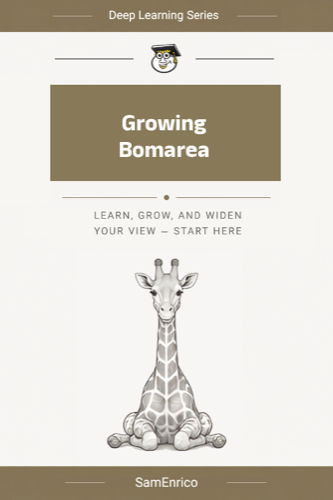
Growing Bomarea eBook
This publication, published by SamEnrico, covers G
by Perry Fred
This publication, published by SamEnrico, covers Growing Bomarea
Formats
Free sample
Chapter 1: The Three-Faced Seed--–- It arrived in a box the size of a shoebox, wrapped in brown packing tape and stamped with Ecuadorian phytosanitary seals. No return address. Just a handwritten note tucked between layers of newspaper: "This is either dinner, a fortune, or a disaster. You figure it out."That was how I met Bomarea.Inside the box, nestled in dry moss, were six knobby, potato-like tubers. They were unremarkable—brown, wrinkled, vaguely organic in the way that dormant things are.
No instructions. No species name. Just the quiet promise of something alive waiting for heat and water.I had ordered them on a whim from a rare plant collector who advertised "Andean edibles and ornamentals." What I received was a horticultural mystery. And like most mysteries, the answer turned out to be far more complicated than I expected.This chapter introduces the central paradox of Bomarea: a single genus that behaves like three completely different plants depending entirely on which species you grow, where you grow it, and what you intend to do with it. By the end of this chapter, you will understand why Bomarea is simultaneously a florist's secret weapon, a forgotten food source, and an ecological nightmare—and why your first decision as a grower is not how to plant, but which face of this remarkable plant you are inviting into your life.The Ornamental Face: Why Florists Keep Secrets The first face of Bomarea is the one that pays the bills for commercial growers.
It belongs primarily to Bomarea superba, a species whose Latin name is not an exaggeration.In the cut-flower industry, longevity is currency. A rose lasts five to seven days in a vase. A tulip, three to five. An alstroemeria (Peruvian lily), Bomarea's better-known cousin, lasts seven to ten days under ideal conditions. Bomarea superba lasts ten to fourteen days.
That extra week of vase life means florists can charge premium prices and customers can enjoy arrangements that outlast almost anything else on the market.But vase life is only part of the story.The Architecture of Drama Unlike alstroemeria, which grows as a clumping shrub reaching two to three feet, Bomarea superba is a true twining vine. In a single growing season, a well-established plant can send out stems fifteen feet long, wrapping clockwise around any support within reach. Each stem produces multiple pendulous umbels—those cascading clusters of flowers that look like nature's chandeliers.A single umbel on a mature B. superba plant carries twenty to thirty individual flowers. Each flower is roughly one inch across, shaped like a small trumpet, and colored a rich golden yellow with deep red spots on the inner petals.
When the plant is in full bloom—which in USDA zones 9 through 10 can happen nearly year-round—a fifteen-foot trellis becomes a waterfall of hundreds of flowers.The Economics of Beauty I spoke with Rosa Hernandez, who has grown Bomarea superba on her cut-flower farm in Carpinteria, California, for twenty-two years. She is not a woman given to hyperbole."People ask me why I don't grow more alstroemeria," she told me, wiping soil from her hands onto her apron. "I tell them alstroemeria is the Toyota. Reliable, fine, everyone knows it. Bomarea is the Porsche.
It costs more, it's harder to find, and the people who want it will pay whatever you ask."She showed me her books. Wholesale price for alstroemeria: two to three dollars per stem. Wholesale price for Bomarea superba: eight to twelve dollars per stem. Retail prices in high-end florist shops run twenty to thirty dollars per stem."Farmers' markets are different," she added. "I sell mixed bouquets with Bomarea as the centerpiece.
Thirty-five dollars for a bouquet that fits in a coffee mug. They sell out in the first hour."Rosa's operation is small—she dedicates only a quarter-acre to B. superba, about two hundred plants—but she estimates her annual revenue from Bomarea alone at forty to fifty thousand dollars. "I could grow more," she said. "But I don't want to.
It's my signature. If everyone had it, it wouldn't be special."That exclusivity is part of the appeal. Bomarea superba is still rare enough in North American horticulture that most home gardeners have never heard of it. For those who seek it out, there is a certain pleasure in growing something that your neighbors cannot identify.The Limits of Ornamental Value But not all ornamental Bomareas are created equal. While B.
superba is the star, other species offer different aesthetics for different contexts.Bomarea carderi produces flowers in soft rose-pink with purple spots. It is less vigorous than B. superba, reaching only ten feet in height, which makes it suitable for smaller gardens and shorter trellises. Its blooms are slightly smaller, but the color palette is more delicate, appealing to florists who work in pastels.Bomarea multiflora offers red flowers with yellow spots—a bolder, almost tropical look. However, as we will discuss in detail in the invasive section of this chapter, B.
multiflora carries significant ecological risk in certain climates. It is not a species to plant casually.Bomarea salsilla, the least common ornamental species in cultivation, produces deep crimson flowers that verge on black in certain lights. It is highly sought after by collectors of unusual colors but is notoriously difficult to propagate.The Ornamental Grower's Checklist Before you decide to grow Bomarea for its flowers, ask yourself these questions:What is your USDA zone? B. superba and B.
carderi reliably survive outdoors only in zones 8 through 10. Zone 7 is possible with heavy winter mulch and a southern exposure, but you will lose plants in harsh winters. Zone 6 and below require container cultivation with indoor winter storage.Do you have vertical space? A fifteen-foot vine is not a balcony plant. Unless you intend to grow it in a container with a small trellis and prune aggressively, you need a wall, fence, or freestanding structure of appropriate height.Can you provide morning sun and afternoon shade?
This is non-negotiable. Full sun all day scorches the leaves. Full shade produces lush foliage and zero flowers. The ideal exposure is east-facing with protection from the west.Are you willing to deadhead? Every flower that goes to seed produces bright orange arils that attract birds.
In most regions, this is merely an aesthetic issue (the plant looks messy). In invasive-prone regions—New Zealand, Hawaii, Tasmania, the Azores—it is a legal and ecological violation. We will return to this.The Edible Face: The Tuber That History Forgot The second face of Bomarea belongs to a single species: Bomarea edulis, known historically as salsilla. If the ornamental face is about beauty and commerce, the edible face is about survival and forgetting.A Staple Erased Before the Spanish arrived in the Andes, before potatoes became the world's fourth-largest food crop, there was salsilla.Archaeological evidence suggests that Bomarea edulis was cultivated in what is now Colombia, Ecuador, and Peru for at least two thousand years. The Chibcha and Muisca peoples, who built sophisticated agricultural societies in the highlands, relied on salsilla as a winter storage crop.
Unlike potatoes, which require cooking to break down toxic solanine compounds, salsilla tubers could be eaten raw, boiled, roasted, or…
This is the end of the free sample. Get the eBook to keep going. Buy now
About this book
Details
- Author
- Perry Fred
- Publisher
- SamEnrico
- Language
- English
- Genre
- Non-Fiction, Informative, Educational
- Released
- 2026-06-02
- Pages (approx.)
- 135
- Available as
- eBook, Audiobook

Read better in the ZLOADR app
Your eBooks on your phone or tablet. Sign in with your SamEnrico account and start reading.
More by Perry Fred
 Shame Of Resting HandbookPerry Fred$11.99
 Hoffa Vs Kennedy Feud Deep InvestigationPerry Fred$11.99
 Nightmare Reduction MeditationPerry Fred$11.99
 Tom Cruise StuntsPerry Fred$11.99
 Job Loss for Retail WorkersPerry Fred$11.99
 SAD Screener PHQ SAD ScalePerry Fred$11.99
 Low Income Money StressPerry Fred$11.99
 Civil Rights Anti War IntersectionPerry Fred$11.99
 The Torso in the Thames: London's First Forensic Dismemberment MysteryPerry Fred$11.99
 The Djinn and the Frost Giant: A Norse-Arabian PactPerry Fred$11.99
 How to Start a Convention Organizers BusinessPerry Fred$11.99
 How to Produce Pharmaceutical Machinery PartsPerry Fred$11.99
You may also like
 Hong Kong Handover 1997Dunn Johnnie$11.99
 Zumba For Postnatal Recovery CourseNeal Christian$11.99
 Zumba for BeginnersLadner Nikia$11.99
 YouTube Comment Mining GuideHumes Pandora$12.99
 Worry Box MeditationCarlin Rudy$11.99
 Workplace Stress MeditationNguyen Lynn$11.99
 Workplace Stress and Sleep RepairHawley Ivory$11.99
 Workplace Perfectionism CureDelaney Jeffry$11.99
 Workplace Injustice Anger GuideWallen Isabelle$11.99
 Work Addiction and Burnout LinkGreenwood Ester$11.99
 Women in Yoga and WellnessBeattie Galina$11.99
 Women in Stand Up ComedyChun Evangeline$11.99