
Non-FictionInformativeEducational
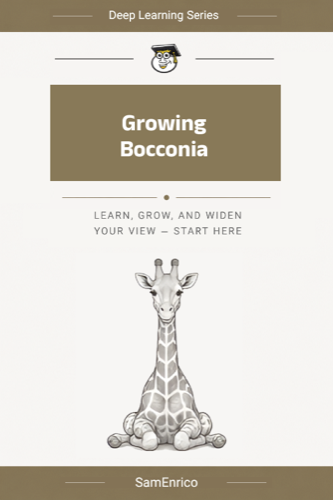
Growing Bocconia eBook
This publication, published by SamEnrico, covers G
by Kyle Aldo
This publication, published by SamEnrico, covers Growing Bocconia
Formats
Free sample
Chapter 1: The Tree That Forgot Its Petals...–- On a humid morning in the cloud forests of Oaxaca, Mexico, a plant grows that defies nearly everything gardeners think they know about the poppy family. It stands ten feet tall, its trunk as thick as a man’s forearm, its leaves lobed like an oversized oak but colored a ghostly blue-green that seems to belong in a prehistoric era. From its upper branches, strange plumes rise like smoke frozen in mid-air—branching panicles covered not in showy petals, but in thousands of tiny stamens that dust the wind with golden pollen. This is Bocconia, the tree poppy, and it has forgotten how to make petals.The revelation that a poppy could lack petals altogether is usually the first surprise for new gardeners. The second comes when they break a stem.
From the wound oozes a thick, bright orange latex that stains fingers and clothes with the tenacity of turmeric. It is this sap—brilliant, sticky, and mildly toxic—that has protected the genus Bocconia for millions of years, allowing it to colonize disturbed slopes, volcanic scree, and abandoned roadsides from Mexico through Central America and into the northern reaches of South America. Unlike its cousin the opium poppy (Papaver somniferum), which seduces with flamboyant reds and purples, Bocconia survives by being unappealing to herbivores while remaining utterly irresistible to gardeners with a taste for the dramatic.This chapter is the foundation upon which the rest of this book is built. Before you can successfully grow Bocconia—before you can prune it, propagate it, or design with it—you must understand what it is, where it came from, and how it differs from every other plant in your garden. We will trace its taxonomic journey from the forests of the New World to the herbaria of 17th-century Europe.
We will profile the three main species available to gardeners today, from the common and forgiving Bocconia frutescens to the rare and coveted Bocconia arborea. And we will meet the man who gave the genus its name: Paolo Boccone, a Sicilian botanist whose wanderings through Mediterranean and European flora inadvertently immortalized a New World tree. By the end of this chapter, you will see Bocconia not as a botanical oddity but as a masterwork of evolutionary strategy—a plant that abandoned petals for efficiency, fragrance for resilience, and showiness for raw, architectural power.A Family Misunderstood: Bocconia in the Poppy Clan To understand Bocconia, you must first forget the poppies you think you know. The Papaveraceae family is vast and diverse, containing roughly 775 species spread across 44 genera. It includes familiar garden favorites like the Iceland poppy (Papaver nudicaule), the Oriental poppy (Papaver orientale), and the corn poppy (Papaver rhoeas) that carpets French battlefields in crimson every summer.
It also includes less obvious members: the bleeding heart (Lamprocapnos spectabilis) with its pendant, heart-shaped flowers, and the prickly poppy (Argemone mexicana) with its thistle-like foliage and golden sap similar to Bocconia’s.What unites this otherwise disparate family is a set of shared characteristics that botanists call synapomorphies—traits inherited from a common ancestor. All poppies produce a milky or colored latex (sap) that ranges from white to yellow to deep orange. All poppies have flowers with two or three sepals that fall off as the bloom opens, and all have numerous stamens arranged in spirals. Most, but not all, have showy petals. And here is where Bocconia diverges.Somewhere in the evolutionary history of the genus—likely during its adaptation to wind pollination rather than insect pollination—Bocconia lost its petals entirely.
What remains is a flower reduced to its essentials: a single pistil surrounded by a halo of stamens, all held within a calyx that splits and falls away. The resulting structure, which this book calls a “plume” for its feathery appearance, is technically a branching panicle of dozens or even hundreds of individual flowers. From a distance, these plumes resemble astilbe or goat’s beard. Up close, they reveal their poppy heritage through the sheer number of stamens and the characteristic form of the ovary, which matures into a small, papery capsule filled with seeds.This loss of petals is not a defect but a strategy. Petals are expensive for plants to produce—they require energy, water, and nutrients.
By eliminating them, Bocconia can redirect those resources into faster growth, more extensive root systems, and abundant seed production. It is a pioneer’s strategy, optimized for colonizing bare ground rather than competing in established forests. And it works brilliantly. In its native range, Bocconia is often one of the first woody plants to appear after a landslide or fire. In Hawaii, where it was introduced as an ornamental, it has become aggressively invasive for the same reason.The Italian Who Never Saw His Tree: Paolo Boccone Every genus name tells a story, and Bocconia’s story begins in Sicily in the 17th century.
Paolo Boccone was born in Palermo in 1633, the son of a prosperous family that expected him to pursue medicine or law. Instead, Boccone fell in love with plants. He became a Cistercian monk, a position that gave him both the education and the freedom to travel throughout Europe studying flora. He corresponded with the leading botanists of his day, including the English naturalist John Ray and the French botanist Joseph Pitton de Tournefort. He published lavishly illustrated books on the plants of Sicily, Malta, and France.
And he never set foot in the Americas.The irony is inescapable: a man who never saw a single Bocconia tree in his life now has a genus named after him. How did this happen? The answer lies in the conventions of 18th-century botany. When Carl Linnaeus formalized the system of binomial nomenclature in his 1753 work Species Plantarum, he drew on the collections and notes of earlier botanists who had traveled to the New World. Among them was the French botanist Charles Plumier, who had journeyed to the Caribbean and Central America in the 1690s.
Plumier collected specimens of a strange, petal-less tree that bled orange sap. He had never seen anything like it. In his notes, he called it “Bocconia” in honor of his Sicilian correspondent, who had helped him identify European plants years earlier.Linnaeus retained the name, and Bocconia entered the botanical canon. The genus currently contains between six and fifteen species, depending on which taxonomist you consult, with new species still being described from remote cloud forests in Colombia and Peru. The three species most relevant to gardeners—frutescens, integrifolia, and arborea—have been in cultivation for over a century, but they remain rare outside of specialty nurseries and botanical gardens.
This book aims to change that.The Three Pillars: Bocconia Species for the Garden Not all Bocconias are created equal. The genus spans a remarkable range of growth habits, from weedy shrubs to near-canopy trees, and understanding the differences is essential for choosing the right plant for your garden. This section profiles the three species most likely to appear in the nursery trade, along with notes on their identification, cultivation requirements, and landscape use.Bocconia frutescens: The Workhorse If you encounter a Bocconia in a garden center, it is almost certainly…
This is the end of the free sample. Get the eBook to keep going. Buy now
About this book
Details
- Author
- Kyle Aldo
- Publisher
- SamEnrico
- Language
- English
- Genre
- Non-Fiction, Informative, Educational
- Released
- 2026-05-18
- Pages (approx.)
- 131
- Available as
- eBook, Audiobook

Read better in the ZLOADR app
Your eBooks on your phone or tablet. Sign in with your SamEnrico account and start reading.
More by Kyle Aldo
 Widow s Tenth Year GuideKyle Aldo$11.99
 Thyroid Anxiety ManagementKyle Aldo$11.99
 Sober Recovery Digital ToolsKyle Aldo$11.99
 The Shame Exposure LadderKyle Aldo$11.99
 Afghanistan War Civilian PeacebuilderKyle Aldo$11.99
 SAD Work Accommodation RequestKyle Aldo$11.99
 Jodie Foster SilenceKyle Aldo$11.99
 Job Loss for NursesKyle Aldo$11.99
 The Iron Chancellor: Bismarck and the Birth of Modern GermanyKyle Aldo$11.99
 The Last Oracle of Delphi: A Voice Silenced by the GodsKyle Aldo$11.99
 How to Produce Moving and Soundproofing Blankets and CoversKyle Aldo$11.99
 A Collector's Handbook to the Rolls-royce Phantom ViKyle Aldo$11.99
You may also like
 Hong Kong Handover 1997Dunn Johnnie$11.99
 Zumba For Postnatal Recovery CourseNeal Christian$11.99
 Zumba for BeginnersLadner Nikia$11.99
 YouTube Comment Mining GuideHumes Pandora$12.99
 Worry Box MeditationCarlin Rudy$11.99
 Workplace Stress MeditationNguyen Lynn$11.99
 Workplace Stress and Sleep RepairHawley Ivory$11.99
 Workplace Perfectionism CureDelaney Jeffry$11.99
 Workplace Injustice Anger GuideWallen Isabelle$11.99
 Work Addiction and Burnout LinkGreenwood Ester$11.99
 Women in Yoga and WellnessBeattie Galina$11.99
 Women in Stand Up ComedyChun Evangeline$11.99