
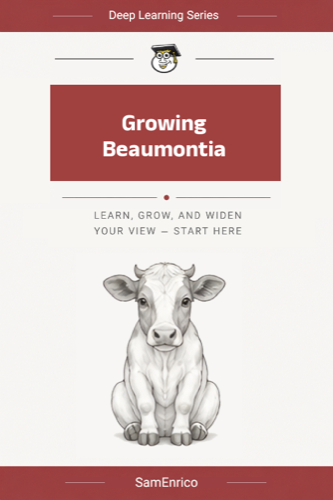
Growing Beaumontia eBook
This publication, published by SamEnrico, covers G
by Riggs Lahoma
This publication, published by SamEnrico, covers Growing Beaumontia
Formats
Free sample
Chapter 1: The Vine That Changed Everything...--–- On a humid monsoon morning in the eastern Himalayas of Sikkim, a French plant hunter named Léon Humblot crouched beneath a dripping forest canopy, his fingers trembling around the handle of a rusted trowel. It was August 1867, and for three weeks he had been tracking a rumor whispered by local tea traders—a vine that produced flowers the size of a man's fist, with a fragrance so powerful that entire valleys smelled of jasmine and citrus for two months every spring. The British botanists in Calcutta had dismissed the stories as folklore. But Humblot, who had already discovered two new rhododendrons in the region, trusted the traders more than he trusted the British. And there, tangled in the upper branches of a dying oak tree at 4,700 feet, he found it.
The vine had wrapped itself around the trunk in a clockwise spiral, its leathery leaves shimmering with rainwater, and from its highest branches hung a cascade of trumpet-shaped flowers, each one pure white with a throat the color of pale butter. The fragrance hit him before he even touched the plant—a sweet, heady perfume that seemed to change with every breath, now citrus, now honeysuckle, now something altogether unfamiliar. He collected twelve cuttings, wrapped their bases in wet moss, and wrote in his field journal that night: "This is no ordinary climber. This is the queen of all vines."Today, that plant is known to science as Beaumontia grandiflora, and to gardeners around the world as the Easter Lily Vine or the Herald's Trumpet. Yet despite its spectacular beauty, its intoxicating fragrance, and its surprisingly forgiving nature, Beaumontia remains one of the most underappreciated treasures in the horticultural world.
Walk into any nursery in Southern California, Florida, or the Mediterranean, and you will find jasmine, bougainvillea, and mandevilla lining the shelves. You will find climbing roses and trumpet vines and passionflowers. But Beaumontia? Rarely. Even among experienced gardeners, the name often draws a blank stare followed by a cautious, "Is that hard to grow?"Here is the secret that Humblot understood intuitively and that this book will prove on every page that follows: Beaumontia is not hard to grow.
It is, in fact, one of the most forgiving and vigorous flowering vines available to gardeners in warm temperate and tropical climates. It tolerates neglect that would kill a gardenia. It bounces back from pruning mistakes that would ruin a wisteria. It thrives in soil that would starve a rose. And in return for this patience, it rewards its grower with a floral display that rivals any climbing plant on earth.But this book is not merely a care manual for a single species.
Growing Beaumontia is an invitation to become part of a small but passionate community of gardeners who have discovered what the tea traders knew all along: that some plants are not just decorations for the landscape but transformative presences that change how we experience our gardens. A Beaumontia in full bloom does not simply look pretty. It announces itself. It demands attention. It fills the evening air with a perfume that drifts through open windows and lingers on clothes long after sunset.
It grows so quickly and so enthusiastically that within three years, a small cutting can become a living canopy over a patio, a fragrant screen along a fence line, or a cascading waterfall of white trumpets from a second-story balcony. This is not gardening as maintenance. This is gardening as magic.Why Beaumontia, Why Now, and Why You Before we dive into the practical details of soil amendments, support structures, and pruning schedules—all of which will receive thorough attention in the chapters ahead—it is worth asking a fundamental question: Why should you, as a gardener, care about a vine that most of your neighbors have never heard of? The answer lies in three distinct advantages that Beaumontia offers over more common climbing plants.The first advantage is fragrance. Gardeners who have grown a single Beaumontia often describe the experience as transformative not because of how the plant looks but because of how it smells.
The flowers produce a complex, nocturnal perfume that has been compared to the scent of gardenia, jasmine, honeysuckle, and lemon blossoms all at once. Unlike many fragrant plants that release their scent only during daylight hours, Beaumontia waits until evening to begin its performance. This means that for gardeners who work during the day and tend their gardens at dusk, the fragrance arrives precisely when they are most available to enjoy it. Placed near a bedroom window, a Beaumontia can fill an entire house with sweetness on warm summer nights. Trained over a patio, it transforms outdoor dining into a sensory experience that rivals the finest restaurants.
And because the flowers appear in cascading clusters of up to thirty trumpets each, the fragrance is not a subtle hint but a confident declaration.The second advantage is speed. Beaumontia is one of the fastest-growing vines in cultivation. A healthy plant in good conditions can add six to ten feet of new growth in a single growing season. This means that gardeners who are impatient for results—and let us be honest, most of us are—do not have to wait three to five years for their vine to become substantial. A one-gallon nursery plant purchased in spring can reach the top of a six-foot trellis by summer and begin producing its first flowers the following year.
For gardeners starting from cuttings, the timeline is only slightly longer. This rapid growth does come with responsibilities, as we will discuss in Chapter 6 on support systems and Chapter 8 on pruning, but the joy of watching a plant transform a bare wall into a living tapestry in a single summer is worth the occasional extra hour of maintenance.The third advantage is forgiveness. Beaumontia is not a prima donna. It does not demand perfect soil p H, precise watering schedules, or constant fertilization. It can tolerate brief periods of drought, occasional overwatering (though not chronic), and soil conditions that range from sandy to clay-heavy, provided drainage is adequate.
It resists most common pests, and even when pests do appear—as we will cover in Chapter 11—they are rarely fatal. Perhaps most importantly, Beaumontia recovers from pruning mistakes that would kill or permanently disfigure other vines. Cut it back too hard? It will resprout from the base. Prune at the wrong time?
You may lose a season of flowers, but the plant itself will be fine. Neglect it for a year? A few weeks of proper care will bring it roaring back. This forgiving nature makes Beaumontia an ideal choice for beginning gardeners who are still learning the rhythms of plant care and for experienced gardeners who want a low-maintenance specimen that does not require constant attention.A Plant of Many Names, One Extraordinary Identity Before we proceed further, let us clarify exactly what Beaumontia is and is not. The genus Beaumontia belongs to the Apocynaceae family, which includes familiar ornamentals such as oleander (Nerium), mandevilla (Mandevilla), and frangipani (Plumeria).
This family is known for two characteristics: spectacular flowers and milky, often irritating sap. Beaumontia possesses both. When you cut…
This is the end of the free sample. Get the eBook to keep going. Buy now
About this book
Details
- Author
- Riggs Lahoma
- Publisher
- SamEnrico
- Language
- English
- Genre
- Non-Fiction, Informative, Educational
- Released
- 2026-05-06
- Pages (approx.)
- 153
- Available as
- eBook, Audiobook

Read better in the ZLOADR app
Your eBooks on your phone or tablet. Sign in with your SamEnrico account and start reading.
More by Riggs Lahoma
 Emotional Sobriety Training ManualRiggs Lahoma$11.99
 Negotiation Communication ScriptsRiggs Lahoma$11.99
 The Story Method MemoryRiggs Lahoma$11.99
 The Shame Prism ModelRiggs Lahoma$11.99
 Social Media Home ComparisonRiggs Lahoma$11.99
 Legacy Through CommunityRiggs Lahoma$11.99
 Hotel Room HIIT GuideRiggs Lahoma$11.99
 Divorce and NatureRiggs Lahoma$11.99
 The Shadow of the Golden Triangle: Mexico's First Narco-WarlordRiggs Lahoma$11.99
 The Harp of Ishtar: Divine Melodies of the Mesopotamian GoddessRiggs Lahoma$11.99
 Generative AI Case Study GuideRiggs Lahoma$12.99
 Co Founder Online Communities ListRiggs Lahoma$12.99