
Non-FictionInformativeEducational
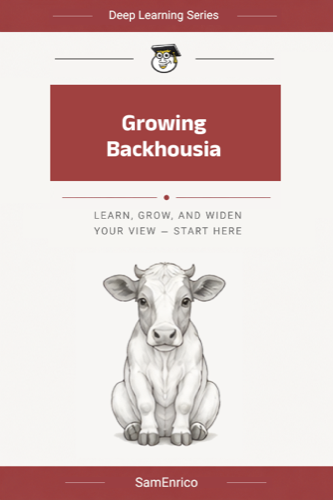
Growing Backhousia eBook
This publication, published by SamEnrico, covers G
by Whitley Kina
This publication, published by SamEnrico, covers Growing Backhousia
Formats
Free sample
Chapter 1: The Leaf That Changed Everything--–- The first time I crushed a Lemon Myrtle leaf between my fingers, I laughed out loud. Not because the situation was funny—I was standing in a friend’s rainforest garden in northern New South Wales, sweating through my shirt, being eaten by mosquitoes—but because the smell was so impossibly, aggressively, almost absurdly lemon that my brain refused to believe it came from a living plant. It smelled like a hundred lemon drops crushed into a single inch of green. It smelled like a marketing department’s idea of lemon. It smelled fake, except it wasn’t.My friend Jenny watched me sniff my fingers like a detective at a crime scene.
“Told you,” she said. “Now crush the other one.”I moved to a different tree, smaller, with leaves that looked almost identical. I pinched. The smell that erupted was entirely different—warm, spicy, clove-cinnamon, the kind of aroma that makes you want to bake bread even when it’s thirty-five degrees outside. Two trees.
Two leaves. One genus. Two completely different flavor universes. I looked at Jenny. She was grinning.“Lemon Myrtle and Cinnamon Myrtle,” she said.
“Same family. Same rainforest. Not the same anything else.”I didn’t know it then, but that afternoon was the beginning of an obsession that would reshape my garden, my cooking, and eventually this book. I went home to Melbourne—Zone 8b, frost-prone, about as far from subtropical rainforest as you can get while staying in the same state—and I immediately did something stupid. I bought a Lemon Myrtle tree and planted it in my backyard without changing a single thing about my heavy clay soil, my exposed windy position, or my impatient watering habits.It died in eleven weeks.I bought another one.
I babied it. I watered it every single day because surely more water was better. It died in fourteen weeks, but only because I think it was stubborn.I bought a third one. This time I did something different: I actually read about where these plants came from. I learned about the Mc Pherson Range on the Queensland-New South Wales border, where ancient rainforests have persisted for millions of years despite ice ages and droughts.
I learned about the Warrungnu and Bundjalung peoples who had used these leaves for medicine, insect repellent, and flavor long before any European botanist wrote a word about them. I learned that Backhousia wasn’t just a plant—it was a survivor, an adaptor, a piece of living history that had evolved strategies I was actively ignoring.The third tree lived. It’s still alive today, seven years later, a four-meter beauty that produces more leaf than my family can use. I’ve given away hundreds of cuttings. I’ve made teas that cleared my sinuses, rubs that transformed ordinary fish into something guests still ask about, and one memorable cheesecake that my mother-in-law requested for her birthday two years running.
I’ve also made mistakes—spectacular ones, the kind that make you want to abandon gardening altogether. I’ve watched myrtle rust eat half a canopy. I’ve over-pruned a tree into a bizarre mushroom shape that took three years to recover. I’ve propagated fifty cuttings and watched forty-seven rot.But I’ve also learned. And what I’ve learned is that Backhousia is not a difficult plant.
It’s not fussy or fragile or reserved for experts. It is, however, a plant that punishes assumptions. You cannot treat it like a rose bush. You cannot treat it like a vegetable patch. You cannot treat it like a eucalyptus, even though it’s in the same family.
Backhousia has its own logic, its own rhythms, its own set of non-negotiable rules. Break those rules, and it dies quickly. Follow them, and it rewards you for decades.This book is those rules, collected, tested, and explained. Not as a dry botanical manual—there are enough of those—but as a conversation between someone who has killed his share of trees and someone who wants to avoid killing theirs. By the time you finish these twelve chapters, you will know how to grow Backhousia in a suburban backyard, on a city balcony, or across an acre of rural land.
You will know which species to choose for your climate, your cooking style, and your patience level. You will know how to harvest, preserve, and cook with leaves that most Australians have never tasted and most of the world has never heard of. And you will know what to do on the worst day—the day you find orange powder on your leaves and feel your heart sink—because that day comes for many of us, and it doesn’t have to be the end.But before any of that, we need to start at the beginning. Because you cannot grow a plant well until you understand where it came from, how it lives, and what it needs to thrive. And Backhousia, more than most garden plants, tells a story worth hearing.The Rainforest That Refused to Die Let me take you to the Mc Pherson Range.
Not literally—though if you ever get the chance to visit the Border Ranges National Park or Lamington National Park, take it—but imaginatively. Picture a spine of ancient mountains running east-west along the border of Queensland and New South Wales. These aren’t dramatic peaks like the Alps or the Andes. They’re rounded, weathered, softened by millions of years of rain and wind. But what they lack in drama, they make up for in biological significance.This range is part of the Gondwana Rainforests of Australia, a UNESCO World Heritage site that preserves some of the oldest continuously surviving rainforest on earth.
While other parts of Australia dried out during the ice ages, turning to savanna and desert, the Mc Pherson Range held on. Its east-facing slopes caught moisture from the Pacific Ocean. Its deep valleys sheltered pockets of cool, wet habitat. And in those pockets, plants that had evolved alongside dinosaurs continued to survive, adapt, and slowly change.One of those plants was Backhousia.The genus was first formally described in 1853 by the German botanist Carl Meissner, who named it after his English colleague James Backhouse—a missionary and plant collector who traveled through Australia in the 1830s. Meissner identified several species based on specimens sent back to Europe, but he had no way of knowing how many more existed in the remote rainforests of eastern Australia.
Over the following decades, botanists added to the list. Today, we recognize fourteen species of Backhousia, all of them endemic to Australia, most of them restricted to narrow bands of rainforest along the east coast.But here’s what the botanists didn’t understand for a long time: Backhousia wasn’t rare because it was weak. It was rare because it was specialized. It had evolved to thrive in a very specific set of conditions—dappled light, consistently moist but well-drained soil, protection from drying winds, and the company of other rainforest species. When Europeans cleared those rainforests for farming and timber, Backhousia populations crashed.
Not because the plant was fragile, but because its habitat was destroyed.The survivors, the trees that still grow in the…
This is the end of the free sample. Get the eBook to keep going. Buy now
About this book
Details
- Author
- Whitley Kina
- Publisher
- SamEnrico
- Language
- English
- Genre
- Non-Fiction, Informative, Educational
- Released
- 2026-06-02
- Pages (approx.)
- 148
- Available as
- eBook, Audiobook

Read better in the ZLOADR app
Your eBooks on your phone or tablet. Sign in with your SamEnrico account and start reading.
More by Whitley Kina
 HIIT for Anxiety GuideWhitley Kina$11.99
 Divorce Mediation Getting To YesWhitley Kina$11.99
 Gambling Addiction Children of GamblersWhitley Kina$11.99
 Detox Mortality RiskWhitley Kina$11.99
 Shame Free Sexuality GuideWhitley Kina$11.99
 Philanthropy Legacy GuideWhitley Kina$11.99
 Grief and Anger After DivorceWhitley Kina$11.99
 Child Loss and Mother's DayWhitley Kina$11.99
 Chains of the Iron Queen: The Forgotten Uprising of 1899Whitley Kina$11.99
 The Lost Tape: How a Jazz Legend’s Unreleased Masterpiece Reshaped MusicWhitley Kina$11.99
 How to Produce Glove Making MachineryWhitley Kina$11.99
 How to Start a Conveyor Bands Made of Leather Business (Beginners Guide)Whitley Kina$11.99
You may also like
 Hong Kong Handover 1997Dunn Johnnie$11.99
 Zumba For Postnatal Recovery CourseNeal Christian$11.99
 Zumba for BeginnersLadner Nikia$11.99
 YouTube Comment Mining GuideHumes Pandora$12.99
 Worry Box MeditationCarlin Rudy$11.99
 Workplace Stress MeditationNguyen Lynn$11.99
 Workplace Stress and Sleep RepairHawley Ivory$11.99
 Workplace Perfectionism CureDelaney Jeffry$11.99
 Workplace Injustice Anger GuideWallen Isabelle$11.99
 Work Addiction and Burnout LinkGreenwood Ester$11.99
 Women in Yoga and WellnessBeattie Galina$11.99
 Women in Stand Up ComedyChun Evangeline$11.99