
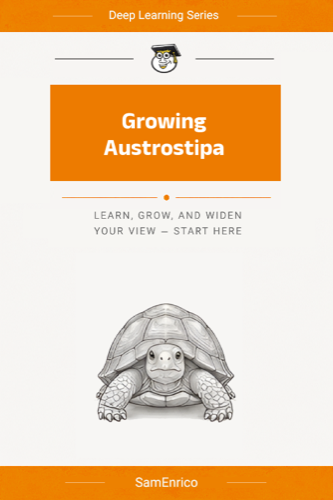
Non-FictionInformativeEducational
Growing Austrostipa eBook
This publication, published by SamEnrico, covers G
This publication, published by SamEnrico, covers Growing Austrostipa
Formats
Free sample
Chapter 1: The Forgotten Native--–- I first killed an Austrostipa in 2009. I did not mean to kill it. I had bought it from a native plant nursery with the vague intention of being a better Australian gardener. The plant came in a small black pot, its thin green leaves poking up like nervous antennae. I took it home, dug a hole in a sunny spot, and did what every gardening book had ever told me to do.
I enriched the soil with compost. I added a handful of slow-release fertilizer. I mulched heavily with wood chips to keep the roots cool and moist. I watered it deeply every three days. The plant looked great for about six weeks.
Then it turned yellow, then brown, then black at the center. By the end of summer, I pulled out a rotten, stinking clump of dead vegetation and threw it in the green waste bin. I assumed the plant was weak. I assumed native grasses were difficult. I assumed the problem was the plant.
I was wrong about all of it. The problem was me. I had treated a grass that evolved to thrive on neglect like a pampered rose, and I had killed it with kindness. That failure haunted me for years. It also sent me down a path of research, experimentation, and eventually obsession.
This book is the result of that obsession. And this chapter is where we start over, together, so you do not make the same mistakes I made.If you have never heard of Austrostipa, you are not alone. Ten years ago, I had not heard of it either. Most Australian gardeners have not. Even many native plant enthusiasts struggle to name a single species.
This is strange because Austrostipa is everywhere. Drive any back road in temperate Australia—from the clay plains of Victoria to the tablelands of New South Wales to the coastal heath of South Australia—and you will see it. It is the grass that covers the hillsides. It is the grass that edges the highways. It is the grass that farmers curse when the awns get stuck in their sheep's wool.
It is common, widespread, and almost entirely invisible to the untrained eye. But once you learn to see it, you cannot unsee it. Once you understand what it is and what it can do, you will start noticing it everywhere, and you will wonder why it is not in every garden in the country.The purpose of this chapter is to open your eyes. I am going to introduce you to the genus Austrostipa: what it is, where it comes from, why it matters, and why you should care. I am going to explain the botanical fundamentals in plain language, without the jargon that makes most plant books feel like homework.
And I am going to convince you that this forgotten native is actually one of the most valuable ornamental grasses you could possibly grow. By the end of this chapter, you will understand why I drove past that field of feathery seed-heads and nearly crashed the car. You will see what I saw. And you will be ready to start growing.What Is Austrostipa, Anyway?Let us start with the name. Austrostipa is a genus of grasses in the family Poaceae, the same family that includes wheat, rice, bamboo, and lawn.
The name is a combination of two words: "Austro," meaning southern, and "Stipa," the name of a related genus. So Austrostipa means "southern Stipa." This is a reference to both its geographic distribution—it is found only in Australia, New Zealand, and New Guinea—and its taxonomic history. For most of botanical history, these grasses were classified as part of the global genus Stipa. But in the 1990s, Australian botanist Surrey Jacobs (yes, that was really his name) reclassified the Australian species into their own genus based on differences in their flowers, their genetics, and their distribution. The split made sense.
Stipa proper is found in Europe, Asia, Africa, and the Americas. Austrostipa is ours. It belongs to this continent in a way that exotic grasses never can.There are currently about seventy recognized species of Austrostipa. That number changes every few years as botanists discover new species in remote parts of Western Australia and the Northern Territory and as genetic analysis reveals hidden diversity within what were once considered single species. Seventy species is a lot.
But here is the good news: you do not need to know all of them. Most Austrostipa species are not in cultivation. Many would not perform well in gardens even if they were. This book focuses on the ten species that matter: the ones that are ornamental, the ones that are adaptable, the ones that have proven themselves in gardens across the country. We will meet those ten in detail in Chapter 2.
For now, think of Austrostipa as a family. The family has many members, but you only need to invite a few to your party.So what unites these seventy species? What makes an Austrostipa an Austrostipa? Three key features: the tussock growth habit, the cool-season photosynthetic pathway, and the distinctive awn. I will explain each of these in depth in the following sections.
But here is the short version. Austrostipa grows in dense clumps, not spreading runners. It does most of its growing in autumn, winter, and spring, and it goes dormant in summer. And its seeds are attached to long, twisted bristles that move with changes in humidity, drilling the seed into the soil. These three features are the secrets to its success.
They are also the secrets to growing it successfully in your garden.The Tussock: Why Clumping Beats Spreading If you have ever grown lawn grass, you know the nightmare. It sends out runners. It invades flower beds. It climbs over paths. It grows under fences.
You spend your weekends pulling runners out of places they do not belong, and you never win. This is because lawn grasses are mostly spreading grasses. Botanists call them stoloniferous or rhizomatous, meaning they produce horizontal stems that run along the ground or below it, sending up new shoots at intervals. This is a great strategy for covering bare ground quickly. It is a terrible strategy for a controlled garden setting.Austrostipa takes the opposite approach.
It is a tussock grass. Tussock grasses grow in dense, upright clumps. Each plant stays where you put it. It expands slowly outward over the years, adding new leaves around the edges and dying back in the center, but it does not send out runners. It does not invade.
It does not spread where it is not wanted. A single Austrostipa plant will live quietly in its allocated space for five to ten years, growing gradually larger, until eventually you decide to divide it or replace it. This is not just convenient. It is a revelation for gardeners who are used to fighting spreading grasses.The tussock form has another advantage: it creates habitat. The dense clump of leaves provides shelter for small animals.
Skinks hide in the base. Small birds nest between the stems. Insects overwinter in the thatch. A garden full of tussock grasses…
This is the end of the free sample. Get the eBook to keep going. Buy now
About this book
Details
- Author
- Bowles Shemika
- Publisher
- SamEnrico
- Language
- English
- Genre
- Non-Fiction, Informative, Educational
- Released
- 2026-05-23
- Pages (approx.)
- 125
- Available as
- eBook, Audiobook

Read better in the ZLOADR app
Your eBooks on your phone or tablet. Sign in with your SamEnrico account and start reading.
More by Bowles Shemika
 Focus On Interests Not PositionsBowles Shemika$11.99
 Asana Timeline Critical Path MethodBowles Shemika$11.99
 Gambling Addiction and LGBTQ PlusBowles Shemika$11.99
 Pregnancy Detox GuideBowles Shemika$11.99
 Child Loss and DivorceBowles Shemika$11.99
 Gambling Addiction And Tax DebtBowles Shemika$11.99
 Client Interruption GuideBowles Shemika$11.99
 Playing With KidsBowles Shemika$11.99
 The Last Echoes of the Great Emu War: When Australia Declared War on BirdsBowles Shemika$11.99
 The Maestro of the Strings: How a Japanese Luthier Revived the KotoBowles Shemika$11.99
 How to Start a Meters for Petrol Pumps (non-electronic) Business (Beginners Guide)Bowles Shemika$11.99
 Student Social Media Job GuideBowles Shemika$12.99
You may also like
 Hong Kong Handover 1997Dunn Johnnie$11.99
 Zumba For Postnatal Recovery CourseNeal Christian$11.99
 Zumba for BeginnersLadner Nikia$11.99
 YouTube Comment Mining GuideHumes Pandora$12.99
 Worry Box MeditationCarlin Rudy$11.99
 Workplace Stress MeditationNguyen Lynn$11.99
 Workplace Stress and Sleep RepairHawley Ivory$11.99
 Workplace Perfectionism CureDelaney Jeffry$11.99
 Workplace Injustice Anger GuideWallen Isabelle$11.99
 Work Addiction and Burnout LinkGreenwood Ester$11.99
 Women in Yoga and WellnessBeattie Galina$11.99
 Women in Stand Up ComedyChun Evangeline$11.99