
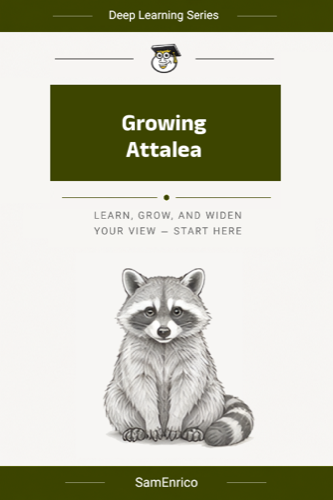
Growing Attalea eBook
This publication, published by SamEnrico, covers G
by Yamamoto Mui
This publication, published by SamEnrico, covers Growing Attalea
Formats
Free sample
Chapter 1: The Silent Giants--Walk into any tropical garden, and you will see them everywhere. The feathery crowns of coconut palms leaning lazily over beaches. The smooth, gray columns of royal palms lining hotel driveways. The clustering trunks of areca palms screening suburban patios. These are the familiar faces of the palm world – the plants that sell postcards, decorate logos, and populate the imagination of anyone dreaming of the tropics.Now walk past them.
Push through the botanical garden gate to the section labeled “Rare Palms.” Follow the path until the crowd noise fades. And there, in a corner of the garden that receives fewer visitors than the compost pile, you will find something different. Not a palm that whispers “vacation.” A palm that announces “cathedral.” A palm whose individual leaves stretch longer than a compact car, whose trunk rises like a concrete pillar, whose crown explodes outward in a shuttlecock of green that blocks out the sky.You are looking at an Attalea. And you have just discovered horticulture’s best-kept secret.This book exists because that secret should not be kept. The genus Attalea – which includes the Cohune palm, the Wine palm, the Babassu, the Piassava, and a dozen other botanical marvels – represents one of the most spectacular, most useful, and most misunderstood groups of plants on earth.
Yet if you search the shelves of any bookstore, browse the catalog of any publisher, or ask the manager of any nursery, you will find almost nothing dedicated to their cultivation. A paragraph here. A photograph there. A passing mention in an encyclopedia of palms that gives them two pages while awarding twenty to the coconut.This is not an accident of publishing. It is a reflection of a deeper reality.
Attalea palms are not for the impatient. They are not for the gardener who wants instant gratification, who measures success in inches per month, who expects a trunk in three years and fruit in five. Attalea operates on a different timescale – one measured in decades, not growing seasons. A grower who plants an Attalea seed today may wait six months to see a sprout, five years to see a pinnate leaf, fifteen years to see a trunk, and twenty years to taste the first fruit. In a world of instant downloads and same-day delivery, that kind of timeline seems almost perverse.And yet.
And yet.The same growers who report these agonizingly slow timelines also report something else. They report that once an Attalea establishes – once that subterranean trunk finally emerges, once the crown rises above the roofline, once the first inflorescence produces its heavy cluster of fruit – the palm becomes a fixture of the landscape that outlives houses, outlives owners, outlives the very memory of the patience required to grow it. They report that the Cohune palm’s oil, pressed from nuts the size of small eggs, rivals coconut oil in quality and surpasses it in smoke point. They report that the Wine palm yields twelve liters of sweet sap in a single tapping season, fermenting within hours into a beverage that has sustained indigenous communities for millennia. They report that the Piassava palm’s fibers, harvested from the bases of the leaves, produce brooms and brushes that outlast anything made from synthetic materials.This is not a gardening book for people who want to fill a weekend.
This is a gardening book for people who want to fill a lifetime.Why Attalea, and Why Now?The timing for a comprehensive guide to Attalea cultivation is not accidental. Three converging trends make this genus more relevant today than at any point in the past century.First, the explosion of interest in permaculture and food forestry has created a new generation of growers who evaluate plants not only by their ornamental value but by their utility. The old question – “Will this look good in my garden?” – has been joined by a new one: “What does this plant give back?” Attalea answers that question emphatically. Oil, wine, fiber, thatch, timber, and in some species, edible fruit pulp. Few palms, and indeed few plants of any kind, offer such a diverse harvest from a single specimen.Second, climate change is redrawing the maps of what can be grown where.
Subtropical regions that once seemed marginal for tropical palms are now experiencing longer, warmer growing seasons. Growers in northern Florida, coastal Texas, inland California, and even parts of Australia and New Zealand are successfully cultivating Attalea species that would have been unthinkable there thirty years ago. The cold hardiness of species like A. speciosa and A. dubia – capable of surviving brief dips to 24 degrees Fahrenheit with only frond damage – opens up cultivation to millions of gardeners who assumed that palms meant coconuts and coconuts meant frost-free zones.Third, the palm-growing community itself has matured.
Online forums like Palm Talk and resources like Palmpedia have created a global network of enthusiasts who share observations, trade seeds, and collectively build knowledge that was once confined to botanical gardens and university herbariums. A grower in Florida can learn from a grower in New Zealand. A nursery in Hawaii can supply seeds to a collector in Spain. This distributed intelligence has accelerated our understanding of Attalea germination, cultivation, and species identification far beyond what any single researcher could accomplish alone.This book stands on the shoulders of that community. Every technique described in these pages has been tested by growers in the field, not just described by botanists in the lab.
Every warning comes from someone who lost a palm and wanted others to avoid the same mistake. Every success story is borrowed from a gardener who waited years for a trunk to emerge and then posted photographs of the result with unrestrained joy.What This Book Is and Is Not Before we go further, let me be clear about what you are holding.This book is a practical cultivation guide. It will tell you how to select seeds, how to germinate them, how to care for juveniles, how to transplant, how to fertilize, how to prune, how to diagnose pests and diseases, and how to harvest the products that Attalea offers. It will give you specific numbers – temperatures, soil ratios, fertilizer NPK values, spacing distances – that you can take directly to your garden.This book is not a botanical monograph. You will not find exhaustive taxonomic keys for distinguishing between Attalea cohune and Attalea geraensis.
You will not find detailed descriptions of every one of the twenty-nine recognized species in the genus. You will find the species that matter to growers – the ones that are available in cultivation, that have proven track records, that offer clear benefits to the home gardener. If you need a complete taxonomic treatment, consult the references listed in Chapter 12.This book is also not a coffee table book. There are photographs, yes, and diagrams, yes, and a full-color plate section that will help you identify deficiencies and compare species. But the primary purpose of this book is not to be looked at.
It is to be used. Dog-ear the pages. Write notes in the margins. Spill soil on the cover. A clean gardening book is a book that has never helped…
This is the end of the free sample. Get the eBook to keep going. Buy now
About this book
Details
- Author
- Yamamoto Mui
- Publisher
- SamEnrico
- Language
- English
- Genre
- Non-Fiction, Informative, Educational
- Released
- 2026-05-06
- Pages (approx.)
- 152
- Available as
- eBook, Audiobook

Read better in the ZLOADR app
Your eBooks on your phone or tablet. Sign in with your SamEnrico account and start reading.
More by Yamamoto Mui
 The Guilt Resolution ProtocolYamamoto Mui$11.99
 Pregnancy Loss for SiblingsYamamoto Mui$11.99
 Notification Management GuideYamamoto Mui$11.99
 Gambling Addiction in the WorkplaceYamamoto Mui$11.99
 Cocaine Use in Latinx CommunitiesYamamoto Mui$11.99
 SIDS Infant Loss GuideYamamoto Mui$11.99
 Nutrition During WithdrawalYamamoto Mui$11.99
 Gambling Addiction And Impulse ControlYamamoto Mui$11.99
 The Silk Road Bankers: How Merchants and Money Shaped EmpiresYamamoto Mui$11.99
 The Scourge of the Sea: Carthage's Naval Dominance in the First Punic WarYamamoto Mui$11.99
 Freemium Connection Quality DetectionYamamoto Mui$12.99
 Student Hospitality Jobs GuideYamamoto Mui$12.99