
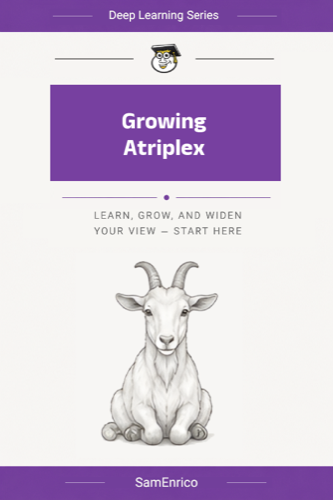
Growing Atriplex
This publication, published by SamEnrico, covers G
This publication, published by SamEnrico, covers Growing Atriplex
Formats
About this book
Free sample
Chapter 1: The Plant That Drinks Salt...--–- When most people hear the word "saltbush," they imagine a scraggly, half-dead weed clinging to the edge of a dusty road in some forgotten corner of the outback. They picture something goats might eat only when they are starving, a botanical afterthought that survives where nothing else will because it is too stubborn to die. That image is not wrong, but it is tragically incomplete. It is like looking at a solar panel and calling it a shiny rock, or watching a surgeon perform a heart transplant and describing it as someone poking around with scissors. The truth about Atriplex—the genus of plants known collectively as saltbush—is far stranger, far more sophisticated, and far more valuable than any roadside weed could ever suggest.This book is not about a plant that simply tolerates hardship.
It is about a plant that has evolved to exploit hardship, to turn the very conditions that destroy other plants into a competitive advantage. Atriplex does not just survive in saline, arid, degraded soils. It thrives there because it has developed biological machinery that would be the envy of any agricultural engineer. While alfalfa wilts and wheat burns and native grasses retreat, saltbush stands firm, its silver-grey leaves shimmering in the heat, actively pulling moisture from the air, excreting salt through specialized cells, and building deep root systems that can reach water tables ten meters below the surface. This is not a survivor.
This is a conqueror.The timing of this book could not be more critical. Across every continent except Antarctica, the same pattern is unfolding. Ancient aquifers are being depleted faster than they can recharge. Topsoil is eroding at rates that should terrify any civilization that depends on agriculture. Rising sea levels are pushing saltwater into coastal farmland, rendering millions of hectares increasingly marginal.
Desertification—the slow, creeping transformation of productive land into barren waste—now affects more than two billion hectares of land globally, an area roughly twice the size of China. In the American Southwest, Lake Mead has fallen to levels not seen since…
This is the end of the free sample. Get the eBook to keep going. Buy now
Contents
- Chapter 1
- Chapter 2
- Chapter 3
- Chapter 4
- Chapter 5
- Chapter 6
- Chapter 7
- Chapter 8
- Chapter 9
- Chapter 10
- Chapter 11
- Chapter 12
Details
- Author
- Ellington Hae
- Publisher
- SamEnrico
- Language
- English
- Genre
- Non-Fiction, Informative, Educational
- Released
- 2026-06-02
- Pages (approx.)
- 146
- Available as
- eBook, Audiobook

Read better in the ZLOADR app
Your eBooks on your phone or tablet. Sign in with your SamEnrico account and start reading.
More by Ellington Hae
 Gambling Addiction and Divorce RecoveryEllington Hae$11.99
 The Assertive Professional Training CourseEllington Hae$11.99
 Stimulant Use in Indigenous CommunitiesEllington Hae$11.99
 Passive Partner Anger ManagementEllington Hae$11.99
 HIIT for Knee Pain GuideEllington Hae$11.99
 Fluid and ElectrolytesEllington Hae$11.99
 Child Fire Death GriefEllington Hae$11.99
 Pregnancy Loss for GrandparentsEllington Hae$11.99
 The Great Unraveling: How the 2008 Financial Crisis Reshaped DemocracyEllington Hae$11.99
 The Bloodline of Command: How Genetics Shaped WWI's Great GeneralsEllington Hae$11.99
 How to Start a Airbags for Motor Vehicle Business (Beginners Guide)Ellington Hae$11.99
 How to Produce Motor Vehicle Airbag PartsEllington Hae$11.99