
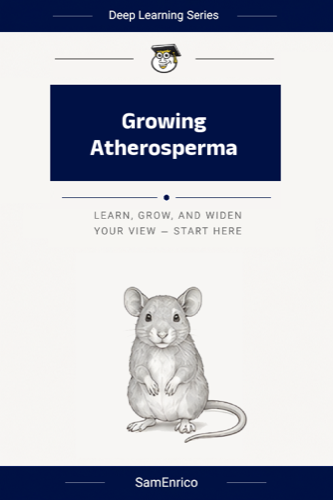
Non-FictionInformativeEducational
Growing Atherosperma eBook
This publication, published by SamEnrico, covers G
This publication, published by SamEnrico, covers Growing Atherosperma
Formats
Free sample
Chapter 1: The Survivor’s Secret...--Every morning for the past eleven years, Margaret Chen has walked past a tree that should not exist. The tree stands in the dappled shade of her suburban Melbourne backyard, a mere twelve kilometers from the city’s bustling center, its glossy, toothed leaves catching the early light like polished emeralds. In winter, its branches erupt in creamy, star-shaped flowers that smell of nutmeg and cloves—a fragrance so unexpected in the urban landscape that neighbors have been known to stop mid-stride, sniffing the air like dogs catching a scent. Margaret did not plant this tree. She did not import it from a specialty nursery or germinate it from hard-won seed.
She inherited it from the previous homeowner, a quietly eccentric botanist who died without leaving notes, labels, or any record of what he had placed in the ground. For more than a decade, Margaret has cared for this tree without knowing exactly what it was—only that it was beautiful, that it survived her neglect, and that it bloomed when everything else in the garden was gray and dormant.When I first met Margaret during my research for this book, she handed me a cutting in a Ziploc bag, its stem still damp from her kitchen sink. “I’ve been calling it my mystery laurel,” she said, shrugging. “The man who lived here before was from Tasmania. He used to talk about ‘the old forests.’ I never really listened.” She laughed, then added, almost as an afterthought: “Last winter, we had that freak frost—minus seven.
The gardenia died. The camellias dropped every bud. This one didn’t even notice.”That last sentence stopped me cold. Because what Margaret did not know—what she could not have known—is that the tree in her backyard is Atherosperma moschatum, the Black Sassafras, a species that textbooks describe as “frost tender,” “limited to cool temperate rainforests,” and “unsuitable for inland gardens.” By every conventional measure, that tree should have perished in the frost that killed her gardenia. And yet, there it stood, thriving, blooming, keeping its secret.Margaret’s tree is not a fluke.
It is a signpost.This book began as a simple gardening guide to a little-known Australian native. But the deeper I dug into the scientific literature, spoke with botanists, visited private collectors, and interviewed gardeners like Margaret, the more I realized that Atherosperma moschatum is not merely a plant to be grown. It is a living lesson in resilience, a botanical rebel that refuses to read the same climate maps as the rest of us. And in an era of rising temperatures, erratic frosts, and collapsing ecosystems, that rebellion matters more than you might think.What This Tree Is (And What It Is Not)Before we go any further, we need to clear up a fundamental confusion. The name “Black Sassafras” has been applied to at least four different trees on three continents, and confusing one for another can lead to spectacular gardening failures.
If you have ever grown the North American sassafras (Sassafras albidum)—the tree whose roots flavor traditional root beer and whose leaves turn brilliant orange in autumn—you have not grown Atherosperma. The two are not even distant cousins. They belong to different plant families, occupy different ecological niches, and have almost opposite cultivation requirements.Let me be explicit: Atherosperma moschatum is a member of the Atherospermataceae family, a small lineage of flowering trees and shrubs restricted entirely to the southern hemisphere. Its closest relatives live in Chile, Argentina, New Zealand, and New Caledonia—remnants of the ancient supercontinent Gondwana, which began breaking apart more than 80 million years ago. The North American sassafras, by contrast, belongs to the Lauraceae family (the same family as avocados, cinnamon, and bay laurel) and has been separated from Atherosperma for at least 120 million years of evolutionary history.
They are as different as a kangaroo and a deer—superficially similar in some respects, but fundamentally distinct.The other common points of confusion include the Brazilian sassafras (Ocotea pretiosa), which produces a commercially valuable essential oil called sassafras oil (now restricted due to safrole content), and the Chinese sassafras (Sassafras tzumu), a rare tree from central China that is sometimes cultivated as an ornamental. Neither is Atherosperma. And crucially, neither shares the Black Sassafras’s specific adaptation to cool, wet, temperate rainforest conditions.So why do they share the same name? The answer is chemistry. All of these plants contain aromatic compounds—primarily safrole, but also methyleugenol, camphor, and various terpenes—that produce a distinctive scent reminiscent of nutmeg, cloves, or root beer.
When European botanists first encountered Atherosperma in Tasmania in the early 19th century, they noted the familiar fragrance and reached for the nearest available name. It was a mistake, but one that has stuck for two hundred years.What does this mean for you, the gardener? It means that if you have read a book about growing North American sassafras (which tolerates drought, likes full sun, and can sucker aggressively) and assumed those same techniques would work for Black Sassafras, you are in for a disappointment. The two trees are not interchangeable. This entire book exists because Atherosperma requires its own set of rules, its own microclimates, its own patience.The Gondwanan Inheritance: Why This Tree Matters Let me take you back to a world you have never seen.
Ninety million years ago, during the Late Cretaceous period, the southern supercontinent of Gondwana still existed in roughly its full form. It was a world of towering conifers, primitive flowering plants, and the first stirrings of what would become the modern temperate rainforests. Dinosaurs still walked the earth, but so did the ancestors of Atherosperma—small, aromatic trees growing in the understory of vast forests that stretched from what is now Australia through Antarctica to South America.As Gondwana fragmented, so did its plant communities. Antarctica froze. Australia drifted north, becoming drier and hotter.
South America developed the Andes, creating rain shadows and new ecological barriers. And yet, Atherosperma and its relatives persisted in the wet, cool refugia that remained—the cloud forests of Tasmania, the temperate rainforests of southern Chile (home to the related Laureliopsis philippiana), the misty highlands of New Caledonia. These are not trees of easy places. They are trees of edges, of pockets, of microclimates carved out by topography and ocean currents.Understanding this evolutionary history is not an academic exercise. It is the key to every practical decision you will make in growing this plant.Consider the concept of a “refugium” (plural: refugia).
In biology, a refugium is an area where a population of organisms survives during a period of unfavorable conditions—an ice age, a drought, a shift in climate. Refugia are characterized by stable microclimates, often created by geographic features: deep valleys, south-facing slopes (in the northern hemisphere), caves, or the lee sides of mountains. Atherosperma has spent millions of years evolving to thrive precisely in these refugial conditions—not because it is weak or demanding, but because refugia are where its ancestors survived while less adaptable species went extinct.This refugial heritage explains almost everything about the plant’s cultivation needs:It requires stable moisture because refugia rarely experience…
This is the end of the free sample. Get the eBook to keep going. Buy now
About this book
Details
- Author
- Jefferies Jonah
- Publisher
- SamEnrico
- Language
- English
- Genre
- Non-Fiction, Informative, Educational
- Released
- 2026-05-18
- Pages (approx.)
- 143
- Available as
- eBook, Audiobook

Read better in the ZLOADR app
Your eBooks on your phone or tablet. Sign in with your SamEnrico account and start reading.
More by Jefferies Jonah
 Gambling Addiction Medication OptionsJefferies Jonah$11.99
 Stimulant Use and Sex WorkJefferies Jonah$11.99
 Overdose Child Death GriefJefferies Jonah$11.99
 Notion Databases for Project TrackingJefferies Jonah$11.99
 Delirium Tremens ProtocolJefferies Jonah$11.99Delirium Tremens ProtocolJefferies Jonah$11.99
 Gambling Addiction And Social IsolationJefferies Jonah$11.99
 HIIT for Seniors GuideJefferies Jonah$11.99
 Pregnancy Loss and TherapyJefferies Jonah$11.99
 The Timbuktu Tandem: A Love Letter to Mathematics and the MindJefferies Jonah$11.99
 How to Produce an ExplosiveJefferies Jonah$11.99
 How to Produce Atv Motor OilJefferies Jonah$11.99
You may also like
 Hong Kong Handover 1997Dunn Johnnie$11.99
 Zumba For Postnatal Recovery CourseNeal Christian$11.99
 Zumba for BeginnersLadner Nikia$11.99
 YouTube Comment Mining GuideHumes Pandora$12.99
 Worry Box MeditationCarlin Rudy$11.99
 Workplace Stress MeditationNguyen Lynn$11.99
 Workplace Stress and Sleep RepairHawley Ivory$11.99
 Workplace Perfectionism CureDelaney Jeffry$11.99
 Workplace Injustice Anger GuideWallen Isabelle$11.99
 Work Addiction and Burnout LinkGreenwood Ester$11.99
 Women in Yoga and WellnessBeattie Galina$11.99
 Women in Stand Up ComedyChun Evangeline$11.99