
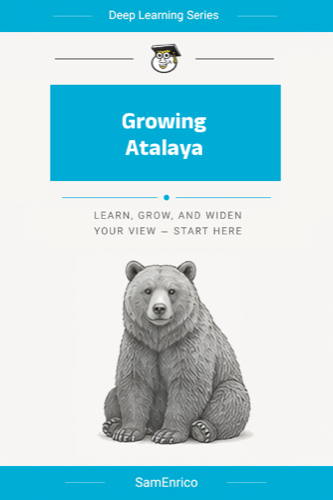
Non-FictionInformativeEducational
Growing Atalaya eBook
This publication, published by SamEnrico, covers G
This publication, published by SamEnrico, covers Growing Atalaya
Formats
Free sample
Chapter 1: The Extinction That Wasn't...–- On a humid Miami morning in 1979, a lepidopterist named Dr. Thomas Emmel walked past a suburban garden and stopped dead. Tucked among the leathery fronds of an ancient cycad, he spotted a flash of crimson and jet black—a caterpillar he had only ever seen in museum drawers. The Atala butterfly (Eumaeus atala), officially declared extinct for nearly a decade, was very much alive, chewing its way through someone's landscaping. That moment of disbelief would ripple through the scientific community and eventually transform how thousands of gardeners think about extinction, abundance, and the responsibilities of stewardship.The story of the Atala's disappearance began long before that Miami morning.
It started with a plant that had survived the asteroid that killed the dinosaurs: the Coontie, Zamia integrifolia, the only cycad native to the eastern United States. For millennia, this ancient plant grew in dense colonies across Florida's sandy scrublands, from the Panhandle down to the Everglades. Its roots were tough, its leaves leathery, and its seeds encased in bright orange flesh that warned of toxins within. It was not a plant that invited intimacy. But it held a secret that would nearly destroy it.The Coontie's underground stem—technically a caudex, a swollen storage organ—contained starch.
Not ordinary starch, but a carbohydrate that, when carefully processed through repeated washing to remove water-soluble toxins, could be ground into a nutritious flour. Indigenous peoples of Florida had used this flour for centuries, calling the plant conti or coonti. They harvested sustainably, taking only what they needed, allowing the slow-growing cycads to regenerate over years.Then came the settlers. Then came industry. Then came the starch factories.By the late 1800s, commercial operations were strip-mining Coonties from Florida's wildlands, grinding entire plants—roots, stems, and all—into a starch sold as "Florida arrowroot." It was a booming business.
One factory alone processed fifty tons of Coontie roots per week. The plants had no defense against this scale of destruction. Cycads grow slowly, taking five to seven years to reach maturity from seed. They could not outpace the industrial appetite.Within decades, wild Coontie populations collapsed across most of their range. The plant that had survived ice ages and asteroid impacts was being pushed toward regional extinction by the humble demand for baking thickeners and medicinal poultices.And when the Coontie went, the Atala went with it.The Silent Extinction The Atala butterfly had never been common in the way that monarchs or swallowtails are common.
It was a specialist, a species that had evolved in such tight lockstep with its host plant that it could not survive without it. The female Atala does not lay eggs on just any plant. She does not sample alternatives. She smells the specific chemistry of Zamia integrifolia through receptors on her antennae, and if that chemistry is absent, she flies on. There is no backup.
There is no plan B.When the Coontie disappeared from the landscape, the Atala had nowhere to go. The last confirmed sighting in the early 20th century faded into memory. By the 1970s, the United States Fish and Wildlife Service and the Florida Department of Agriculture were using the same grim phrase: "presumed extinct." Museums kept their pinned specimens behind glass. Textbooks listed the Atala alongside the passenger pigeon and the Carolina parakeet as a cautionary tale.But extinction, it turns out, is a word that sometimes arrives too early.The Garden That Refused to Forget The Coontie had not been completely eradicated. It had retreated—to remote hammocks, to protected preserves, to the occasional backyard of a gardener who appreciated its prehistoric form.
Nurserymen had kept the plant in cultivation, not because they knew about the butterfly, but because the cycad's architectural fronds added texture to landscapes. A few thousand plants survived in human care, scattered across South Florida like seeds in a forgotten drawer.Those plants were the Atala's resurrection.No one knows exactly when or how the first female found her way back. Perhaps she emerged from a remnant population in the Bahamas, riding trade winds across the Gulf Stream. Perhaps she had been hiding all along in the last wild stands of Coontie in the Everglades, overlooked by scientists who had already written her obituary. The most likely explanation is simpler: as suburban gardeners began planting Coonties in the 1980s and 1990s, they inadvertently created a network of habitat islands.
The butterfly, never truly gone, simply expanded from its last refuges when the food supply returned.What we know for certain is that by the mid-1990s, Atala sightings were no longer remarkable. By the early 2000s, they were common. By 2010, they were a nuisance.Yes, a nuisance. The butterfly that had been declared extinct had become, in the words of one exasperated Miami gardener, "a green-eating machine that won't stop reproducing."From Rarity to Overabundance This is the strange, almost ironic arc of the Atala's story: the butterfly went from being so rare that scientists doubted its existence to being so common that gardeners begged for solutions to control it. In less than two decades, the population exploded from a handful of individuals to millions.The reasons for this explosion are rooted in the very biology that once made the Atala vulnerable.
Specialists are efficient. An Atala female does not waste time searching for the right host plant—she knows it instantly. She does not sample inferior options. She finds a Coontie, and she lays eggs. And because she has been shaped by evolution to maximize her reproductive output in a landscape where host plants are scarce, she is capable of laying sixty, seventy, even eighty eggs in her brief adult life.In a wild landscape with scattered Coonties, this strategy makes sense.
Most eggs will be eaten by predators. Most caterpillars will never reach adulthood. The plant can support the few that survive.But in a suburban garden—in a landscape where predators have been reduced by human activity, where Coonties are planted in clusters, where there are no natural checks—that same strategy becomes catastrophic. Sixty eggs become sixty caterpillars. Those caterpillars eat.
They grow. They molt. They eat more. Within ten days, sixty caterpillars have consumed hundreds of leaves. And then they pupate, emerge as adults, mate, and each of those sixty females lays another sixty eggs.
In one month, a single female's lineage can produce over three thousand caterpillars.The garden does not have three thousand leaves.This is the central paradox of modern Atala gardening: success creates catastrophe. If you plant Coonties, the butterflies will come. If they come, they will lay eggs. If you do nothing, the eggs will hatch, and the caterpillars will eat every leaf in sight. And then they will starve.
Not slowly, not peacefully, but en masse, clinging to bare stems, desperately searching for food that no longer exists.The Myth of "More Butterflies Is Better"Walk into any butterfly garden center, pick up any introductory book on butterfly gardening, and you will hear the same message: plant host plants, avoid pesticides, and let nature take its course. The implied promise is that if you create the right conditions, the butterflies will come…
This is the end of the free sample. Get the eBook to keep going. Buy now
About this book
Details
- Author
- Gallardo Leia
- Publisher
- SamEnrico
- Language
- English
- Genre
- Non-Fiction, Informative, Educational
- Released
- 2026-05-11
- Pages (approx.)
- 132
- Available as
- eBook, Audiobook

Read better in the ZLOADR app
Your eBooks on your phone or tablet. Sign in with your SamEnrico account and start reading.
More by Gallardo Leia
 Gambling Addiction and ADHD ConnectionGallardo Leia$11.99
 Cocaine Use in Restaurant IndustryGallardo Leia$11.99
 Adult Child Loss GriefGallardo Leia$11.99
 Trello Power Ups Mastery GuideGallardo Leia$11.99
 Polydrug Detox StrategyGallardo Leia$11.99
 HIIT for Moms GuideGallardo Leia$11.99
 Online Fighting De escalationGallardo Leia$11.99
 Baby Loss Support Groups OnlineGallardo Leia$11.99
 The Silent Code: How a 19th-Century Spy Ring Shaped Modern CryptographyGallardo Leia$11.99
 The Ionian Gambit: Athens' Doomed Naval Gambit in the Peloponnesian WarGallardo Leia$11.99
 A Collector's Handbook to the Renault 4lGallardo Leia$11.99
 How to Produce EnginesGallardo Leia$11.99
You may also like
 Hong Kong Handover 1997Dunn Johnnie$11.99
 Zumba For Postnatal Recovery CourseNeal Christian$11.99
 Zumba for BeginnersLadner Nikia$11.99
 YouTube Comment Mining GuideHumes Pandora$12.99
 Worry Box MeditationCarlin Rudy$11.99
 Workplace Stress MeditationNguyen Lynn$11.99
 Workplace Stress and Sleep RepairHawley Ivory$11.99
 Workplace Perfectionism CureDelaney Jeffry$11.99
 Workplace Injustice Anger GuideWallen Isabelle$11.99
 Work Addiction and Burnout LinkGreenwood Ester$11.99
 Women in Yoga and WellnessBeattie Galina$11.99
 Women in Stand Up ComedyChun Evangeline$11.99