
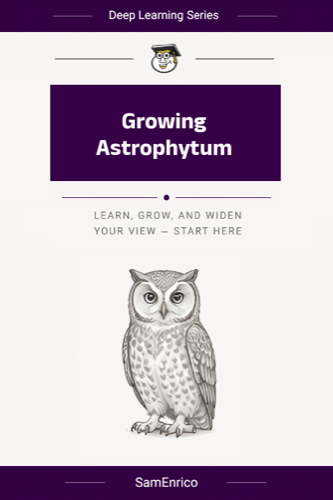
Non-FictionInformativeEducational
Growing Astrophytum eBook
This publication, published by SamEnrico, covers G
This publication, published by SamEnrico, covers Growing Astrophytum
Formats
Free sample
Chapter 1: The Star Within...--The first time I held an Astrophytum, I nearly dropped it.Not because it was heavy — it weighed less than a coffee mug — but because my fingers, wrapped in three layers of folded newspaper, could not find a safe place to grip. The body was a perfect, spineless dome of deep green, stitched with five precise ribs and dusted with white flecks like a constellation mapped onto a living stone. Beneath my tentative touch, it felt cool and impossibly firm, more like river-smoothed marble than anything that breathed. And yet, it was alive. Somewhere inside that armored geometry, unseen and silent, water moved through vascular tissues, cells divided, and a taproot no thicker than a pencil thread pushed deeper into its gritty soil.
The shopkeeper, an elderly Japanese man who had grown cacti for fifty years, watched my fumbling with quiet amusement. "You are nervous," he said. "This is good. Nervous means you understand. This plant will outlive you.
Do not kill it in the first month."I bought it anyway — a small Astrophytum asterias, barely three centimeters across, labeled only with a handwritten price tag and the words "Super Kabuto." That was eighteen years ago. The plant still sits on my greenhouse bench, now the size of a grapefruit, its flecking so dense that the green beneath is barely visible. It has survived overwatering, underwatering, a spider mite infestation, a cracked pot, and one memorable winter when I forgot to close the greenhouse vent and the temperature dropped to -3°C (27°F). It has rewarded me with dozens of yellow flowers, hundreds of seeds, and a quiet lesson that I have spent this entire book trying to articulate: Astrophytum are not difficult to grow. They are simply unforgiving of haste.This chapter is about why that lesson matters.
Before we mix a single gram of soil, before we discuss grafting knives or grow lights or the precise alkalinity of limestone-infused water, we must first understand what an Astrophytum is — not just botanically, but culturally, historically, and emotionally. The genus Astrophytum represents a unique intersection of natural wonder and human obsession. Few plants have inspired such dedicated devotion. Fewer still have survived centuries of collection pressure, habitat destruction, and the strange, almost fetishistic admiration of Japanese bonsai masters who elevated a desert cactus into a living art form. To grow Astrophytum well, you must first understand the star within — the ancient lineage, the hard-won survival strategies, and the peculiar beauty that has captivated collectors from Victorian England to modern-day Instagram.The Naming of Stars The story begins in 1839, not in a Mexican desert but in a Parisian herbarium.
Charles Lemaire, a Belgian botanist with a gift for taxonomy and a weakness for dramatic nomenclature, found himself examining a dried specimen collected two years earlier by Henri Guillaume Galeotti, a French-born botanist who had been tramping through the semi-desert highlands of San Luis Potosí. The specimen was unlike any cactus Lemaire had seen. Most cacti of the time — the ones Europeans knew — were spiny, sprawling, and vaguely threatening. This one had no spines to speak of. Its body was divided into five prominent, wing-like ribs that radiated from the apex like the points of a compass rose.
And scattered across its surface were tiny, woolly flecks that caught the light like dust on a mirror.Lemaire named it Echinocactus myriostigma — "spiny cactus with a thousand spots" — and thought little more of it. But within a decade, other explorers sent back similar specimens: one with long, twisting spines (Echinocactus capricornis), one with a flatter, sea-urchin shape (Echinocactus asterias), and one towering specimen with brilliant yellow flowers (Echinocactus ornatus). It was clear to subsequent botanists that these plants belonged together, distinct from the broader Echinocactus genus. In 1922, the American botanist Nathaniel Lord Britton and his collaborator Joseph Nelson Rose formally erected the genus Astrophytum, from the Greek astron (star) and phyton (plant). The name was perfect.
When viewed from above, each plant's ribs create a star-shaped silhouette — a celestial geometry pressed into the dust of northern Mexico.Today, after nearly two centuries of revision, debate, and DNA sequencing, the genus contains six accepted species. They are, in order of discovery:Astrophytum myriostigma — the Bishop's Cap, named for its resemblance to a cleric's mitre. Usually spineless, usually five-ribbed, always covered in white flecks. The most variable species, with forms ranging from perfectly columnar to strangely lumpy. This is the species that started everything.Astrophytum ornatum — the Monk's Hood.
The largest of the genus, capable of reaching one meter (three feet) in height in cultivation. The only species that reliably produces yellow flowers even in less-than-ideal conditions. Covered in yellow spines that age to brown. The tough one — the species you give to beginners who have killed everything else.Astrophytum capricorne — the Goat's Horn, named for its long, twisting, sexually suggestive spines. These spines can grow to ten centimeters (four inches), curling back toward the body like rams' horns.
The flowers are spectacular — pure yellow with blood-red centers. This species hybridizes freely with myriostigma, producing some of the most desirable cultivars in the Japanese tradition.Astrophytum asterias — the Star Cactus, or, colloquially, the Sea Urchin. No spines. Flat, dome-shaped body with six to eight ribs. The most coveted species in cultivation, particularly the Japanese-bred 'Super Kabuto' form with its impossibly dense, symmetrical flecking.
Also the most difficult to keep alive — rot-prone, light-sensitive, and agonizingly slow. This is the species that separates casual growers from collectors.Astrophytum coahuilense — the late bloomer, not formally distinguished from asterias until the 1920s. It looks nearly identical but grows in a different region (Coahuila, not Texas) and has subtle differences: more ribs (typically six to eight, like asterias, but arranged more evenly), larger flowers, and a greater tolerance for cold and humidity. The collector's trick: coahuilense has flecks that form distinct bands or rings, while asterias has flecks scattered randomly.Astrophytum caput-medusae — the Medusa's Head. Discovered in 2002, this species upended everything taxonomists thought they knew about the genus.
It has no ribs. Instead, it produces long, twisting, snake-like tubercles that rise from a central caudex (a swollen root-stem). A central cephalium — a woolly, bristly structure — produces pinkish-yellow flowers. Some botanists argued it deserved its own genus. DNA said otherwise: it's an Astrophytum, albeit the strangest one by far.Six species.
That is the entire genus. Fewer than the number of oak trees in a single city park, fewer than the number of orchid hybrids registered in a single year. And yet, within those six botanical categories, there exists infinite variation. No two Astrophytum are identical. The white flecks — actually clusters of microscopic, water-absorbing trichomes — arrange themselves in patterns as unique as fingerprints.
Spine length varies from zero to ten centimeters. Rib count can shift from four to ten, sometimes on the same plant over its lifetime. Body color ranges from pale gray-green to deep forest green to, in rare chlorotic mutants, a sickly but beautiful yellow. This variability is the engine of collector obsession. If you want identical plants, grow clones.
If you want surprises, grow Astrophytum from seed.The White Flecking: More Than Decoration Those white flecks — the "thousand spots" that so impressed Lemaire —…
This is the end of the free sample. Get the eBook to keep going. Buy now
About this book
Details
- Author
- Coffman Florentina
- Publisher
- SamEnrico
- Language
- English
- Genre
- Non-Fiction, Informative, Educational
- Released
- 2026-05-11
- Pages (approx.)
- 158
- Available as
- eBook, Audiobook

Read better in the ZLOADR app
Your eBooks on your phone or tablet. Sign in with your SamEnrico account and start reading.
More by Coffman Florentina
 Methamphetamine in Construction TradeCoffman Florentina$11.99
 Child Death Grief WorkbookCoffman Florentina$11.99
 Asana Workflow Automation BlueprintCoffman Florentina$11.99
 HIIT for Busy ProfessionalsCoffman Florentina$11.99
 Alcohol Withdrawal MedicationsCoffman Florentina$11.99
 Anger Safety Plan CreationCoffman Florentina$11.99
 Baby Footprint and HandprintCoffman Florentina$11.99
 The Tsar's Golden Age: Catherine the Great and the Enlightenment of RussiaCoffman Florentina$11.99
 The Archimedes Principle: Unlocking the Depths of the MediterraneanCoffman Florentina$11.99
 A Collector's Handbook to the Renault 4cvCoffman Florentina$11.99
 How to Produce Energy Saving Equipment PartsCoffman Florentina$11.99
 Student Tax Return Europe GuideCoffman Florentina$12.99
You may also like
 Hong Kong Handover 1997Dunn Johnnie$11.99
 Zumba For Postnatal Recovery CourseNeal Christian$11.99
 Zumba for BeginnersLadner Nikia$11.99
 YouTube Comment Mining GuideHumes Pandora$12.99
 Worry Box MeditationCarlin Rudy$11.99
 Workplace Stress MeditationNguyen Lynn$11.99
 Workplace Stress and Sleep RepairHawley Ivory$11.99
 Workplace Perfectionism CureDelaney Jeffry$11.99
 Workplace Injustice Anger GuideWallen Isabelle$11.99
 Work Addiction and Burnout LinkGreenwood Ester$11.99
 Women in Yoga and WellnessBeattie Galina$11.99
 Women in Stand Up ComedyChun Evangeline$11.99