
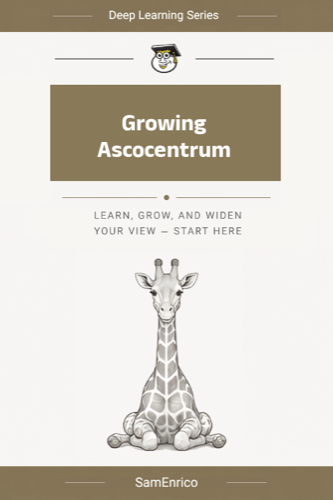
Non-FictionInformativeEducational
Growing Ascocentrum eBook
This publication, published by SamEnrico, covers G
by Massey Ollie
This publication, published by SamEnrico, covers Growing Ascocentrum
Formats
Free sample
Chapter 1: Ghosts of the Monsoon...–- The first thing you must understand about Ascocentrum is that it does not belong to you. It belongs to the wind-scoured ridgelines of the Cardamom Mountains, to the limestone karsts that punch through the haze of northern Thailand, and to the brief, furious violence of the Asian monsoon. Every plant you will ever hold in a slatted wooden basket carries the genetic memory of a place where roots cling to bare rock and leaves drink mist instead of rain. To grow this orchid well, you must first abandon the fiction of the windowsill as a neutral space. You are not cultivating a plant.
You are recreating a ghost habitat—a thin slice of Southeast Asian sky trapped inside your greenhouse, your sunroom, or your grow tent. And that ghost is demanding.The great secret of the vandaceous orchids—the secret that separates those who merely keep Ascocentrum alive from those who force them to erupt in pillars of orange and magenta—is that these plants were never designed for human convenience. They evolved in a world of extremes: drenching rains that last for weeks, followed by dry spells that crack the bark of the trees they cling to. They adapted to light so intense that most orchids would bleach and wither. They learned to store water in leaves as thick as a hunting knife and to photosynthesize through roots that dangle in open air like green question marks.
Every decision you make as a grower—where to place the plant, what to attach it to, when to water and when to withhold—either honors that evolutionary legacy or fights against it. Most failures begin not with pests or disease, but with a quiet act of domestication: the belief that an orchid will adapt to you.The Geography of Memory Before we discuss culture, before we discuss fertilizer ratios or the precise lux requirements that will make your eyes glaze over, we must first walk the ridges where Ascocentrum still grows wild. Not because you need to visit these places—though you should, if you ever have the chance—but because the plant's physical form is a written history of its habitat. You cannot understand why an Ascocentrum refuses to bloom under a tree canopy. You cannot understand why its roots rot in standard potting mix.
You cannot understand why the leaves fold along their central crease when the air grows dry. All of these traits are answers to specific environmental questions that the plant has been asking for millions of years.The genus Ascocentrum—and yes, we will use the horticultural name throughout this book, despite the taxonomists who have folded it into Vanda, because growers speak a different language than herbarium curators—inhabits a narrow band of Southeast Asia. From the eastern foothills of the Himalayas in India and Myanmar, across the mountainous spine of Thailand, through Laos and Vietnam, and down into the Philippine archipelago, these plants stake their claim to the most contested real estate in the orchid world: the bright, airy margins where monsoon forests give way to open sky. Unlike their larger cousins in the Vanda genus, which often grow high in the canopy where light filters through leaves, Ascocentrum species tend to occupy the lower branches of open woodlands, the exposed faces of limestone cliffs, and even the bare twigs of deciduous trees that lose their leaves entirely during the dry season. This is not a shade plant.
This is not a plant that tolerates competition. This is a botanical sun-worshipper that has carved out a niche in the spaces where other orchids cannot survive.Consider the three most widely cultivated species, each a variation on a theme. Ascocentrum curvifolium, named for its recurved, sickle-shaped leaves, grows in the dry deciduous forests of Myanmar and northern Thailand. Its leaves curl downward naturally—an adaptation that channels water toward the roots while reducing surface area exposed to the midday sun. The flowers, a deep orange that borders on vermilion, emerge in tight cylindrical racemes that can hold fifty or more individual blooms.
Ascocentrum miniatum, the smallest of the genus, barely reaches six inches in height at maturity, yet produces proportionally enormous spikes of bright orange-red flowers that seem too large for the plant. This species grows on exposed limestone in the Philippines, where it endures months of drought followed by typhoon-driven rain. Ascocentrum ampullaceum, the most robust of the three, ranges from India to Nepal to northern Thailand, producing variable flower colors from pale pink to deep purple. Notice the pattern: every species comes from a place with a pronounced dry season. Every species has adapted to store water in thick, succulent leaves.
Every species has evolved to flower in response to a specific environmental trigger—usually the first rains after a dry spell or the lengthening days that signal the end of winter.These are not accidents of evolution. These are survival strategies that you must either replicate or circumvent. And the growers who achieve the most spectacular results are those who learn to read the plant's responses as a form of botanical language. When the leaves of an Ascocentrum develop a reddish tinge, the plant is not sick. It is producing anthocyanin pigments to protect itself from what it perceives as excessive light—a sign that you have pushed it close to its upper tolerance.
When the roots turn silvery-green instead of bright green, the plant is signaling that it needs water. When the leaf tips turn black and papery, you have over-fertilized or allowed mineral salts to accumulate. Every symptom is a sentence. Every recovery is a translation.The Victorian Obsession The Western discovery of Ascocentrum follows a familiar pattern in orchid history: a European plant hunter, often working for a wealthy aristocrat or a commercial nursery, stumbles upon a plant so alien and beautiful that it ignites a collecting frenzy. The first Ascocentrum species to reach European greenhouses was A.
ampullaceum, introduced from India in the 1830s by the East India Company's network of amateur botanists. For decades, it was lumped under various Vanda or Saccolabium names, its true identity obscured by the taxonomic limitations of the era. Only in 1913 did the German botanist Rudolf Schlechter recognize that these plants formed a distinct group, characterized by their short stems, dense inflorescences, and the unique structure of their labellum. He named the genus Ascocentrum—from the Greek askos (a leather bag or wineskin) and kentron (a spur)—referring to the pouch-like spur at the base of the flower.The Victorian orchid growers were not merely collectors. They were experimentalists working without the benefit of tissue culture, artificial lighting, or synthetic fertilizers.
They grew Ascocentrum in hot, humid greenhouses heated by coal-fired boilers, often with disastrous results. Some succeeded through sheer luck and careful observation. Others failed and blamed the plants. The literature from this period is filled with contradictory advice: one authority insists that Ascocentrum must be grown in sphagnum moss packed tightly into clay pots; another argues that the plants will rot unless mounted on cork slabs with almost no media at all. Both were correct, within their specific contexts.
The moss-grown plants survived in dry, drafty greenhouses where the sphagnum retained moisture between waterings. The mounted plants thrived in…
This is the end of the free sample. Get the eBook to keep going. Buy now
About this book
Details
- Author
- Massey Ollie
- Publisher
- SamEnrico
- Language
- English
- Genre
- Non-Fiction, Informative, Educational
- Released
- 2026-06-03
- Pages (approx.)
- 147
- Available as
- eBook, Audiobook

Read better in the ZLOADR app
Your eBooks on your phone or tablet. Sign in with your SamEnrico account and start reading.
More by Massey Ollie
 Retirement Income Drawdown PlanMassey Ollie$11.99
 Teen Aesthetic Self WorthMassey Ollie$11.99
 Voice Actor Thrill Ride MemoirMassey Ollie$11.99
 Meth Recovery TimelineMassey Ollie$11.99
 Incline HIIT GuideMassey Ollie$11.99
 Emotional Regulation for PMDDMassey Ollie$11.99
 Anger After Loss and GriefMassey Ollie$11.99
 Baby Shower After Pregnancy LossMassey Ollie$11.99
 The Gold Heist of the Soninke: The Grand Loot of the Wadjan EmpireMassey Ollie$11.99
 The Fire and Wisdom of the Axumite Philosophers: Igniting the Spark of KnowledgeMassey Ollie$11.99
 SMS Onboarding for Freemium UsersMassey Ollie$12.99
 Danish Student Job HandbookMassey Ollie$12.99
You may also like
 Hong Kong Handover 1997Dunn Johnnie$11.99
 Zumba For Postnatal Recovery CourseNeal Christian$11.99
 Zumba for BeginnersLadner Nikia$11.99
 YouTube Comment Mining GuideHumes Pandora$12.99
 Worry Box MeditationCarlin Rudy$11.99
 Workplace Stress MeditationNguyen Lynn$11.99
 Workplace Stress and Sleep RepairHawley Ivory$11.99
 Workplace Perfectionism CureDelaney Jeffry$11.99
 Workplace Injustice Anger GuideWallen Isabelle$11.99
 Work Addiction and Burnout LinkGreenwood Ester$11.99
 Women in Yoga and WellnessBeattie Galina$11.99
 Women in Stand Up ComedyChun Evangeline$11.99