
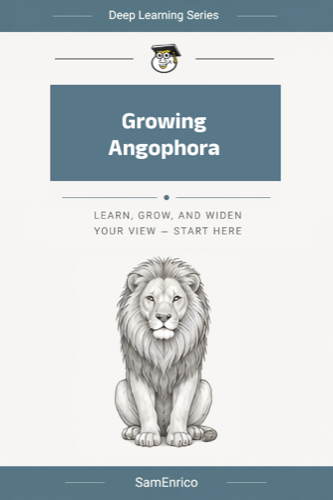
Non-FictionInformativeEducational
Growing Angophora eBook
This publication, published by SamEnrico, covers G
This publication, published by SamEnrico, covers Growing Angophora
Formats
Free sample
Chapter 1: Beyond the Gum Tree…––Most people, when they picture an Australian native tree, see a eucalyptus. They imagine the ghost gums of the outback, the peppermint trees of the cool temperate forests, or the towering blue gums of commercial plantations. But there is a quieter, more ancient, and in many ways more forgiving relative that has been hiding in plain sight for centuries. Its bark peels in ribbons of salmon and cream. Its leaves grow in perfect opposite pairs, like clasped hands.
Its flowers explode in soft white clouds when most other trees are dormant. And yet, ask a hundred gardeners to name it, and ninety-nine will draw a blank. This is the Angophora – the "other" eucalypt, the forgotten apple, the smooth-barked sentinel of eastern Australia’s waterways and ridges. This book exists because the Angophora deserves more than a footnote in botanical texts. It deserves a place in your garden, your street, and your imagination.The journey of understanding Angophora begins with a single, liberating realization: this is not a difficult tree.
Unlike many of its fussy eucalyptus cousins that sulk in rich soil, drop limbs without warning, or resent the slightest root disturbance, Angophoras are remarkably adaptable. They are the golden retrievers of the Australian myrtle family – eager, resilient, and rewarding. But like any good companion, they have preferences. Ignore their need for sun and drainage, and they will languish. Understand their quirks – the opposite leaves, the absence of a bud cap, the urn-shaped fruit that holds seeds for years – and you unlock a tree that can outlive you, outshine your ornamentals, and outpollinate your bee garden.
This chapter lays the foundation for everything that follows. It is not a dry botanical key. It is an invitation to see Angophora as a living being with needs, gifts, and a story worth telling.The Apple Deception: Why Settlers Got It Wrong (And Why It Matters)Let us address the elephant in the room – or rather, the apple. When the First Fleet’s botanists and convicts stumbled upon the rugged sandstone ridges around Sydney Cove in 1788, they saw trees with rough, fissured bark and broad, leathery leaves. To their European eyes, these trees vaguely resembled the apple orchards of Kent and Somerset.
They called them “apples” – the Smooth-barked Apple, the Dwarf Apple, the Rough-barked Apple. It was a name born of homesickness, not horticulture. Because an Angophora produces no apple. No fruit at all, in fact, that any human would want to eat. What it produces are woody, ribbed capsules that look like tiny urns or upside-down bells.
Inside those urns are tiny, papery seeds with a single wing – designed not for mammalian consumption but for wind dispersal. The “apple” name stuck, but it has caused centuries of confusion. Gardeners plant Angophoras expecting autumn harvests. Children ask when the fruit will ripen. The answer is never.
And that is precisely the point.This misnomer matters for a practical reason. It reveals that Angophoras are not production trees. They are not grown for timber (though their wood is dense and beautiful), not grown for fruit, and not grown for quick profit. They are grown for beauty, for shade, for biodiversity, and for the sheer pleasure of watching a living sculpture change over decades. The “apple” name also obscures their true kinship.
Angophora, Eucalyptus, and Corymbia (the bloodwoods) all belong to the myrtle family, Myrtaceae. But Angophora stands apart in three visible ways. First, its leaves are opposite – meaning they emerge in pairs directly across from each other on the stem – rather than alternate like eucalyptus leaves. Second, its flowers lack the distinctive operculum, or bud cap, that eucalyptus flowers pop off when they bloom. Third, its seed capsules are ribbed and angular, not smooth and hemispherical.
These are not trivial differences. They are clues to the Angophora’s evolutionary path – a path that favored resilience over rapid growth, and longevity over quick colonization.The Nine Sisters: A Tour of the Genus Before you can grow Angophora, you must choose which Angophora. The genus is modest by Australian standards – only about nine to twelve recognized species, depending on which taxonomist you consult, and all of them endemic to eastern Australia. Their range stretches from the tropical humidity of far north Queensland down to the cool tablelands of Victoria and even into Tasmania’s milder pockets. No Angophora is native to Western Australia, South Australia, or the Northern Territory.
If you live in Perth or Adelaide, you will be growing a visitor, not a native. That is fine – Angophoras are adaptable – but it means you must pay extra attention to water and soil.The nine species fall into three rough categories: the large stately trees, the medium garden specimens, and the rare or regionally restricted treasures. Let me introduce you to them as you would a new neighbor – by name, personality, and preferred habitat.First, the heavyweights. Angophora costata – the Smooth-barked Apple, also known as the Sydney Red Gum – is the rock star of the genus. It grows to 20-30 meters in its natural habitat, though in gardens it often stays closer to 15-20.
Its bark is the headline act: smooth as polished marble, shedding in large flakes to reveal a fresh layer of salmon pink, then fading to grey before shedding again. The effect is a trunk that looks airbrushed – a constantly changing canvas of cream, rose, and charcoal. A. costata is also the most forgiving of the large species, tolerating poor soils, moderate drought, and even light coastal salt spray. But it demands space.
Plant it within 6 meters of your house or driveway, and you will eventually have a conversation with a chainsaw. Its roots are not aggressively invasive – nothing like a fig or a poplar – but its trunk swells dramatically with age, and surface roots can lift paving over decades.Second, the cold specialist. Angophora floribunda – the Rough-barked Apple – is the species for gardeners who shiver through winter. It grows to 15-25 meters, with persistent fibrous bark that never sheds. The flowers are among the most profuse of any Angophora, turning the canopy white in December and January (or June and July in the Northern Hemisphere).
A. floribunda is the only species that reliably survives frosts down to -5°C (23°F) for short periods. It is the Angophora for Canberra, for the NSW tablelands, for Tasmania’s sheltered valleys, and for anyone in USDA zone 8b who dreams of an Australian native.Third, the small garden savior. Angophora hispida – the Dwarf Apple – is the species that makes this book possible for suburban gardeners. In its natural form, it reaches 7-10 meters – still a small tree by Angophora standards.
But here is the secret that most books miss: A. hispida responds magnificently to coppicing. If you cut it back to a 30-centimeter stump every 2-3 years, it regenerates as a multi-stemmed shrub, never exceeding 4-5 meters. This is not a dwarf cultivar. It is an active management technique, and it works because A.
hispida has a prominent lignotuber – a woody swelling at the base that stores energy and dormant buds. Fire in the bush triggers the same response. Your pruning shears are just a controlled substitute. For gardeners with…
This is the end of the free sample. Get the eBook to keep going. Buy now
About this book
Details
- Author
- Matthews Lonnie
- Publisher
- SamEnrico
- Language
- English
- Genre
- Non-Fiction, Informative, Educational
- Released
- 2026-06-02
- Pages (approx.)
- 131
- Available as
- eBook, Audiobook

Read better in the ZLOADR app
Your eBooks on your phone or tablet. Sign in with your SamEnrico account and start reading.
More by Matthews Lonnie
 Stress Sleep Deprivation CycleMatthews Lonnie$11.99
 Stress Reduction for MemoryMatthews Lonnie$11.99
 Step Work Journaling For Twelve Step Recovery CourseMatthews Lonnie$11.99
 Team OKR Facilitation GuideMatthews Lonnie$11.99
 Bounty Hunters for Equifax HackersMatthews Lonnie$11.99
 Goal Setting for Personal GrowthMatthews Lonnie$11.99
 The Remote Induction ProtocolMatthews Lonnie$11.99
 Suicide and DepressionMatthews Lonnie$11.99
 The Great Penguin Rescue: Operation SnowstormMatthews Lonnie$11.99
 The Flying Scotsman: The Unstoppable Season That Redefined CricketMatthews Lonnie$11.99
 How to Produce Yoga and Pilates BlocksMatthews Lonnie$11.99
 How to Produce Mildew RemoverMatthews Lonnie$11.99
You may also like
 Hong Kong Handover 1997Dunn Johnnie$11.99
 Zumba For Postnatal Recovery CourseNeal Christian$11.99
 Zumba for BeginnersLadner Nikia$11.99
 YouTube Comment Mining GuideHumes Pandora$12.99
 Worry Box MeditationCarlin Rudy$11.99
 Workplace Stress MeditationNguyen Lynn$11.99
 Workplace Stress and Sleep RepairHawley Ivory$11.99
 Workplace Perfectionism CureDelaney Jeffry$11.99
 Workplace Injustice Anger GuideWallen Isabelle$11.99
 Work Addiction and Burnout LinkGreenwood Ester$11.99
 Women in Yoga and WellnessBeattie Galina$11.99
 Women in Stand Up ComedyChun Evangeline$11.99