
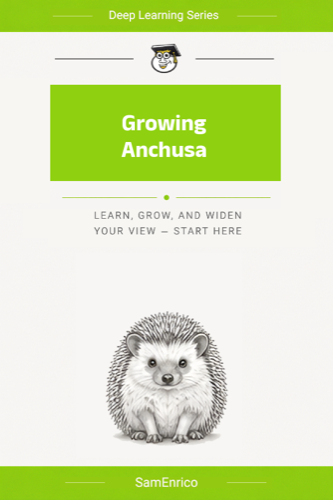
Non-FictionInformativeEducational
Growing Anchusa eBook
This publication, published by SamEnrico, covers G
by Newsom Ines
This publication, published by SamEnrico, covers Growing Anchusa
Formats
Free sample
Chapter 1: The Weed That Wasn't...--Walking through the gardens of a sixteenth-century English manor, you would have found Anchusa growing not in the wild margins where it is often relegated today, but in the carefully tended physic garden alongside lavender, rosemary, and sage. The herbalist would have called it "alkanet" or "bugloss," and she would have valued its deep red root as highly as any imported spice. Four hundred years later, that same plant appears on noxious weed lists in American counties, its very name a warning to gardeners. What happened? How did a plant prized by Tudor dyers and celebrated by Greek botanists become a botanical pariah?
The answer reveals less about Anchusa itself and more about our changing relationship with plants that refuse to beg for our attention.This chapter serves as your complete botanical introduction to the genus Anchusa — a group of roughly thirty-five species within the Boraginaceae family, which also includes borage, comfrey, forget-me-nots, and lungwort. By the time you finish these pages, you will understand not only how to identify the major species but why this plant's very biology has been misunderstood. You will learn to see Anchusa not as a weed but as what it truly is: a resilient, generous, and historically significant plant that asks for almost nothing and gives nectar, dye, and beauty in return. Most importantly, you will understand the controversy surrounding its cultivation and, armed with that knowledge, make an informed decision about whether Anchusa belongs in your garden.The Name Tells a Story: Anchusa Through Language Before we examine leaves and flowers, consider the name itself. Anchusa derives from the Greek word anchousa, meaning "to paint" or "to stain." This is not a reference to the blue flowers that catch the eye, but to the taproot hidden beneath the soil.
When bruised or cut, that root exudes a thick, reddish-brown juice that stains fingers, cloth, and wood with remarkable tenacity. The Greek physician Dioscorides, writing in the first century CE, described this property in his monumental work De Materia Medica, noting that the root "being applied with wax takes away rough nails and foul scars." He also recorded its use as a dye for wool and leather, a practice already ancient by his time.The common name "alkanet" arrives through a different linguistic path. It comes from the Arabic al-henna, a reference to the plant's use as a dye similar to true henna (Lawsonia inermis), though the two plants are entirely unrelated. Spanish alcana, Italian alcanna, and Old French alkanet all trace to this Arabic root. The persistence of the name across languages and centuries testifies to the plant's enduring economic importance.
When a name survives the rise and fall of empires, the plant it describes has served human needs across cultures and generations.The common name "bugloss" — applied to several Anchusa species, particularly A. officinalis — comes from the Greek bous (ox) and glossa (tongue), referring to the rough, tongue-shaped leaves. Medieval herbalists saw in the leaf's texture a signature of its use: rough leaves for rough throats. This doctrine of signatures, though scientifically discarded, gave us some of our most enduring plant names and associations.Understanding the names matters because names carry assumptions. When a county weed board labels Anchusa arvensis as a noxious invader and an organic gardener celebrates Anchusa azurea as a pollinator magnet, they are often discussing the same genus with different assumptions.
This book works from a simple premise: no plant is a weed by nature. A plant becomes a weed only when it grows where a human does not want it. Anchusa is no more inherently problematic than a rose that spreads beyond its bed — and far easier to control.Entering the Boraginaceae: Family Resemblances To understand Anchusa, we must first understand its family. The Boraginaceae is a large and diverse family containing approximately 2,000 species across 150 genera. They share several distinguishing characteristics, and learning to recognize these family traits will help you not only identify Anchusa but distinguish it from look-alikes — a skill of particular importance given the safety considerations covered in Chapter 9.The most immediately noticeable trait is the leaves.
Boraginaceae leaves are almost always rough, hairy, and somewhat prickly to the touch. This texture comes from stiff, multicellular trichomes — hair-like structures that protect the plant from herbivores and reduce water loss. Run your fingers along a borage leaf, a comfrey leaf, or an Anchusa leaf, and you will feel the same sandpaper-like texture. In Anchusa, these trichomes are particularly pronounced on the lower leaves, giving the plant a gray-green cast from a distance.The flowers tell a different story. In almost all Boraginaceae species, flowers emerge from coiled, scorpion-like clusters called cymes.
As the coil unfurls from the tip downward, flowers open in sequence, creating a distinctive flowering pattern. Individual flowers are usually funnel-shaped or tubular, with five petals fused at the base. While borage and forget-me-nots also display this structure, Anchusa flowers tend to be larger and more intensely colored than most family members — a key identification point.The fruit is another family marker. Boraginaceae produces four nutlets per flower, each containing a single seed. These nutlets are often hard, smooth, or ornamented depending on the species.
In Anchusa, the nutlets are typically rough-textured and brown at maturity, and they scatter near the parent plant — the mechanism behind the plant's spread, which we will address thoroughly in Chapter 10.One cautionary note before we proceed: The Boraginaceae family also contains plants with documented toxicity, particularly regarding pyrrolizidine alkaloids. Comfrey (Symphytum officinale), a beloved garden herb, has been the subject of safety concerns for this reason. Anchusa contains lower levels of these compounds than comfrey, but the presence of toxic relatives means that positive identification of your plants matters. Chapter 9 provides a complete visual guide to distinguishing Anchusa from its potentially hazardous cousins.The Thirty-Five Species: A Genus Overview The genus Anchusa contains approximately thirty-five species distributed across Europe, Asia, and Africa, with the greatest diversity in the Mediterranean region. They occupy a wide range of habitats — from coastal dunes to mountain meadows, from roadside ditches to cultivated fields — but they share a preference for full sun and well-drained soil.Most species fall into one of two life cycle patterns.
Biennial species germinate and produce a rosette of leaves in their first year, then flower, set seed, and die in their second year. Perennial species return year after year, though individual plants may become less vigorous after three to five years and benefit from replacement. Some species, particularly in cultivation, blur this distinction, behaving as short-lived perennials that self-seed so readily that the gardener perceives them as perennials even though individual plants complete their cycle in two years.For the home gardener, three species deserve particular attention. Each offers different characteristics in terms of size, bloom time, hardiness, and garden use.Anchusa officinalis: The Common Alkanet A. officinalis is the species most frequently encountered in older botanical literature and the one most often referred to simply as "alkanet" or "common bugloss." It is a biennial or short-lived perennial, typically reaching twelve to twenty-four inches in height, with a branching habit that produces multiple flower stems from a central rosette.The flowers are a deep, true…
This is the end of the free sample. Get the eBook to keep going. Buy now
About this book
Details
- Author
- Newsom Ines
- Publisher
- SamEnrico
- Language
- English
- Genre
- Non-Fiction, Informative, Educational
- Released
- 2026-05-11
- Pages (approx.)
- 149
- Available as
- eBook, Audiobook

Read better in the ZLOADR app
Your eBooks on your phone or tablet. Sign in with your SamEnrico account and start reading.
More by Newsom Ines
 Making Amends Step Nine Recovery HandbookNewsom Ines$11.99
 Resilience Building AffirmationsNewsom Ines$11.99
 Forgiveness Therapy WorkbookNewsom Ines$11.99
 Goal Setting for SleepNewsom Ines$11.99
 Parent Loss and DepressionNewsom Ines$11.99
 Lawrence Krauss BioNewsom Ines$11.99
 Phishing Attack That Started YahooNewsom Ines$11.99
 Anniversary of SuicideNewsom Ines$11.99
 The Teahouse of the Singing Cranes: Japan's Forgotten Melodic RevolutionNewsom Ines$11.99
 The Butcher of Toronto: Canada's Forgotten Victorian CannibalNewsom Ines$11.99
 How to Produce Microphone StandsNewsom Ines$11.99
 How to Produce WristbandsNewsom Ines$11.99
You may also like
 Hong Kong Handover 1997Dunn Johnnie$11.99
 Zumba For Postnatal Recovery CourseNeal Christian$11.99
 Zumba for BeginnersLadner Nikia$11.99
 YouTube Comment Mining GuideHumes Pandora$12.99
 Worry Box MeditationCarlin Rudy$11.99
 Workplace Stress MeditationNguyen Lynn$11.99
 Workplace Stress and Sleep RepairHawley Ivory$11.99
 Workplace Perfectionism CureDelaney Jeffry$11.99
 Workplace Injustice Anger GuideWallen Isabelle$11.99
 Work Addiction and Burnout LinkGreenwood Ester$11.99
 Women in Yoga and WellnessBeattie Galina$11.99
 Women in Stand Up ComedyChun Evangeline$11.99