
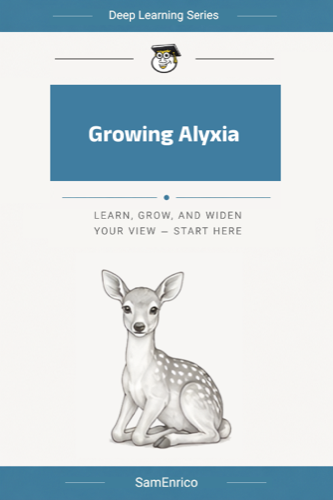
Non-FictionInformativeEducational
Growing Alyxia eBook
This publication, published by SamEnrico, covers G
by Wolfe Barry
This publication, published by SamEnrico, covers Growing Alyxia
Formats
Free sample
Chapter 1: The Chain Unbroken...--The first time you hold an Alyxia seed in your palm, you are holding a contradiction. It is small—smaller than a peppercorn—and yet it carries within its brown, papery coat the genetic memory of ancient rainforests stretching from the lowland hills of the Himalayas to the salt-scoured cliffs of New Caledonia. It is a seed that demands patience, refusing to germinate for months, sometimes longer. And when it finally does send up its first pair of leaves—glossy, dark, impossibly perfect—you will understand why the genus Alyxia has seduced plant collectors for over two centuries.This chapter is the foundation upon which every subsequent page of this book rests. Before you learn to water, prune, propagate, or landscape with Alyxia, you must first understand what this plant is.
Where did it come from? How is it classified? What distinguishes one species from another? And—most critically for the gardener standing in a nursery or scrolling through an online seed catalog—which species is right for your specific conditions, goals, and patience level?We will begin with the botanical blueprint: the taxonomic classification that places Alyxia within the larger Apocynaceae family, alongside familiar ornamentals like oleander and plumeria. From there, we will travel across the globe, mapping the native habitats that have shaped this genus into the resilient, fragrant, and visually striking plant it is today.
We will meet the three key species that dominate cultivation—A. ruscifolia, A. buxifolia, and A. spicata—and learn how to tell them apart not just by appearance but by growth habit, environmental tolerance, and ornamental value. Finally, we will explore the practical implications of those growth habits, because a plant that wants to scramble over a six-foot trellis will fare very differently in a two-gallon pot on a city balcony.By the end of this chapter, you will not simply know about Alyxia.
You will understand it. And that understanding will transform you from a gardener who follows instructions into a grower who makes informed decisions.The Family Tree: Apocynaceae and the Genus Alyxia Every plant tells a story of kinship. The genus Alyxia belongs to the family Apocynaceae, a name derived from the Greek apokynon meaning "away from dog" —a reference to the family's historical (and often inaccurate) reputation for toxicity to canines. The Apocynaceae family is vast, comprising over 4,500 species spread across 415 genera. It includes plants as diverse as the frangipani (Plumeria), the oleander (Nerium oleander), the Madagascar periwinkle (Catharanthus roseus), and the hoya vines beloved by indoor gardeners.What unites this seemingly disparate family?
Several shared characteristics. Most Apocynaceae produce a milky, often latex-like sap when cut—though Alyxia is an exception, producing clear sap instead. The family is also characterized by opposite or whorled leaves (a trait we will examine closely in Alyxia), and flowers with five petals that are often fused into a distinctive "pinwheel" or "propeller" shape. If you have ever examined an oleander flower up close, you have seen the structural blueprint that Alyxia follows, albeit on a more delicate and fragrant scale.Within Apocynaceae, Alyxia belongs to the subfamily Rauvolfioideae and the tribe Alyxieae. This places it near genera such as Pteralyxia (a Hawaiian endemic) and Chilocarpus (a Southeast Asian climber).
The tribe is distinguished by fruit structure—specifically, the formation of paired drupes that resemble a chain, from which the genus derives its name.The genus Alyxia was first formally described by Robert Brown in his 1810 work Prodromus Florae Novae Hollandiae. Brown, one of the most significant botanists of his era, based his description on specimens collected during his voyage to Australia with Matthew Flinders. He noted the unusual fruit structure immediately: a string of two to six fleshy drupes, each containing a single seed, connected in a linear arrangement like beads on a necklace. He named the genus from the Greek alysis, meaning "chain" or "bond"—a reference so apt that it has survived two centuries of taxonomic revision.Today, depending on which taxonomist you consult, the genus Alyxia contains between 80 and 120 species. The exact number fluctuates as botanists reclassify regional variants and as new species are discovered in remote rainforests.
What is not in dispute is the genus's geographic range, which is both broad and fragmented in ways that tell a fascinating evolutionary story.Native Lands: From the Himalayas to the Pacific Close your eyes and imagine the places where Alyxia grows wild. You might picture the misty highlands of the Himalayas, where Alyxia stellata scrambles over moss-covered boulders at 2,500 meters elevation. Or the lowland rainforests of Queensland, Australia, where Alyxia ruscifolia forms dense thickets along creek banks, its white flowers perfuming the humid air after summer rains. Or the wind-blasted coastlines of New Caledonia, where Alyxia buxifolia hunkers against the spray, its leathery leaves defying salt and drought.The native range of Alyxia stretches in a broad arc from the Indian subcontinent through Southeast Asia, across the Malay Archipelago, into Australia and New Guinea, and eastward across the Pacific Islands to Hawaii and the Marquesas. This distribution pattern—known to biogeographers as the "Malesian" distribution—suggests an ancient lineage that predates many of the geological and climatic events that have shaped the modern Pacific.Let us break this range down region by region.The Himalayas and Mainland Asia: Several Alyxia species, most notably A.
stellata and A. sinensis, are found from Nepal and Bhutan eastward through northeastern India, Myanmar, Thailand, Laos, and into southern China (Yunnan and Guangxi provinces). These are primarily forest-dwelling species, growing in the understory of subtropical broadleaf forests at elevations ranging from 500 to 2,500 meters. They experience distinct wet and dry seasons, with monsoon rains from May to September and cooler, drier conditions for the remainder of the year. For the gardener, this means these species can tolerate a wider range of seasonal moisture fluctuations than their purely tropical cousins.Southeast Asia and the Malay Archipelago: The islands of Sumatra, Borneo, Java, Sulawesi, and the Philippines host a stunning diversity of Alyxia species, many of which remain poorly known to Western horticulture.
These equatorial species grow in lowland and hill rainforests, where temperatures remain consistently warm (70–85°F year-round) and rainfall exceeds 100 inches annually. They are adapted to constant humidity and rich, well-drained volcanic soils. In cultivation, these species are the most demanding, requiring carefully controlled conditions that mimic their native cloud forests.Australia: The Australian species of Alyxia are the most frequently cultivated worldwide, and for good reason. Alyxia ruscifolia (the common chain fruit) and Alyxia buxifolia (the sea box) are found along the eastern and southern coasts of the continent, from northern Queensland down to Victoria and across to South Australia. Their habitats range from subtropical rainforests to dry sclerophyll woodlands to exposed coastal heathlands.
This diversity of habitats has produced plants with remarkable environmental tolerance. A. ruscifolia thrives in everything from full sun to deep shade, from sandy loams to clay-rich soils. A. buxifolia is even more adaptable, surviving salt spray, gale-force winds, and extended drought.
For the home gardener, the Australian species are the safest entry point into the genus.The Pacific Islands: Eastward from New Guinea, Alyxia species are found on New Caledonia, Vanuatu, Fiji, Samoa, Tonga, the Cook…
This is the end of the free sample. Get the eBook to keep going. Buy now
About this book
Details
- Author
- Wolfe Barry
- Publisher
- SamEnrico
- Language
- English
- Genre
- Non-Fiction, Informative, Educational
- Released
- 2026-06-03
- Pages (approx.)
- 149
- Available as
- eBook, Audiobook

Read better in the ZLOADR app
Your eBooks on your phone or tablet. Sign in with your SamEnrico account and start reading.
More by Wolfe Barry
 Twelve Step Answering Service VolunteerWolfe Barry$11.99
 Addressing A Coworker HabitWolfe Barry$11.99
 OKRs Objectives Key ResultsWolfe Barry$11.99
 Creative Block Self Talk RewiringWolfe Barry$11.99
 Philip Pullman BioWolfe Barry$11.99
 Goal Setting for NonprofitsWolfe Barry$11.99
 Equifax Outsourced Security AuditsWolfe Barry$11.99
 Dip Progression GuideWolfe Barry$11.99
 Wings of Defiance: The Secret Missions of the Tuskegee Airmen in EuropeWolfe Barry$11.99
 A Collector's Handbook to the Panther DevilleWolfe Barry$11.99
 Mailchimp Campaign Testing GuideWolfe Barry$12.99
 Ledge AI Trial Balance ReviewWolfe Barry$12.99
You may also like
 Hong Kong Handover 1997Dunn Johnnie$11.99
 Zumba For Postnatal Recovery CourseNeal Christian$11.99
 Zumba for BeginnersLadner Nikia$11.99
 YouTube Comment Mining GuideHumes Pandora$12.99
 Worry Box MeditationCarlin Rudy$11.99
 Workplace Stress MeditationNguyen Lynn$11.99
 Workplace Stress and Sleep RepairHawley Ivory$11.99
 Workplace Perfectionism CureDelaney Jeffry$11.99
 Workplace Injustice Anger GuideWallen Isabelle$11.99
 Work Addiction and Burnout LinkGreenwood Ester$11.99
 Women in Yoga and WellnessBeattie Galina$11.99
 Women in Stand Up ComedyChun Evangeline$11.99