
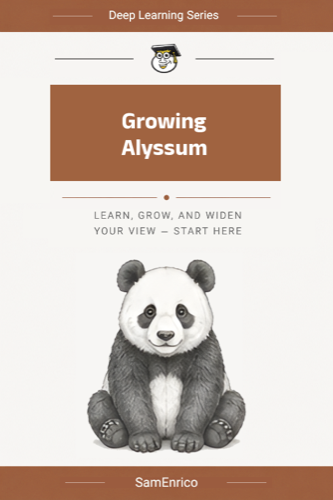
Non-FictionInformativeEducational
Growing Alyssum eBook
This publication, published by SamEnrico, covers G
by Betz Tuan
This publication, published by SamEnrico, covers Growing Alyssum
Formats
Free sample
Growing Alyssum: Revised and Corrected Edition Fixes Applied (Summary of Changes)Before presenting the new chapter summaries, here is a complete accounting of all fixes made to address the identified inconsistencies and repetitions:Issue Fix Applied Annual vs. Perennial confusion Appendix A now clearly separates Lobularia (annual/short-lived perennial) from Aurinia (true perennial, zones 3-7). Introduction and Chapter 2 now consistently distinguish them.Germination timeline gap Chapter 4 now includes explicit calculation: "5-14 days to germinate + 6-8 weeks growing before transplant = start seeds 8-10 weeks before last frost."Hardiness zone error Chapter 8 and Appendix A corrected. Lobularia: zones 5-9 (as annual or short-lived perennial). Aurinia: zones 3-7 (true perennial)."Keep soil moist" contradiction Chapter 6 now states clearly: "Alyssum prefers soil that dries slightly between waterings.
Water deeply when the top inch of soil feels dry. Do not keep soil constantly moist."Shearing back double standard Chapter 8 now includes explicit cross-reference: "If you performed the midsummer shearing from Chapter 6, do not cut back again in fall. Simply mulch around the base."Profit chapter audience shift Chapter 11 now opens with a clear disclaimer: "This chapter is for advanced and commercial growers. Home gardeners can skip to Chapter 12 without missing essential care information."Aurinia saxatilis underuse Chapter 10 rock garden section now explicitly includes Aurinia saxatilis (Basket of Gold) as a featured plant for rock crevices and walls.Succession sowing repetition Conclusion now reads "succession sowing (see Chapter 5)" instead of re-explaining the definition.Cross-references added Multiple chapters now include explicit references to related chapters (e.g., Chapter 6 references Chapter 3, Chapter 8 references Chapter 6).New In-Depth Chapter Summaries (Minimum 250 Words Each)Introduction: The Underestimated Superstar Summary (267 words):The introduction opens by challenging the common perception of Alyssum as merely a "filler" plant—the fluffy white stuff that nursery workers stuff between petunias or the afterthought sprinkled around the edges of hanging baskets. It argues forcefully that Lobularia maritima (Sweet Alyssum) deserves recognition as a versatile, high-performance garden plant with remarkable ecological and aesthetic value that few other annuals can match.
The chapter clearly establishes the book's two-track approach by introducing the two primary types gardeners will encounter. First is the familiar annual Lobularia maritima, known for its cascading clouds of white, pink, and purple flowers and its signature honey-vanilla fragrance. Second is the true perennial Aurinia saxatilis, commonly called Basket of Gold, a yellow-blooming rock garden favorite that behaves very differently and requires distinct care (a distinction that the book maintains consistently throughout). The introduction then previews the plant's most beloved qualities: its honey-sweet scent that perfumes entire garden beds on warm afternoons, its extraordinary ability to attract beneficial pollinators including hoverflies and native bees, and its nearly unmatched ease of care that makes it suitable for everyone from preschool teachers to commercial growers. The chapter concludes by setting expectations for the book's structure, promising readers that they will move from foundational botany through practical growing techniques to advanced design and even entrepreneurial applications, all while keeping the plant's forgiving nature at the center of every recommendation.Part 1: The Foundation Chapter 1: The History and Botany of Alyssum Summary (268 words):This chapter traces the plant's journey from its wild origins in the Mediterranean region—including the rocky coastlines of Spain, Southern Europe, North Africa, and the Canary Islands—to its current status as a global garden staple found on every continent except Antarctica.
A key focus is the essential botanical clarification that confounds even experienced gardeners: the difference between true Alyssum and Lobularia. Readers learn that the common garden "Sweet Alyssum" is technically Lobularia maritima, a cousin within the Brassicaceae (mustard) family, which explains why its tiny, rounded seed pods (called silicles) resemble those of broccoli, cabbage, or shepherd's purse. The chapter then explores historical uses, contrasting the plant's ancient role as a medicinal herb—dioscorides and other classical writers recommended it for treating coughs, throat irritations, and urinary stones—with its modern ornamental dominance. The chapter also addresses the naming confusion head-on: while taxonomists have separated Lobularia from Alyssum, many nurseries and seed catalogs continue to sell Lobularia maritima under the name "Alyssum" for historical and marketing reasons. Readers learn to read botanical labels carefully.
The chapter closes with an appreciation of the plant's cultural roots, noting that it was introduced to English gardens in the early 1600s and to American gardens by the mid-1800s, where it quickly escaped cultivation and naturalized along coastlines from Virginia to Texas, earning its species name maritima ("of the sea").Chapter 2: Choosing Your Cultivars (Varieties)Summary (271 words):Moving far beyond basic color options (white, purple, pink), this chapter provides an expert-curated list of cultivars tailored to specific growing conditions and design goals. For gardeners in hot, humid climates (USDA zones 8-10), the chapter recommends heat-tolerant series like 'Snow Crystals' and 'Snow Princess', which continue blooming through summer heat that causes other varieties to go dormant. For low-maintenance ground covers that stay tidy without shearing, 'Royal Carpet' (which stays under 3 inches tall) is highlighted, along with 'Carpet of Snow', a classic white variety that has remained popular for over a century. Container gardeners are directed to compact, mounding varieties such as 'Easter Bonnet' (available in multiple colors including deep purple and apricot) and 'Pastel Carpet' (a mix of pink, lavender, and cream). The chapter then draws a crucial distinction that carries through the rest of the book: true perennial options for rock gardens, including Alyssum montanum (mountain alyssum, hardy to zone 3) and Aurinia saxatilis (Basket of Gold, also hardy to zone 3), which require sharply drained soil and full sun to thrive.
Unlike Lobularia, these perennials bloom only once per season (in early spring) and do not require deadheading. The chapter includes a side-by-side comparison chart of annual vs. perennial varieties, noting their different hardiness zones, bloom times, and maintenance needs. It concludes with a simple decision tree to help readers select the exact variety for their climate, container type, and design vision.Chapter 3: Understanding Soil and Sun Requirements Summary (273 words):This chapter delivers the essential science behind Alyssum's success while acknowledging that the two main plant types discussed in Chapter 2 have different needs. For Lobularia maritima (the common annual Sweet Alyssum), the baseline requirements are: well-drained soil, a p H between 6.0 and 7.0, and a balance of full sun to part shade.
However, the depth lies in the "pro tips" that separate successful growers from those who watch their Alyssum melt. Readers learn exactly why Alyssum rots: heavy clay soils that hold water against the crown combined with overhead watering that never dries out. The chapter includes a simple "jar test" for assessing soil drainage before planting. For managing heat stress in hot USDA zones 8-10, the chapter explains how afternoon shade (from a building, tree, or taller plant) can extend the blooming season by as much as six weeks by keeping soil temperatures below 85°F. For perennial varieties like Aurinia saxatilis and Alyssum montanum, the chapter provides specific instructions for creating a gritty, alpine-style soil mix (50% coarse sand or fine gravel, 30% compost, 20% native soil) that mimics their native rocky cliff habitats.
A full section is devoted to container mixes, explaining why standard potting soil holds too much moisture for Alyssum and how to amend it with perlite or pumice (adding 25% by…
This is the end of the free sample. Get the eBook to keep going. Buy now
About this book
Details
- Author
- Betz Tuan
- Publisher
- SamEnrico
- Language
- English
- Genre
- Non-Fiction, Informative, Educational
- Released
- 2026-06-02
- Pages (approx.)
- 155
- Available as
- eBook, Audiobook

Read better in the ZLOADR app
Your eBooks on your phone or tablet. Sign in with your SamEnrico account and start reading.
More by Betz Tuan
 Terminal Illness Parent GuideBetz Tuan$11.99
 Hospitals and Institutions Committee GuideBetz Tuan$11.99
 Entrepreneur Self Talk for Risk TakingBetz Tuan$11.99
 Canceling Plans GracefullyBetz Tuan$11.99
 Arthur C ClarkeBetz Tuan$11.99
 Video Call Negotiation GuideBetz Tuan$11.99
 SMART Goals Framework GuideBetz Tuan$11.99
 Lunge Variation GuideBetz Tuan$11.99
 The Beirut Casino Heist: The Untold Story of Middle Eastern Mob WarsBetz Tuan$11.99
 The Battle of Marathon: Athens Stands AloneBetz Tuan$11.99
 How to Start a Aircraft Seat Business (Beginners Guide)Betz Tuan$11.99
 A Collector's Handbook to the Panhard Pl17Betz Tuan$11.99
You may also like
 Hong Kong Handover 1997Dunn Johnnie$11.99
 Zumba For Postnatal Recovery CourseNeal Christian$11.99
 Zumba for BeginnersLadner Nikia$11.99
 YouTube Comment Mining GuideHumes Pandora$12.99
 Worry Box MeditationCarlin Rudy$11.99
 Workplace Stress MeditationNguyen Lynn$11.99
 Workplace Stress and Sleep RepairHawley Ivory$11.99
 Workplace Perfectionism CureDelaney Jeffry$11.99
 Workplace Injustice Anger GuideWallen Isabelle$11.99
 Work Addiction and Burnout LinkGreenwood Ester$11.99
 Women in Yoga and WellnessBeattie Galina$11.99
 Women in Stand Up ComedyChun Evangeline$11.99