
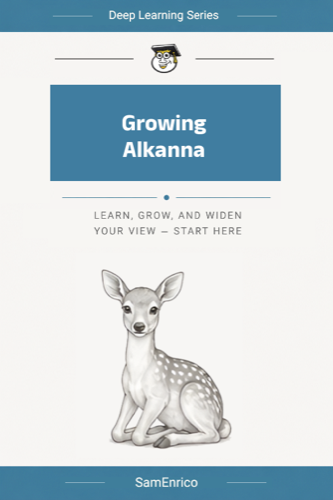
Non-FictionInformativeEducational
Growing Alkanna
This publication, published by SamEnrico, covers G
by Petrie Reyes
This publication, published by SamEnrico, covers Growing Alkanna
Formats
About this book
Free sample
Chapter 1: The Red Secret...–- On a hillside in Crete, where the limestone cliffs meet the Aegean Sea, a plant grows that has been staining human history red for over three thousand years. It requires no irrigation, no fertilizer, and no care. Yet its roots contain a pigment so valuable that pharmaceutical companies now pay more per pound than they do for saffron. This plant is Alkanna tinctoria – the dyer’s alkanet – and it holds a secret that most gardeners, farmers, and even botanists have overlooked.The secret is this: Alkanna does not want your help. It does not want rich soil, constant watering, or pampering.
Everything you have learned about gardening – compost, mulch, regular irrigation, fertile loam – is exactly the opposite of what this plant needs. Alkanna thrives on neglect, produces its deepest red under stress, and rewards the grower who understands that sometimes, the best thing you can do is nothing at all.This chapter introduces you to the plant itself: where it comes from, what makes it unique, and why understanding its botanical identity is the first and most critical step toward successful cultivation. By the end of this chapter, you will see Alkanna not as a difficult crop, but as a remarkably adapted survivor that has evolved to prosper exactly where other plants fail.The Taxonomy Trap: Why Names Matter Before you can grow a plant successfully, you must know what it actually is – not just its common name, but its place in the botanical order. Alkanna tinctoria belongs to the Boraginaceae family, a group of roughly 2,000 species that includes familiar garden plants like borage (Borago officinalis), comfrey (Symphytum officinale), forget-me-nots (Myosotis), and Virginia bluebells (Mertensia). The family name comes from the Latin borago, meaning “rough-haired,” a reference to the characteristic stiff, hairy leaves that define the group.If you run your finger along an alkanna leaf, you will feel those hairs immediately.
They are not just a botanical curiosity – they serve a purpose. The trichomes (hair-like structures) help the plant conserve moisture by trapping a layer of humid air against the leaf surface, reducing…
This is the end of the free sample. Get the eBook to keep going. Buy now
Contents
- Chapter 1
- Chapter 2
- Chapter 3
- Chapter 4
- Chapter 5
- Chapter 6
- Chapter 7
- Chapter 8
- Chapter 9
- Chapter 10
- Chapter 11
- Chapter 12
Details
- Author
- Petrie Reyes
- Publisher
- SamEnrico
- Language
- English
- Genre
- Non-Fiction, Informative, Educational
- Released
- 2026-05-11
- Pages (approx.)
- 149
- Available as
- eBook, Audiobook

Read better in the ZLOADR app
Your eBooks on your phone or tablet. Sign in with your SamEnrico account and start reading.
More by Petrie Reyes
 Grief and Doubt After Parent LossPetrie Reyes$11.99
 Twelve Step Sponsorship ExplainedPetrie Reyes$11.99
 Glycine for Growth HormonePetrie Reyes$11.99Glycine for Growth HormonePetrie Reyes$11.99
 Carl Sagan HumanismPetrie Reyes$11.99
 The Nonprofit Fellowship PathwayPetrie Reyes$11.99
 Quality Manual Documentation TemplatePetrie Reyes$11.99
 Gig Platform Customer ServicePetrie Reyes$11.99
 Social Security Numbers Exposed GuidePetrie Reyes$11.99
 Errol Morris: The Man Who Made the Unseen VisiblePetrie Reyes$11.99
 The Unbreakable Will: The Rise of Eliud Kipchoge’s Sub-2 MarathonPetrie Reyes$11.99
 How to Start a Cloth Embossing Business (Beginners Guide)Petrie Reyes$11.99
You may also like
 Hong Kong Handover 1997Dunn Johnnie$11.99
 Zumba For Postnatal Recovery CourseNeal Christian$11.99
 Zumba for BeginnersLadner Nikia$11.99
 YouTube Comment Mining GuideHumes Pandora$12.99
 Worry Box MeditationCarlin Rudy$11.99
 Workplace Stress MeditationNguyen Lynn$11.99
 Workplace Stress and Sleep RepairHawley Ivory$11.99
 Workplace Perfectionism CureDelaney Jeffry$11.99
 Workplace Injustice Anger GuideWallen Isabelle$11.99
 Work Addiction and Burnout LinkGreenwood Ester$11.99
 Women in Yoga and WellnessBeattie Galina$11.99
 Women in Stand Up ComedyChun Evangeline$11.99