
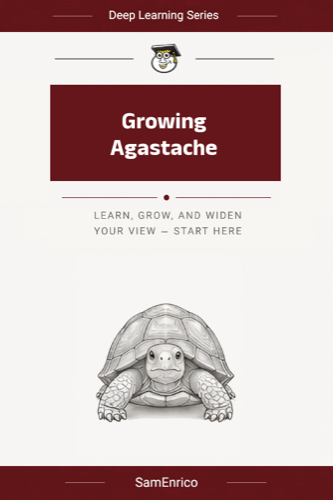
Non-FictionInformativeEducational
Growing Agastache eBook
This publication, published by SamEnrico, covers G
This publication, published by SamEnrico, covers Growing Agastache
Formats
Free sample
Chapter 1: The Forgotten Virtue--–- Every garden has a martyr. You know the one—the rose that demands weekly spraying, the tomato that succumbs to blight the moment you look away, the orchid that drops its blooms if you move it six inches to the left. We have been trained to believe that beautiful plants require suffering. Not the plant's suffering—yours.This book exists to introduce you to a different kind of relationship. Not the high-maintenance romance of the diva plant, but the quiet, steady friendship of a plant that asks for almost nothing and gives everything.
That plant is Agastache—though you may know it by one of its common names: Giant Hyssop, Hummingbird Mint, or the evocative "Texas Hummingbird Mint" for its southwestern cousins.Before we discuss how to grow Agastache—and we will, in exhaustive detail—we must first understand why this genus has remained in the shadows for so long. Because the story of Agastache is not merely a horticultural tale. It is a story about what we value, what we overlook, and what we stand to lose when we prioritize the difficult over the dependable.The question at the heart of this chapter is deceptively simple: Why has a plant this beautiful, this resilient, this ecologically valuable remained a secret?The Great Overlook Walk into any big-box garden center in April, and you will see the usual suspects. Rows of impatiens blushing in their pink plastic pots. Endless petunias in colors that seem designed by a committee of preschoolers.
Knockout roses by the hundreds, each one promising "easy beauty" while secretly demanding deadheading, fertilizing, and the precise application of fungicides at exactly the right moment.Somewhere, often in a forgotten corner near the perennial table, you might find a flat of Agastache. If you are lucky. More often, you will not find it at all. You will need to seek it out at a native plant nursery, order it from a specialty grower, or—as many of us do—start it from seed in a fit of late-winter optimism.Why is this plant so underrepresented in the mainstream garden trade? The answer is not botanical.
It is economic.The horticultural industry, like any industry, favors products that need to be replaced. A rose that succumbs to black spot? Buy another one next spring. An annual that freezes with the first frost? See you in April with your wallet open.
But a perennial Agastache that returns year after year, self-sows modestly, and asks for nothing? That is bad for repeat business.This is not conspiracy. This is commerce. The industry has optimized for plants that create dependency. Agastache, with its fierce independence, does not fit the model.There is a second reason for its obscurity: confusion.
Walk into that same garden center and ask for Agastache, and you will likely be met with a blank stare. Ask for Anise Hyssop, and the employee might point you toward the herb section. Ask for Hummingbird Mint, and they might send you to the annuals. The common names are a mess, and the botanical name—Agastache—sounds like something a doctor would diagnose rather than something you would plant for joy.This confusion extends to the plants themselves. Some Agastache species are native to the cold prairies of the northern United States and Canada.
Others evolved in the blistering heat of the Chihuahuan Desert. These two groups have radically different needs, yet they share a genus name. A gardener who buys a desert Agastache and plants it in heavy clay soil in rainy Seattle will watch it die and conclude, incorrectly, that all Agastache are fussy.We will untangle this confusion in the pages ahead. For now, understand this: Agastache is not a single plant with a single set of instructions. It is a genus of approximately twenty-two species, ranging from the prairie to the desert, from sea level to seven thousand feet, from the Canadian border to the mountains of Oaxaca.
Within that range lies a plant for almost every garden in North America—if you know which one to choose.A Portrait of Resilience Let us set aside the economics and the confusion for a moment and simply look at the plant.An Agastache in full bloom is a spectacle. The flowers are arranged in verticillasters—dense whorls stacked along a terminal spike like a tiered wedding cake. Each individual flower is tubular, two-lipped, and perfectly shaped for the long tongue of a hummingbird or the probing face of a bumblebee. The colors range from the deep lavender-blue of the prairie types to the electric orange and shocking pink of the desert hybrids. When backlit by the afternoon sun, the flower spikes appear to glow from within.The foliage is equally distinctive.
The leaves are opposite, serrated, and aromatic. Crush a leaf between your fingers, and you will release a scent that defies easy description. Depending on the species, you might smell anise, licorice, root beer, bubblegum, mint, or something that hovers between camphor and citrus. This scent is not a mere novelty; it is a sophisticated chemical defense system. The volatile oils that smell so delightful to us are the same compounds that repel deer, rabbits, and most insect pests.
The plant is fragrant because it is poisonous to its enemies.The root system is the real secret. Desert Agastache species send down a taproot that can reach eighteen inches or more—a probe searching for moisture in the most unforgiving conditions. Prairie species have a more fibrous root system, but they are no less determined. This deep rooting allows the plant to access water that never reaches the surface, which is why Agastache can remain green and blooming while surrounding plants wilt and brown.Above ground, the stems are square—a signature of the mint family, Lamiaceae—and range from eighteen inches to four feet or more, depending on the species and growing conditions. The plant's architecture is upright and airy, which means it does not smother its neighbors.
In a mixed border, Agastache acts as a vertical accent, a plume of color that rises above lower-growing companions.Bloom time is where Agastache truly distinguishes itself. Most perennials have a two-to-four-week window of glory, after which they retreat into vegetative obscurity. Agastache begins blooming in mid-summer—typically July—and continues unabated until the first hard frost. In mild climates, that can mean October or even November. A hundred days of continuous bloom is not an exaggeration; it is the standard.During those hundred days, the plant is a pollinator superhighway.
Hummingbirds visit the red and orange varieties with the single-minded focus of a commuter on a familiar route. Bumblebees work the blue and purple flowers methodically, moving from spike to spike with a hum that vibrates through the stems. Solitary bees—the mason bees, leafcutter bees, and sweat bees that receive far less attention than their honeybee cousins—crawl into the flowers and emerge dusted with pollen.One study conducted at Penn State University counted the pollinator visits to a single Agastache 'Blue Fortune' plant over a six-hour period. The number was 247. That is forty-one visitors per hour, nearly one every ninety seconds.
And this was not a particularly exceptional plant. It was a routine garden specimen doing what Agastache does every day…
This is the end of the free sample. Get the eBook to keep going. Buy now
About this book
Details
- Author
- Connors Daryl
- Publisher
- SamEnrico
- Language
- English
- Genre
- Non-Fiction, Informative, Educational
- Released
- 2026-06-02
- Pages (approx.)
- 148
- Available as
- eBook, Audiobook

Read better in the ZLOADR app
Your eBooks on your phone or tablet. Sign in with your SamEnrico account and start reading.
More by Connors Daryl
 Writing Goal SettingConnors Daryl$11.99
 Time Blocking GoalsConnors Daryl$11.99
 Restaurant Dividend StocksConnors Daryl$11.99
 The Distraction Proof Parent GuideConnors Daryl$11.99
 Nonprofit Culture Shock Survival GuideConnors Daryl$11.99
 Meth Sexual DysfunctionConnors Daryl$11.99
 Grief and Medication After Child LossConnors Daryl$11.99
 Burnout Recovery Gratitude PracticeConnors Daryl$11.99
 The Oxford Conspiracy: Scholars, Spies, and the Birth of Modern ScienceConnors Daryl$11.99
 Odysseus Unbroken: The Mentor’s Last LessonConnors Daryl$11.99
 How to Produce Medical Cryogenic EquipmentConnors Daryl$11.99
 How to Produce Wiring AccessoriesConnors Daryl$11.99
You may also like
 Hong Kong Handover 1997Dunn Johnnie$11.99
 Zumba For Postnatal Recovery CourseNeal Christian$11.99
 Zumba for BeginnersLadner Nikia$11.99
 YouTube Comment Mining GuideHumes Pandora$12.99
 Worry Box MeditationCarlin Rudy$11.99
 Workplace Stress MeditationNguyen Lynn$11.99
 Workplace Stress and Sleep RepairHawley Ivory$11.99
 Workplace Perfectionism CureDelaney Jeffry$11.99
 Workplace Injustice Anger GuideWallen Isabelle$11.99
 Work Addiction and Burnout LinkGreenwood Ester$11.99
 Women in Yoga and WellnessBeattie Galina$11.99
 Women in Stand Up ComedyChun Evangeline$11.99