
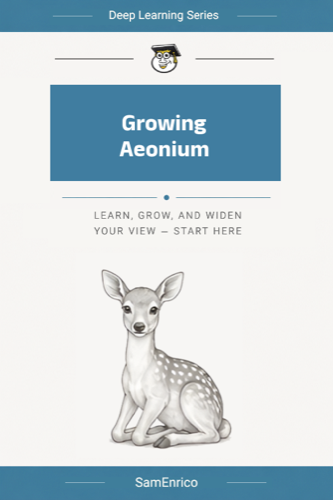
Non-FictionInformativeEducational
Growing Aeonium eBook
This publication, published by SamEnrico, covers G
This publication, published by SamEnrico, covers Growing Aeonium
Formats
Free sample
Chapter 1: The Volcano’s Gift...--The first time I saw an Aeonium in its natural habitat, I almost walked past it.I was hiking along a crumbling volcanic ridge on Tenerife, the largest of the Canary Islands, my eyes scanning the ground for the usual suspects of dry-climate botany—spiny Euphorbias, hardy Verode shrubs, the occasional prickly pear cactus that had naturalized so thoroughly it seemed ancient. The sun was punishing, the air tasted of salt and basalt dust, and every plant I'd seen for the past hour had been armored, thorny, or aggressively adapted to scarcity. I was looking for desert plants. I expected desert plants.What I found, tucked into a north-facing crevice where the morning fog lingered longer than anywhere else on that exposed ridge, was something entirely different.A rosette of fleshy, lime-green leaves, perfectly flat as if pressed by a giant’s hand, clung to the vertical rock face. It had no spines, no armor, no obvious defenses.
It was soft. It was lush. In a landscape that screamed "touch me and bleed," this plant seemed almost naive. I reached out and touched a leaf—smooth, cool, slightly waxy. Beneath my fingers, the rosette trembled on a woody stem that snaked back into the shadows of the crevice.
It looked less like a survivor and more like an accidental tourist from a rainforest.That was my first lesson in misunderstanding Aeoniums. I had come looking for cacti. I had found something stranger, older, and far more subtle.We make the same mistake when we try to grow them at home. We treat Aeoniums like desert succulents—blasting them with full sun, watering them on the same schedule as our Echeverias and Aloes, and then wondering why they stretch, scorch, or collapse into black mush. The problem isn't our effort.
The problem is our assumptions. Aeoniums are not desert plants. They never were. To understand how to keep them alive—let alone help them thrive—you have to go back to the volcanoes, the fog, and the forgotten forests where they evolved.The Islands That Made Them The Canary Islands are not a single environment. They are seven major islands (plus a few smaller ones) strung across the Atlantic like a broken necklace, each with its own personality, its own weather, and its own distinct species of Aeonium.
This is the first and most important fact any grower must absorb: Aeoniums are not generalists. They are hyper-specialists, fine-tuned to microclimates that can change completely within a two-hour walk.Let me take you there.Tenerife, the largest island, is dominated by Mount Teide, Spain’s highest peak. On the dry, southern slopes, you find Aeonium arboreum—the common green tree aeonium—growing alongside dragon trees and cardón cacti. These plants are tough, branching heavily to form small shrubs, their rosettes held high above the ground. They receive maybe ten inches of rain a year, mostly in winter, and they have learned to store every drop in their thick, woody stems.But drive twenty miles to the north side of the same island, into the Anaga Mountains, and everything changes.
Here, the prevailing northeast trade winds slam into the mountains, creating a "sea of clouds" that drapes the laurel forests in near-constant mist and fog. Rainfall jumps to over thirty inches annually. The sun is filtered through a canopy of ancient broadleaf trees. And the Aeoniums here—Aeonium tabuliforme, the dinner plate aeonium—have evolved into something almost unrecognizable. They grow flat against vertical cliffs, their rosettes expanding to nearly two feet across, each leaf broad and thin to catch the diffuse light.
They are not sun-worshippers. They are shade-dwellers, adapted to the dim, humid understory of a cloud forest.One genus. Two radically different plants. This is why your friend’s Aeonium 'Zwartkop' might love a full-sun balcony while your Aeonium tabuliforme crisps to a brown disc in the same spot. They are cousins separated by thousands of years of island evolution, and they speak different botanical languages.The pattern repeats across the archipelago.
On Gran Canaria, you find Aeonium percarneum with its red-tinged leaves adapted to rocky, windswept ridges. On La Palma, Aeonium palmense grows as a ground-hugging mat in high-altitude pine forests. On the tiny, arid islet of Alegranza, Aeonium balsamiferum produces a sticky, fragrant resin that smells like incense—a defense against the relentless sun and salt spray. Each species tells a story of its island, its elevation, its exposure. And each requires a slightly different hand in cultivation.But here is the secret that unlocks all of them: every single Aeonium, from the common green arboreum to the rarest collector’s treasure, follows the same seasonal rhythm.
And that rhythm is not the rhythm of the desert. It is the rhythm of the Mediterranean—specifically, the mild, wet winters and dry, warm summers of the Canary Islands’ coastal zones.The Winter-Grower’s Calendar Close your eyes and imagine a Mediterranean climate. Not the scorching Sahara, but the coastal hills of Greece, California, or Chile. Winters are cool (not freezing) and rainy. Summers are warm (not hellish) and dry.
This is the Aeonium’s ancestral comfort zone. And everything about their growth cycle flows from these two seasons.From November through March, when the rains come and temperatures hover between 55°F and 70°F (13°C to 21°C), Aeoniums are in their element. They unfurl new leaves, stretch their stems, and, if they are old enough, send up those dramatic, conical flower stalks that can reach three feet tall. This is their growing season. During these months, they are hungry for water, eager for light (but still preferring morning sun over afternoon blaze), and ready to be propagated, repotted, and fertilized.Then something changes.
Around April, as the rains taper off and daytime temperatures begin to climb past 75°F (24°C), the Aeonium senses what’s coming. Growth slows. New leaves become smaller. The plant begins to pull inward, conserving resources. By June, when Mediterranean summers turn dry and temperatures regularly exceed 85°F (29°C), most Aeoniums have entered a state of dormancy.
They are not dead. They are not dying. They are waiting.During this summer rest period, an Aeonium looks much the same as it did in winter—perhaps a bit tighter, perhaps with slightly curled lower leaves—but it has fundamentally changed its metabolism. It stops taking up water through its roots. It closes its stomata during the day to prevent moisture loss.
It lives off the water stored in its fleshy leaves and stems. If you water it now, the roots, which are not actively absorbing, will sit in damp soil. And damp soil, combined with summer heat, is the perfect breeding ground for the rot that kills more Aeoniums than any other cause.This is the single biggest mistake I see growers make. They water their Aeoniums in July, the plant sits in moisture it cannot use, the roots suffocate, and by August the stem has turned to black mush. The grower assumes the plant needed more water because it looked "dry." In fact, the plant needed less.The reverse is true in winter.
I have seen novice growers panic when their Aeoniums look parched in February—the lower leaves curling like crumpled paper, the…
This is the end of the free sample. Get the eBook to keep going. Buy now
About this book
Details
- Author
- Pearson Oscar
- Publisher
- SamEnrico
- Language
- English
- Genre
- Non-Fiction, Informative, Educational
- Released
- 2026-05-11
- Pages (approx.)
- 137
- Available as
- eBook, Audiobook

Read better in the ZLOADR app
Your eBooks on your phone or tablet. Sign in with your SamEnrico account and start reading.
More by Pearson Oscar
 Mitigation Planning GuidePearson Oscar$11.99
 Burnout Recovery Acupuncture GuidePearson Oscar$11.99
 Cocaine Bowel Ischemia GuidePearson Oscar$11.99
 The Five Second Interruption RulePearson Oscar$11.99
 HGH and Acromegaly RisksPearson Oscar$11.99
 The Nonprofit Job Search TimelinePearson Oscar$11.99
 Learning Goal SettingPearson Oscar$11.99
 Grief and Writing After Child LossPearson Oscar$11.99
 The Blood of the Shirakawa: The Genpei War's Last Stand at Ichi-no-TaniPearson Oscar$11.99
 Voltaire’s Lightning: Sparks of the EnlightenmentPearson Oscar$11.99
 How to Produce Wire SpringsPearson Oscar$11.99
 Minimal Viable Product CoursePearson Oscar$12.99
You may also like
 Hong Kong Handover 1997Dunn Johnnie$11.99
 Zumba For Postnatal Recovery CourseNeal Christian$11.99
 Zumba for BeginnersLadner Nikia$11.99
 YouTube Comment Mining GuideHumes Pandora$12.99
 Worry Box MeditationCarlin Rudy$11.99
 Workplace Stress MeditationNguyen Lynn$11.99
 Workplace Stress and Sleep RepairHawley Ivory$11.99
 Workplace Perfectionism CureDelaney Jeffry$11.99
 Workplace Injustice Anger GuideWallen Isabelle$11.99
 Work Addiction and Burnout LinkGreenwood Ester$11.99
 Women in Yoga and WellnessBeattie Galina$11.99
 Women in Stand Up ComedyChun Evangeline$11.99