
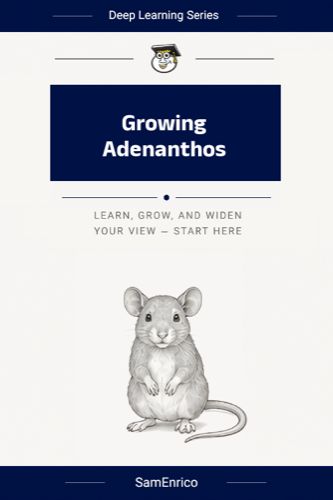
Growing Adenanthos
This publication, published by SamEnrico, covers G
This publication, published by SamEnrico, covers Growing Adenanthos
Formats
About this book
Free sample
Chapter 1: The 60-Million-Year Secret--–- Most gardeners kill their plants with kindness. They water too much, fertilize too often, and fuss over every yellow leaf. Then they wonder why their garden looks exhausted while the wild landscape down the road thrives on absolute neglect. The truth about Adenanthos—and the entire Proteaceae family to which it belongs—is that these plants evolved for a world that would kill almost anything else. Understanding that world is the difference between a Woolly Bush that soars to five meters of silvery perfection and a sad, yellowing shrub that lingers for a season before giving up entirely.The secret begins 60 million years ago, when the ancient supercontinent of Gondwana was breaking apart.
Australia, still connected to Antarctica and South America, drifted northward through dramatic climate shifts. In the southwest corner of what would become Western Australia, something remarkable happened. The soil weathered into some of the most nutrient-poor dirt on the planet—deep sands and gravelly laterites with phosphorus levels so low that most plants would simply refuse to grow. But a family of plants called Proteaceae did more than survive. They adapted in ways that turned scarcity into strength.Today, that evolutionary legacy lives in every Adenanthos leaf, every root hair, every flower.
And if you want to grow these extraordinary plants, you must stop thinking like a conventional gardener and start thinking like a 60-million-year-old survivor. This chapter will rewire your understanding of what plants need—and what they absolutely do not.The Proteaceae Dynasty: Ancient Survivors of a Starving Continent The family Proteaceae is ancient. Fossil evidence places its origins in the Cretaceous period, when dinosaurs still walked the earth. Today it includes over 1,600 species spread across the southern hemisphere—Protea and Leucospermum from South Africa, Banksia and Grevillea from Australia, Embothrium from South America, and of course Adenanthos from Western Australia. What unites these diverse plants, from towering trees to prostrate groundcovers, is a set of adaptations to extreme soil poverty.The name "Proteaceae" comes from Proteus, the shape-shifting Greek god, because the family contains such wildly different forms.
But beneath the surface variation lies a common genius. These plants did not evolve to compete for resources in rich…
This is the end of the free sample. Get the eBook to keep going. Buy now
Contents
- Chapter 1
- Chapter 2
- Chapter 3
- Chapter 4
- Chapter 5
- Chapter 6
- Chapter 7
- Chapter 8
- Chapter 9
- Chapter 10
- Chapter 11
- Chapter 12
Details
- Author
- Simpson Dewey
- Publisher
- SamEnrico
- Language
- English
- Genre
- Non-Fiction, Informative, Educational
- Released
- 2026-05-25
- Pages (approx.)
- 155
- Available as
- eBook, Audiobook

Read better in the ZLOADR app
Your eBooks on your phone or tablet. Sign in with your SamEnrico account and start reading.
More by Simpson Dewey
 Dividend Debt Ratio HandbookSimpson Dewey$11.99
 The Interruption Scripting ToolkitSimpson Dewey$11.99
 Mindfulness for RetirementSimpson Dewey$11.99
 Body Image Self Talk RewiringSimpson Dewey$11.99
 French Underground Press GuideSimpson Dewey$11.99
 Virtual Co Working Anti DelaySimpson Dewey$11.99
 Grief and Work After Child LossSimpson Dewey$11.99
 Burnout And Boundary ViolationsSimpson Dewey$11.99
 The Silent Revolution: How a 19th-Century Latin American Talk Show Host Defied CensorshipSimpson Dewey$11.99
 Gwyn ap Nudd: The Hollow King of the OtherworldSimpson Dewey$11.99
 A Collector's Handbook to the Nsu Ro80Simpson Dewey$11.99
 How to Produce Winter Sports and ActivitiesSimpson Dewey$11.99