
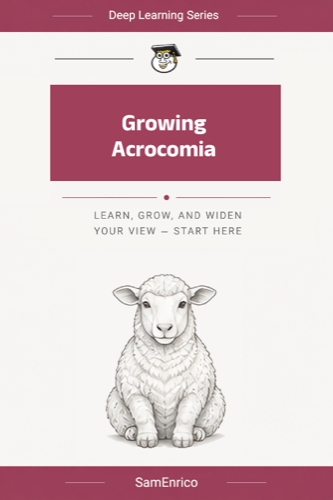
Non-FictionInformativeEducational
Growing Acrocomia eBook
This publication, published by SamEnrico, covers G
This publication, published by SamEnrico, covers Growing Acrocomia
Formats
Free sample
Chapter 1: The Palm That Refused to Kneel--The first time I watched a macauba palm survive a six-month drought while the African oil palms beside it lay dead and cracking, I knew agriculture had been looking in the wrong direction. That was 2007 on a degraded cattle pasture in Mato Grosso do Sul, Brazil, and the image has never left me. One row of Elaeis guineensis—the so-called miracle crop of the tropics—reduced to brown, skeletal fans. And twenty meters away, Acrocomia aculeata standing green, productive, and utterly indifferent to the suffering around it. Not because it was pampered.
Quite the opposite. The macauba had received no irrigation, no fertilizer, and no one had wept over its survival. It simply refused to die.That, in a single frame, is the promise of this palm. And also the source of its greatest challenge. Because a crop that refuses to kneel to hardship also refuses to kneel to humans.
The spines are the first thing you notice. Long, black, needle-sharp daggers that line the trunk like a medieval weapon. They are not subtle, and they are not forgiving. Walk too close without protection, and you will remember the encounter for weeks. The fruit, when it falls, is encased in a shell so hard that farmers once used them as ball bearings.
The seeds, if you simply plant them in soil, will sit dormant for two years or more, laughing at your impatience.But here is the truth that the oil palm industry has spent fifty billion dollars trying to ignore. The African oil palm is a spoiled aristocrat. It demands deep, rich soils. It demands rain every month of the year. It demands chemical nursemaids in quantities that have turned Southeast Asian rivers into dead zones.
And it demands that you clear rainforest to plant it, because oil palm cannot compete with weeds in any other context. Acrocomia asks for none of these things. It evolved on the hardscrabble savannas and dry forests of South America, where the soil is thin, the dry season lasts half the year, and fire is a regular visitor. It did not become productive by accident. It became productive because the alternative was extinction.This chapter introduces you to that palm.
Not as a botanical curiosity, but as a legitimate agricultural revolution waiting to happen. We will cover the history of human use, the hard data comparing Acrocomia to the African oil palm, the global market potential across all product streams, and—just as importantly—the risks that have kept this crop on the margins for too long. By the end of this chapter, you will understand why multinational corporations are quietly investing in macauba research, why smallholders in Brazil are replacing degraded pasture with this spiny giant, and why the next decade may finally be the moment when Acrocomia steps out of the shadow of its pampered cousin.A Crop Born of Hardship, Not Luxury The genus Acrocomia contains approximately forty recognized species and varieties, though taxonomists argue about the exact number with the enthusiasm of people who enjoy academic fencing. The most important species for commercial cultivation is Acrocomia aculeata, known locally as macauba, macaúba, or the grugru palm. Its native range stretches from southern Mexico through Central America and across much of South America, including Brazil, Bolivia, Paraguay, Argentina, and parts of Colombia and Venezuela.
That range is not accidental. It correlates almost perfectly with the seasonally dry tropics—regions that receive enough rain to support forest but experience one to five months of significant water deficit every year.Listen carefully to that fact, because it is the single most important thing you will read in this book. The African oil palm comes from the humid tropics, where rainfall exceeds evaporation in every month of the year. Acrocomia comes from the seasonal tropics, where plants must either tolerate drought or die. This evolutionary history is written into every cell of the palm.
The roots grow deep and aggressively, searching for water tables that oil palm never bothers to reach. The leaves have a waxy cuticle and sunken stomata that reduce water loss. The trunk stores water in its fibrous tissue, acting as a living reservoir. And when conditions become truly extreme, the palm simply stops growing and waits. Dormancy is not a failure for Acrocomia.
It is a strategy.Indigenous peoples understood this palm long before agronomists gave it a Latin name. Archaeological evidence suggests that Acrocomia fruit was a dietary staple in the Brazilian cerrado and the Paraguayan Chaco for at least two thousand years. The pulp was eaten fresh or fermented into a mildly alcoholic beverage. The kernel was cracked open for its rich, lauric oil, which was used for cooking and as a base for body paints. The leaves provided fiber for ropes, baskets, and thatch.
The spines, when heat-treated, were used as fish hooks and sewing needles. And the endocarp—that impossibly hard shell—was carved into beads, buttons, and even small containers. Nothing was wasted. This was not primitive agriculture. This was integrated biorefining, indigenous style.European explorers and naturalists took notice early.
The German botanist Carl Friedrich Philipp von Martius, who traveled through Brazil from 1817 to 1820, devoted several pages of his monumental Flora Brasiliensis to Acrocomia, praising the quality of the oil and the strength of the fiber. Portuguese colonists adopted the palm for a different purpose: feeding livestock. The fallen fruit, with its high oil content and protein-rich kernel, proved an excellent supplement for cattle during the dry season when pasture grasses turned brown and nutritionless. To this day, the Portuguese common name "macaúba" is thought to derive from the Tupi words for "fruit that feeds animals."And yet, despite this long history of use, Acrocomia remained a wild or semi-wild resource for centuries. No one domesticated it.
No one bred it for higher yield or smaller spines. No one planted orchards in neat rows and calculated cost-benefit ratios. Why? The answer is not complicated. The African oil palm arrived in the Americas in the sixteenth century, brought by slave ships as a food source for the voyage.
And wherever oil palm was planted, it thrived—as long as the conditions were right. But here is the critical distinction that most histories miss. Oil palm thrived only in the narrow band of perpetually wet tropics. Acrocomia thrived everywhere else. The colonial powers, and later the agribusiness giants, chose the path of least resistance.
They followed the water.The Great Palm Comparison: Acrocomia Versus Elaeis Let us put aside romanticism and look at the data. The African oil palm (Elaeis guineensis) is an extraordinary crop. Under ideal conditions, it produces more oil per hectare than any other plant on earth—up to five tons per year. It has been the subject of intensive breeding programs for more than a century, resulting in varieties with consistent yields, uniform fruit color, and dramatically reduced height (which makes harvesting easier). The global palm oil industry is worth more than sixty billion dollars annually.
It feeds billions of people, lubricates countless machines, and appears in half the packaged products on supermarket shelves. To dismiss oil palm as a failure would be…
This is the end of the free sample. Get the eBook to keep going. Buy now
About this book
Details
- Author
- Hart Santiago
- Publisher
- SamEnrico
- Language
- English
- Genre
- Non-Fiction, Informative, Educational
- Released
- 2026-06-02
- Pages (approx.)
- 148
- Available as
- eBook, Audiobook

Read better in the ZLOADR app
Your eBooks on your phone or tablet. Sign in with your SamEnrico account and start reading.
More by Hart Santiago
 Mindfulness for ExerciseHart Santiago$11.99
 Massage Therapy and HGHHart Santiago$11.99
 Email Interruption Elimination PlanHart Santiago$11.99
 Burnout Prevention For HealthcareHart Santiago$11.99
 Confidence Building Self Talk StrategiesHart Santiago$11.99
 Career Goal PlanningHart Santiago$11.99
 Norwegian Resistance Radio GamesHart Santiago$11.99
 Child Loss Brain Fog RecoveryHart Santiago$11.99
 Blood of the Vine: The Lost Winemakers of the Silk RoadHart Santiago$11.99
 The Shanghai Kidnapping: The British Consul’s Daring Rescue (1927)Hart Santiago$11.99
 How to Start a Hobby in CollagingHart Santiago$11.99
 A Collector's Handbook to the Nsu IiHart Santiago$11.99
You may also like
 Hong Kong Handover 1997Dunn Johnnie$11.99
 Zumba For Postnatal Recovery CourseNeal Christian$11.99
 Zumba for BeginnersLadner Nikia$11.99
 YouTube Comment Mining GuideHumes Pandora$12.99
 Worry Box MeditationCarlin Rudy$11.99
 Workplace Stress MeditationNguyen Lynn$11.99
 Workplace Stress and Sleep RepairHawley Ivory$11.99
 Workplace Perfectionism CureDelaney Jeffry$11.99
 Workplace Injustice Anger GuideWallen Isabelle$11.99
 Work Addiction and Burnout LinkGreenwood Ester$11.99
 Women in Yoga and WellnessBeattie Galina$11.99
 Women in Stand Up ComedyChun Evangeline$11.99