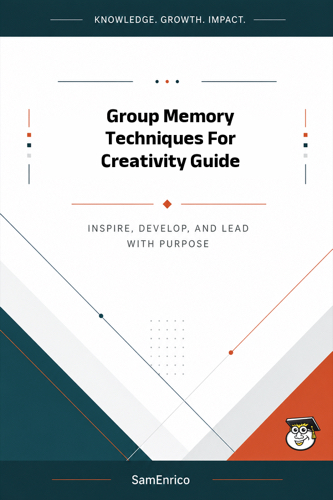
Group Memory Techniques For Creativity Guide Audiobook
Uses shared visual archives and brain dumps to fre
by Loper Jule
Uses shared visual archives and brain dumps to free working memory for idea generation.
Formats
Free sample
Chapter 1: The Overload Paradox--–- By the time you finish reading this sentence, your brain will have done something extraordinary. It will have converted black marks on a page into meaning, held the beginning of the sentence in memory while processing the middle, predicted the end, and decided whether any of it matters. All of this happens within a working memory system so constrained that it can hold roughly seven items at once. Seven. That is it.
That is the entire capacity of the human brain’s real-time processing engine.Now consider what happens when you put seven people in a room. Each person arrives with their own seven-slot working memory. That is forty-nine slots of processing power, theoretically. But what actually happens is not multiplication. It is division.
The group does not become seven times smarter. It becomes seven times more taxed. Each person uses their precious mental slots not only on the problem but also on tracking who is speaking, who agrees, who disagrees, who might be offended, who has not spoken yet, and what they themselves will say when they finally find a gap in the conversation.This is the Overload Paradox. Groups contain more knowledge than any individual, yet they consistently produce worse thinking. They are drowning in information while starving for insight.
They have the pieces but cannot see the puzzle. And the culprit is not low intelligence, bad intentions, or poor facilitation. The culprit is cognitive load overlap—the invisible tax that every group pays every time they try to think together.This chapter will give you a new lens for seeing your team’s meetings. You will learn why your smartest people sometimes say nothing, why your most obvious solutions get overlooked, and why your team leaves meetings exhausted without having produced anything new. More importantly, you will learn the single most important diagnostic for measuring your team’s cognitive health and the foundational concept—Transactive Memory—that will unlock every technique in this book.The Seven Plus or Minus Two Trap In 1956, the cognitive psychologist George Miller published a paper with a title that has become legendary: “The Magical Number Seven, Plus or Minus Two.” Miller was not writing about magic.
He was writing about the hard limits of human information processing. His experiments showed that the average person can hold between five and nine discrete chunks of information in working memory…
This is the end of the free sample. Get the Audiobook to keep going. Buy now
About this book
Details
- Author
- Loper Jule
- Publisher
- SamEnrico
- Language
- English
- Genre
- Non-Fiction, Self-Help, Cognitive Load
- Released
- 2026-06-10
- Pages (approx.)
- 142
- Available as
- eBook, Audiobook

Listen in the VoxFlicks app
Audiobooks and audio dramas wherever you go. Sign in with your SamEnrico account and press play.
More by Loper Jule
 Bodyweight Partner CalisthenicsLoper Jule$11.99
 Indonesian Talent MobilityLoper Jule$11.99
 Near Miss Gambling TrapLoper Jule$11.99
 Anger Trigger Self Assessment WorkbookLoper Jule$11.99
 The Phantom of the 2008 Crash: How One Man Predicted the Financial ApocalypseLoper Jule$11.99
 Silken Secrets: The Scandalous Letters of Lady Caroline LambLoper Jule$11.99
 Gumroad Pre Sale ValidationLoper Jule$12.99
 Corporate Buyer Profile AnalysisLoper Jule$12.99
 PLC Maintenance MechanicLoper Jule$11.99
 Understanding Chromosome 5, Uniparental DisomyLoper Jule$17.99
 How to Start a Motor Homes (used) (wholesale) Business (Beginners Guide)Loper Jule$11.99