
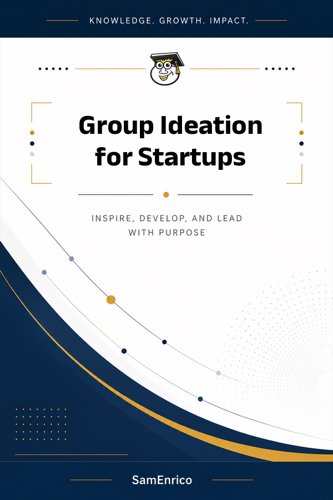
Group Ideation for Startups eBook
Early stage team creative problem solving.
by Foret Creola
Early stage team creative problem solving.
Formats
Free sample
Chapter 1: Process Beats Genius--–- The first time I watched a startup die, I was twenty-four years old and working as a product manager at a company that had raised eighteen million dollars. The founders were brilliant. The engineers were top-tier. The office had a nap room, a keg, and a ping-pong table. By every external measure, we were winning.
But six months after launch, the user graphs flatlined. Three months after that, we ran out of money. And at the funeral—the final all-hands meeting where the CEO told us to clear our desks—he said something I have never forgotten. “We built exactly what we said we would build,” he said. “I don’t understand what went wrong.”That is the moment I realized that startups don’t fail because of bad execution.
They fail because they solve the wrong problem. And they solve the wrong problem because they fall in love with their first idea and never learn how to ideate properly.This chapter is about that failure and how to prevent it. It is about the myth of the lone visionary genius—the belief that creativity strikes like lightning, that great ideas emerge fully formed from the minds of founders, and that process kills inspiration. That myth is not just wrong. It is dangerous.
It has wasted billions of dollars and destroyed thousands of teams. And until you abandon it, your startup is at risk of becoming another statistic.The Lone Genius Myth: A Fairy Tale We Tell Ourselves We love stories about lone geniuses. Steve Jobs in his garage. Mark Zuckerberg in his dorm room. The founder who stayed up for three days, drank a gallon of coffee, and emerged with the idea that changed the world.
These stories are compelling. They make us believe that creativity is a mystical gift, that you either have it or you don’t, that process is for boring people and geniuses just feel their way to the answer.Here is the truth that the stories leave out: Steve Jobs had Steve Wozniak. Mark Zuckerberg had Eduardo Saverin, Dustin Moskovitz, and Chris Hughes. The lone genius is almost always a team. And the “Eureka moment” is almost always preceded by weeks, months, or years of messy, collaborative, often frustrating exploration.Research from the Journal of Product Innovation Management analyzed hundreds of successful startups and found that the single most predictive factor of success was not the brilliance of the founder’s original idea.
It was the team’s ability to iterate on that idea—to test it, break it, improve it, and sometimes abandon it entirely. In other words, successful startups don’t have better ideas. They have better processes for turning raw concepts into validated solutions.This is liberating news. It means you don’t have to be a genius. You don’t have to wait for inspiration to strike.
You don’t have to be the smartest person in the room. You just need a system. And the rest of this book is that system.Art vs. Design: Why Startups Need the Latter Before we dive into the system, we need to understand a critical distinction: the difference between art and design.Art is personal expression. The artist creates for themselves.
They ask, “What do I want to say?” The value of art is in its authenticity, its originality, its ability to make the viewer feel something. Art does not need to solve a problem. It does not need to be useful. It does not need to be understood by anyone other than the artist.Design is problem-solving for others. The designer asks, “What does the user need?” The value of design is in its utility, its clarity, its ability to help someone accomplish a goal.
Design that does not solve a problem is not good design, regardless of how beautiful it is.Most startup founders think they are practicing design. They believe they are solving customer problems. But in reality, they are often practicing art—expressing their own vision, building what they think is cool, falling in love with their own creativity. And then they are surprised when the market does not love them back.Here is the hard truth: Your customers do not care about your vision. They do not care about your clever architecture or your elegant code or your beautiful design.
They care about their problems. If you solve their problem, they will use your product. If you don’t, they won’t. It is that simple. And that brutal.This is why process beats genius.
A genius with no process will build what they imagine the customer needs. A team with a good process will go out, talk to customers, test assumptions, and build what the customer actually needs. The genius might get lucky. The team with the process gets repeatable results.The Financial Cost of Poor Ideation Poor ideation is not an abstract problem. It has a direct, measurable cost.
Let me break it down.Wasted Developer Hours The average software developer costs a startup between $150,000 and $250,000 per year, including salary, benefits, and overhead. A team of four developers costs between $600,000 and $1,000,000 per year. If that team spends three months building a feature that nobody wants, you have burned between $150,000 and $250,000 on something that will never generate revenue. That is not a learning experience. That is a fire.Opportunity Cost The feature you built instead of the feature customers actually needed—that is opportunity cost.
While your team was building the wrong thing, a competitor was building the right thing. While you were polishing a feature that would never be used, you were not talking to customers, not testing assumptions, not learning. Opportunity cost is invisible, which makes it even more dangerous than direct cost. You cannot see it on a spreadsheet. But you can feel it when your startup runs out of money and your competitor gets acquired.Team Demoralization This is the hidden cost, and it is the most destructive.
Developers want to build things that matter. When they spend months building something that launches to crickets, they stop believing. They stop caring. They start updating their resumes. I have watched talented engineers leave great companies not because of pay or perks, but because they were tired of building things nobody used.
Demoralization is contagious. One cynical engineer poisons the whole team. And once the team stops believing, no amount of funding or process can save you.Poor ideation is not a victimless crime. It costs money, time, and the trust of the people who work for you. The good news is that it is preventable.
The solution is a structured ideation process.The Ideation Matrix: Your Four-Stage Roadmap This book is built around a framework I call the Ideation Matrix. It has four stages, and they must be followed in order. Skipping a stage is like building a house without a foundation—it might look good for a while, but it will eventually collapse.Stage 1: Explore The Explore stage is about understanding the problem space without jumping to solutions. Most teams skip this stage entirely. They have a hypothesis—"Busy parents need a way to coordinate childcare"—and they start building.…
This is the end of the free sample. Get the eBook to keep going. Buy now
About this book
Details
- Author
- Foret Creola
- Publisher
- SamEnrico
- Language
- English
- Genre
- Non-Fiction, Self-Help, Startup
- Released
- 2026-06-07
- Pages (approx.)
- 120
- Available as
- eBook, Audiobook

Read better in the ZLOADR app
Your eBooks on your phone or tablet. Sign in with your SamEnrico account and start reading.
More by Foret Creola
 Starlight Sky VisualizationForet Creola$11.99
 Road Rage Visualization PracticeForet Creola$11.99
 Returning to Work PostpartumForet Creola$11.99
 Unemployment Resilience GuideForet Creola$11.99
 Boundary Violation TriggerForet Creola$11.99
 Breast Cancer Advocacy GuideForet Creola$11.99
 Influence Techniques for Real EstateForet Creola$11.99
 The Wiretappers of Windsor: How Canada's Bootleggers Outsmarted the LawForet Creola$11.99
 Tewkesbury: The Last Lancastrian StandForet Creola$11.99
 A Collector's Handbook to the Triumph Herald CoupèForet Creola$11.99
 Dogo Argentinos: The Argentine MastiffForet Creola$11.99
 Compliance and AML for Export PaymentsForet Creola$12.99
You may also like
 Hong Kong Handover 1997Dunn Johnnie$11.99
 Zumba For Postnatal Recovery CourseNeal Christian$11.99
 Zumba for BeginnersLadner Nikia$11.99
 YouTube Comment Mining GuideHumes Pandora$12.99
 Worry Box MeditationCarlin Rudy$11.99
 Workplace Stress MeditationNguyen Lynn$11.99
 Workplace Stress and Sleep RepairHawley Ivory$11.99
 Workplace Perfectionism CureDelaney Jeffry$11.99
 Workplace Injustice Anger GuideWallen Isabelle$11.99
 Work Addiction and Burnout LinkGreenwood Ester$11.99
 Women in Yoga and WellnessBeattie Galina$11.99
 Women in Stand Up ComedyChun Evangeline$11.99