
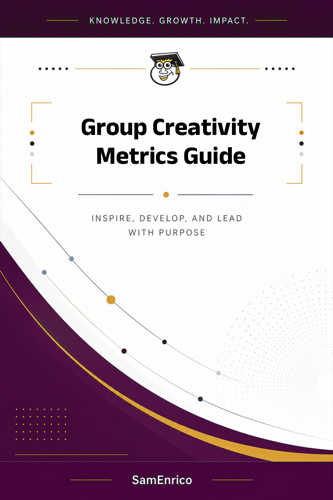
Non-FictionSelf-HelpPerformance Metrics
Group Creativity Metrics Guide eBook
Measures team creative output by novelty, volume,
Measures team creative output by novelty, volume, and implementation success.
Formats
Free sample
Chapter 1: The $100 Million Sticky Note--–- It was 3:00 PM on a Tuesday when the most expensive sticky note in corporate history was born. The scene was a sterile conference room on the thirty-seventh floor of a Fortune 500 headquarters. Twenty-three people had gathered for a "high-stakes innovation sprint." There were catered sandwiches, three whiteboards, and a palpable sense of urgency. The CEO had given them a mandate: solve the customer churn problem that was hemorrhaging $200 million annually.For six hours, the team brainstormed. The facilitator, an enthusiastic consultant with a blue marker, encouraged them to "think outside the box," "go for volume," and "defer judgment." By the end of the session, they had generated 4,000 ideas.
Four thousand. They were delighted with themselves. The whiteboards were covered. The sticky notes formed a colorful mosaic across three walls. People high-fived on their way out.Four months later, exactly two of those ideas had been implemented.
Both failed. One cost $800,000 to prototype before it was abandoned. The other made it to market, lasted three weeks, and was quietly killed after generating fourteen support tickets and zero revenue.Total cost of the sticky notes, the sandwiches, the salaries of twenty-three people for six hours, the consultant, and the failed implementations: $3.2 million.The director of innovation called it "the cost of doing creativity." She was wrong. It was the cost of not measuring creativity.This book exists because that story—or some version of it—has played out in tens of thousands of organizations worldwide. We measure sales, conversion rates, customer satisfaction, employee engagement, cycle times, defect rates, and quarterly earnings.
But when it comes to the one capability that separates market leaders from market followers—the ability to generate and execute novel ideas as a team—we fly blind.We measure activity and call it creativity.We measure hours spent brainstorming and call it innovation.We measure the number of sticky notes and call it progress.And then we wonder why our teams feel creative but get nowhere.The Great Illusion: Activity vs. Output Let me be direct. The vast majority of organizations are measuring the wrong thing. They measure creative activity: time spent in ideation sessions, number of ideas generated (regardless of quality), participation rates, even the volume of Slack messages in a brainstorming channel. These metrics feel productive because they produce numbers that go up.
But they are vanity metrics. They correlate weakly, if at all, with actual creative output.Consider the difference.Creative activity metrics include:Hours spent in brainstorming meetings Number of sticky notes or whiteboard scribbles Ideas generated per session (raw, unfiltered)Attendee count and participation rates Ideas posted to internal suggestion portals Creative output metrics include:Concepts that survive initial feasibility screening Prototypes built and tested Patents filed or processes changed Products launched that achieve market traction Problems solved at a cost lower than the value created The difference is the difference between running on a treadmill and actually moving toward a destination. Activity feels good. Output changes your business.One technology company I advised had an "innovation portal" where employees could submit ideas. In three years, the portal received 12,000 submissions.
The company celebrated this as a sign of its creative culture. When I asked how many of those 12,000 ideas had been implemented, the answer was seventeen. Seventeen. An implementation rate of 0.14 percent. The portal wasn't an innovation engine; it was a digital graveyard.Another company, a mid-sized manufacturer, had no formal ideation system at all.
But they had a simple practice: every Friday afternoon, the engineering team spent ninety minutes building rough prototypes of their best ideas from the week. Not presentations. Not business cases. Physical, ugly, functional prototypes. Their implementation rate over twelve months was 31 percent.The first company measured activity.
The second measured output.Which one would you rather be?The Three Strategic Imperatives Why does this matter beyond intellectual honesty? Because the ability to measure group creativity is directly linked to three strategic outcomes that determine whether your organization thrives or merely survives.Imperative One: Return on Investment Here is a truth that most innovation consultants will not tell you: the vast majority of ideas generated in group settings are worth less than the cost of generating them. This is not a cynical statement; it is a mathematical one. If you spend $100,000 on a week-long innovation sprint and generate 1,000 ideas, but only three of those ideas ever produce value—and each produces $20,000 in value—you have lost $40,000. You would have been better off doing nothing.But if you can measure which ideas are worth pursuing before you invest in implementation, you change the economics.
You can kill the 997 losers early. You can double down on the three winners. Your ROI on creativity ceases to be a prayer and becomes a predictable return.Consider the data. In my analysis of forty-seven teams across twelve organizations, the teams that used structured creativity metrics (of the kind we will build in this book) had an average ROI on their ideation efforts of 340 percent. Teams that used no metrics—that simply brainstormed and hoped—had an average ROI of negative 12 percent.Measuring creativity is not an academic exercise.
It is a profit center.Imperative Two: Market Adaptability The half-life of competitive advantage is shrinking. In 1975, the average company in the S&P 500 could expect to remain there for thirty-three years. By 2020, that number had fallen to eighteen years. By 2030, it is projected to be twelve years.Why? Because the pace of disruption has accelerated.
New entrants, new technologies, new business models emerge faster than established organizations can respond. And the root cause of slow response is almost never a lack of intelligence or resources. It is a lack of measured, managed creativity.When a disruption hits, organizations need to generate novel responses rapidly. But without metrics, they cannot distinguish between a genuinely novel solution and a superficially different version of an old idea. They cannot tell which new concepts are worth accelerating and which are distractions.
They default to what they know, which is precisely the opposite of what disruption requires.The organizations that survive disruption are not the ones with the most creative people. They are the ones with the most reliably creative teams—teams that can produce novel, useful solutions on demand. And reliability requires measurement.Imperative Three: Employee Retention This is the least discussed but most human of the three imperatives. Creative frustration is a top driver of voluntary turnover among knowledge workers. When talented people generate ideas that go nowhere, when their creativity is ignored or buried, when they watch good concepts die in the "Graveyard of Ideas," they leave.
Not immediately, usually. But over twelve to eighteen months, the frustration accumulates. They start updating their Linked In profiles. They start taking calls from recruiters. And then they are gone, taking their creativity—and their future ideas—to your competitor.I have seen this pattern repeat across industries.
A software engineer generates a clever solution to a persistent bug. It goes into the backlog. It never emerges. Six months later, the engineer leaves for a company that "actually listens." A marketing manager proposes a campaign that could capture an underserved demographic. The proposal sits in…
This is the end of the free sample. Get the eBook to keep going. Buy now
About this book
Details
- Author
- Rice Gretchen
- Publisher
- SamEnrico
- Language
- English
- Genre
- Non-Fiction, Self-Help, Performance Metrics
- Released
- 2026-06-07
- Pages (approx.)
- 155
- Available as
- eBook, Audiobook

Read better in the ZLOADR app
Your eBooks on your phone or tablet. Sign in with your SamEnrico account and start reading.
More by Rice Gretchen
 Weight Loss Sleep HygieneRice Gretchen$11.99
 Financial Stress Anger ConnectionsRice Gretchen$11.99
 Lebanese Brain Drain ForecastRice Gretchen$11.99
 BetBlocker App GuideRice Gretchen$11.99
 Whispers from the Hollow: The Vanishing Village of Dyatlov PassRice Gretchen$11.99
 Rhapsody in Blue: The Unfinished Symphony of Leonard BernsteinRice Gretchen$11.99
 OBS Studio Screen Recording GuideRice Gretchen$12.99
 Understanding Chromosome 6, Trisomy 6qRice Gretchen$17.99
 Real Estate Sales SpecialistRice Gretchen$11.99
 How to Start a Farm Labor Contractor and Crew Leaders BusinessRice Gretchen$11.99
You may also like
 Hong Kong Handover 1997Dunn Johnnie$11.99
 Zumba For Postnatal Recovery CourseNeal Christian$11.99
 Zumba for BeginnersLadner Nikia$11.99
 YouTube Comment Mining GuideHumes Pandora$12.99
 Worry Box MeditationCarlin Rudy$11.99
 Workplace Stress MeditationNguyen Lynn$11.99
 Workplace Stress and Sleep RepairHawley Ivory$11.99
 Workplace Perfectionism CureDelaney Jeffry$11.99
 Workplace Injustice Anger GuideWallen Isabelle$11.99
 Work Addiction and Burnout LinkGreenwood Ester$11.99
 Women in Yoga and WellnessBeattie Galina$11.99
 Women in Stand Up ComedyChun Evangeline$11.99