
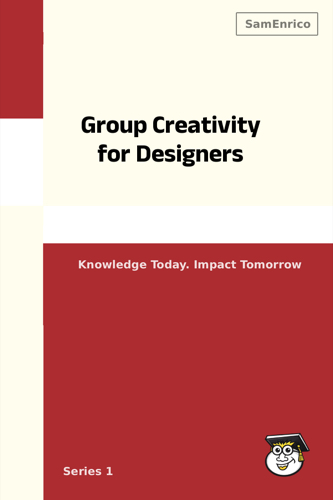
Group Creativity for Designers eBook
Design team collaborative iteration.
Design team collaborative iteration.
Formats
Free sample
Chapter 1: The Eureka Lie--–- Every designer knows the feeling. You’re staring at a blank screen, a sketchpad, or a whiteboard. The deadline is approaching. The pressure is mounting. And somewhere in the back of your mind, a seductive whisper begins: What if the breakthrough just… arrives?
What if, in a flash of insight, the perfect solution reveals itself?That whisper is the Eureka lie. And it is the single most dangerous myth in the design profession.Not because inspiration doesn’t exist. It does. But because the story we tell about inspiration—the lone genius, the sudden flash, the solitary breakthrough—has convinced generations of designers that creativity is a solo sport. And that belief is destroying your team’s potential.Let me tell you a story.
In 2018, a design team at a well-funded healthtech startup gathered for a kickoff meeting. Their mission: redesign the patient check-in flow for a network of urgent care clinics. The lead designer, a brilliant and fiercely independent woman named Sarah, had already sketched out a vision during a late-night session. She presented it to the team—a product manager, two developers, a UX researcher, and a visual designer—with quiet confidence. “I think I’ve cracked it,” she said.The room went silent.
The product manager nodded politely. The developers squinted at the screens. The researcher asked a gentle question: “Have we watched any patients actually try to check in yet?” Sarah waved her hand. “I’ve read the research summary. I know the pain points.”The team spent six weeks building high-fidelity mockups based on Sarah’s vision.
They held fourteen review meetings. The lead designer cried twice. The developer, brought in only at the “handoff,” said: “This is impossible to build without three months of backend work.” The feature never shipped. Sarah quit. The startup died nine months later.The problem wasn’t talent.
Sarah was brilliant. The problem was a hidden religion that most designers don’t even know they follow: the religion of the Lone Genius, the Perfect Mockup, and the Handoff.This book is your excommunication.The Myth of the Solitary Flash Let’s start with a simple fact: almost no great design in human history emerged from a single person having a single moment of insight.The i Phone’s multi-touch interface wasn’t Steve Jobs waking up from a dream. It was a team of hundreds, including engineers from Finger Works (a company Apple acquired), designers like Bas Ording who prototyped rubber-banding scroll physics, and software developers who fought for months about latency thresholds. The final product was a synthesis of conflict, failure, and iteration—not a revelation.The Post-it Note wasn’t a eureka moment. Spencer Silver, a 3M chemist, accidentally created a low-tack adhesive in 1968.
He spent five years trying to find a use for it. Art Fry, another 3M scientist, was singing in his church choir and frustrated that his bookmarks kept falling out of his hymnal. He remembered Silver’s adhesive. The idea emerged from a conversation, a shared problem, and years of failed attempts—not a flash.The original Macintosh interface was not Steve Jobs dictating to a passive team. It was Jobs stealing ideas from Xerox PARC, then a team of designers and engineers (including Bill Atkinson, Susan Kare, and Andy Hertzfeld) fighting, arguing, and iterating through dozens of contradictory prototypes.
The famous “desktop metaphor” was a compromise between people who wanted text-based interfaces and people who wanted purely visual ones.Why does this myth persist? Because we love origin stories. We love the idea that genius is mystical, unpredictable, and concentrated in exceptional individuals. It makes for better movies. It makes designers feel special.
And it absolves organizations from investing in team culture—because if creativity is magic, you can’t manage it anyway.But here’s the truth that top design studios have learned: breakthrough designs emerge from structured social interaction, where friction and synthesis between different minds produce novel outcomes that no individual could have achieved alone.Collaboration is not a soft skill. It is the engine of iteration. And iteration is the only path to breakthrough.Why the Lone Genius Model Fails in Complex Systems The lone genius model worked—sort of—in simpler times. A single craftsman could design a chair, build it, and sell it. A lone graphic designer could create a logo and call it done.
But modern design problems are not chairs or logos. They are complex systems.Consider the difference between designing a poster and designing a healthcare app.The poster has one user (the viewer), one context (a wall), one measure of success (does it grab attention?). One designer, working alone, can plausibly solve that problem. The healthcare app has multiple users (patients, nurses, doctors, administrators), multiple contexts (waiting rooms, exam rooms, mobile phones, desktop computers), and multiple measures of success (speed, accuracy, patient satisfaction, regulatory compliance, security).No single person holds all the answers for a complex system. Not even the most brilliant designer.This is not opinion.
It’s cognitive science. Research on “wicked problems” (problems that change as you try to solve them) demonstrates that complex design challenges require distributed cognition—knowledge spread across multiple brains. The product manager understands business constraints that the designer doesn’t see. The developer understands technical feasibility that the designer hasn’t considered. The user researcher understands behavioral patterns that the designer would never guess.When a lone designer generates a solution in isolation, they are not being efficient.
They are being blind. They are substituting their own assumptions for the team’s collective intelligence.The startup in our opening story died because Sarah substituted her assumptions for the team’s collective intelligence. She didn’t watch patients check in. She didn’t ask developers about feasibility. She didn’t create space for the researcher’s data to challenge her vision.
She was brilliant. And she was wrong.Three Pillars of Collaborative Creativity If the lone genius model is broken, what replaces it? Over the past decade, researchers studying high-performing creative teams have identified three foundational conditions that predict whether a group will generate breakthrough ideas or descend into dysfunction.These three pillars appear in every chapter of this book. Master them, and your team can iterate toward anything. Ignore them, and no process or tool will save you.Pillar One: Psychological Safety In 2012, Google launched Project Aristotle, a massive internal study to determine what made some teams more effective than others.
They analyzed dozens of variables: who sat where, how often teams met, whether members had similar backgrounds, whether they socialized outside work.The single strongest predictor of team effectiveness was not intelligence, expertise, or even leadership. It was psychological safety: the belief that you will not be punished or humiliated for speaking up with ideas, questions, concerns, or mistakes.Psychological safety is the difference between a team where a junior designer says, “I don’t understand this requirement” and a team where that junior designer stays silent. It’s the difference between a developer who says, “This will take three times longer than you think” and a developer who nods along knowing the timeline is fantasy.Without psychological safety, iteration is impossible. Because…
This is the end of the free sample. Get the eBook to keep going. Buy now
About this book
Details
- Author
- Woodcock Cecil
- Publisher
- SamEnrico
- Language
- English
- Genre
- Non-Fiction, Self-Help, Design
- Released
- 2026-06-10
- Pages (approx.)
- 143
- Available as
- eBook, Audiobook

Read better in the ZLOADR app
Your eBooks on your phone or tablet. Sign in with your SamEnrico account and start reading.
More by Woodcock Cecil
 Breast Health For Deaf WomenWoodcock Cecil$11.99
 Angry Driving Thought StoppingWoodcock Cecil$11.99
 Postpartum Gratitude PracticeWoodcock Cecil$11.99
 Influence Techniques for AccountantsWoodcock Cecil$11.99
 The Growth Mindset WorkbookWoodcock Cecil$11.99
 Rainbow After Storm VisualizationWoodcock Cecil$11.99
 Self Employed Income LossWoodcock Cecil$11.99
 Desert Mercy: The Unsung Heroes of the North African CampaignWoodcock Cecil$11.99
 The Phantom of La Scala: The Opera Scandal That Shocked the WorldWoodcock Cecil$11.99
 How to Produce Paintball and Airsoft EquipmentWoodcock Cecil$11.99
 A Collector's Handbook to the Triumph Spitfire 2000 Mk IWoodcock Cecil$11.99
 Organic Export Certification HandbookWoodcock Cecil$12.99
You may also like
 Hong Kong Handover 1997Dunn Johnnie$11.99
 Zumba For Postnatal Recovery CourseNeal Christian$11.99
 Zumba for BeginnersLadner Nikia$11.99
 YouTube Comment Mining GuideHumes Pandora$12.99
 Worry Box MeditationCarlin Rudy$11.99
 Workplace Stress MeditationNguyen Lynn$11.99
 Workplace Stress and Sleep RepairHawley Ivory$11.99
 Workplace Perfectionism CureDelaney Jeffry$11.99
 Workplace Injustice Anger GuideWallen Isabelle$11.99
 Work Addiction and Burnout LinkGreenwood Ester$11.99
 Women in Yoga and WellnessBeattie Galina$11.99
 Women in Stand Up ComedyChun Evangeline$11.99