
Non-FictionSelf-HelpArchitecture
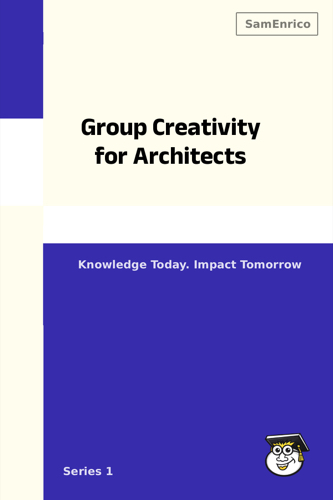
Group Creativity for Architects eBook
Firm collaborative design charrettes.
Firm collaborative design charrettes.
Formats
Free sample
Chapter 1: The Cart Before the Castle...–- In the winter of 1899, at the École des Beaux-Arts in Paris, a student named Pierre was caught in a ritual that had defined architectural education for nearly two centuries. His drawings were not finished. The deadline was dawn. And the charrette—the "little cart"—was already creaking down the cobblestone corridor to collect the work of his classmates, whether complete or not.Pierre did something unprecedented. He grabbed his charcoal, his straightedge, and a fresh sheet of trace, and he ran toward the cart.
As the cart moved from studio to studio, Pierre walked alongside it, drawing. Not in isolation. Not in silence. In full view of his peers, his professors, and his rivals. He sketched his section, then passed it to a classmate, who added a detail.
Another classmate corrected a proportion. By the time the cart reached the final collection point, Pierre's drawing had been touched by seven different hands. It was not the best-crafted drawing in the pile. But it was, by unanimous agreement of the jurors, the most inventive.The cart did not care who held the charcoal. The cart only cared that the work moved forward.That is the original meaning of the charrette.
It was never about solitary genius. It was about deadline-driven, collective, visible, improvised problem-solving among people who trusted each other enough to let strangers finish their sentences—and their sections.More than a century later, we have forgotten this.The Lone Architect Who Never Existed The myth of the lone genius is one of architecture's most durable and damaging fictions. We tell ourselves stories of Frank Lloyd Wright drawing Fallingwater on a napkin in a single afternoon. We imagine Le Corbusier alone in his Parisian atelier, conjuring Villa Savoye from pure geometric intuition. We teach our students the cult of the starchitect—the singular visionary whose name alone sells buildings, books, and tickets to lectures.But these stories are not true.
Or rather, they are true only in the way that a magician's reveal is true: the audience sees the final trick, not the years of practice, the failed attempts, or the collaborators who made the illusion possible.Fallingwater was not a napkin sketch. It was the product of months of structural negotiation with engineer Mendel Glickman, who convinced a reluctant Wright that cantilevering the main terrace required steel reinforcement far beyond Wright's initial drawings. The Villa Savoye was not a solo flight. It was refined through dozens of critiques from Le Corbusier's studio partners, including Pierre Jeanneret, who redesigned the ramp system when the original proved too steep for human use. Even the most "singular" buildings in architectural history are, in reality, the outcomes of group creativity.Why does the myth persist?
Because it serves a psychological function for firms, for clients, and for architects themselves. For firms, the lone genius narrative justifies hierarchy: if the partner is the genius, then junior staff are merely hands. For clients, the narrative simplifies accountability: one person to praise, one person to blame. And for architects, the narrative soothes the anxiety of complexity: if genius is a gift, then failure is not incompetence but the absence of magic.But contemporary architectural problems do not respond to magic. They respond to systems thinking, and systems thinking is almost never solitary.Wicked Problems and the Limits of One Brain In 1973, design theorists Horst Rittel and Melvin Webber introduced the concept of "wicked problems" to distinguish complex social challenges from tame, engineering-style problems.
A tame problem—say, calculating the load-bearing capacity of a steel beam—has a clear stopping point, a definitive test of success, and a limited set of possible solutions. A wicked problem has none of these features. It is intertwined with other problems. Every attempt to solve it changes its definition. And there is no single "correct" answer, only better or worse responses.Consider a typical architectural commission today.
You are designing a mixed-use building in a dense urban neighborhood. The client wants maximum leasable area. The city zoning code requires a setback that reduces that area by 15 percent. The community board wants affordable housing units that the client's pro forma cannot support without subsidies. The structural engineer warns that your proposed corner window system will require transfer beams that increase steel costs by 22 percent.
The sustainability consultant demands an envelope that meets Passive House standards, which conflicts with the mechanical engineer's preferred HVAC system. And the construction manager informs you that the site has undocumented utility lines that will delay excavation by at least six weeks.This is not one problem. It is a nest of problems. And no single mind—however brilliant, however experienced, however well-compensated—can hold all of these constraints simultaneously while generating novel spatial configurations that satisfy them.The lone genius, confronted with a wicked problem, does one of two things: simplifies the problem until it fits a signature move (the starchitect's "look"), or delegates the contradictions to specialists who resolve them after the design is supposedly "finished" (the cause of most change orders and budget overruns).The charrette does neither. The charrette acknowledges that wicked problems require distributed cognition—the ability of a group to think together, each person holding one piece of the puzzle while describing it aloud so others can connect their piece to theirs.From Author to Curator: A Necessary Identity Shift If the lone genius is a myth, then the role of the architect must change.
This book proposes a fundamental identity shift: from architect as author to architect as curator.The author writes alone. The author controls every word. The author's name appears on the spine, and the author alone is held responsible for the book's success or failure. The curator, by contrast, selects, arranges, and synthesizes the work of others. The curator does not need to be the best artist in the gallery, the best musician in the orchestra, or the best designer in the room.
The curator needs the judgment to recognize which fragment of which idea, combined with which other fragment from which other person, will produce something that no single person could have imagined alone.In the context of a design charrette, the architect as curator does four things that the architect as author cannot:First, the curator listens for pattern. While junior staff sketch wildly and the structural engineer mutters about spans and the client mentions a favorite building in Copenhagen, the curator hears not noise but signal. The curator notices that three different people have drawn the same corner condition in three different ways, and that the fourth person's offhand comment about "flow" connects all three.Second, the curator postpones judgment. The author, trained to critique, sees a bad sketch and says "no." The curator sees a bad sketch and asks, "What if we took the bottom third of this drawing and combined it with the top third of that drawing?" The curator knows that ideas are not born fully formed; they are assembled from fragments, and fragments are easy to kill and hard to resurrect.Third, the curator makes visible what is invisible. The author presents a polished drawing and says, "This is the solution." The curator presents a wall of trace…
This is the end of the free sample. Get the eBook to keep going. Buy now
About this book
Details
- Author
- Gorman Marine
- Publisher
- SamEnrico
- Language
- English
- Genre
- Non-Fiction, Self-Help, Architecture
- Released
- 2026-06-06
- Pages (approx.)
- 138
- Available as
- eBook, Audiobook

Read better in the ZLOADR app
Your eBooks on your phone or tablet. Sign in with your SamEnrico account and start reading.
More by Gorman Marine
 Stress and Dental Health GuideGorman Marine$11.99
 The Growth Mindset for AthletesGorman Marine$11.99
 Multiple Job Loss RecoveryGorman Marine$11.99
 Divorce and Living AloneGorman Marine$11.99
 Kegel Exercise HandbookGorman Marine$11.99
 Gratitude Evening ReflectionGorman Marine$11.99
 Diabetes Related ED GuideGorman Marine$11.99Diabetes Related ED GuideGorman Marine$11.99
 The Surgeon of the Great North Road: A Victorian Highwayman's Deadly SecretGorman Marine$11.99
 The Battle of Dogali: Italy's Bloody Wake-Up Call in AfricaGorman Marine$11.99
 How to Produce Paintball Harnesses and PacksGorman Marine$11.99
 Emus: Flightless BirdGorman Marine$11.99
You may also like
 Hong Kong Handover 1997Dunn Johnnie$11.99
 Zumba For Postnatal Recovery CourseNeal Christian$11.99
 Zumba for BeginnersLadner Nikia$11.99
 YouTube Comment Mining GuideHumes Pandora$12.99
 Worry Box MeditationCarlin Rudy$11.99
 Workplace Stress MeditationNguyen Lynn$11.99
 Workplace Stress and Sleep RepairHawley Ivory$11.99
 Workplace Perfectionism CureDelaney Jeffry$11.99
 Workplace Injustice Anger GuideWallen Isabelle$11.99
 Work Addiction and Burnout LinkGreenwood Ester$11.99
 Women in Yoga and WellnessBeattie Galina$11.99
 Women in Stand Up ComedyChun Evangeline$11.99