
Non-FictionSelf-HelpTeam Rituals
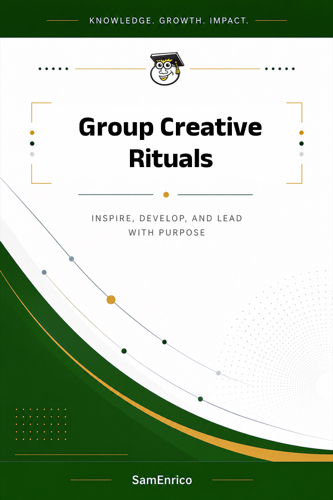
Group Creative Rituals eBook
Regular team practices that build collective imagi
by Turley Hiedi
Regular team practices that build collective imagination over time.
Formats
Free sample
Chapter 1: The Imagination Recession–- Every Monday morning, across millions of office kitchens and Zoom squares, the same ritual plays out. Not the kind of ritual this book is about. The other kind. The dead kind.Someone asks, “Does anyone have any creative ideas?” Silence. Someone else says, “Let’s brainstorm.” A shared groan, unspoken but universal.
A facilitator opens a digital whiteboard. Sticky notes appear. Purple for “synergy.” Blue for “think outside the box.” Yellow for “circle back.” Within twenty minutes, the team has produced forty-seven words that mean nothing, three arguments about font choices, and a collective sense of failure that will linger until the next meeting.This is not creativity. This is the performance of creativity. And your team is exhausted from performing it.The problem is not that your people lack imagination.
The problem is that you have no system for accessing the imagination they already possess. You have confused the spark with the fire. You have mistaken the rare, accidental moment of insight for a repeatable practice. You are waiting for lightning to strike while standing in a field during a drought, holding a metal rod, wondering why nothing is happening.This chapter is a diagnosis. Before we build rituals, we must understand why they are missing.
Before we practice collective imagination, we must name the disease that has replaced it. That disease has three symptoms: the collapse of the ritual container, the tyranny of the performance culture, and the quiet epidemic of what I call the Imagination Recession.Let me be clear about what I mean by that last term. An economic recession is a period of declining productivity, rising stagnation, and widespread fear that things will not improve. The Imagination Recession is exactly that, but for teams. Output remains stable.
Metrics are met. Deadlines are hit. And yet, no one can remember the last time they felt genuinely surprised by a colleague’s idea. No one can recall the last meeting that ended with energy rather than exhaustion. The work gets done.
But nothing new is born.This is not a small problem. In the twenty-first-century economy, imagination is not a luxury. It is the only sustainable competitive advantage. Software can optimize. Algorithms can predict.
Artificial intelligence can generate. But only human beings, working together in trusted groups, can imagine something that has never existed before. And they cannot do that on command. They can only do it through practice.The good news is that the solution is not complicated. It is not expensive.
It does not require a consultant, a retreat, or a software license. The solution is ritual. But not the empty, performative rituals you have been taught to tolerate. The real thing.The Serial Collective: Why Sitting Together Is Not Creating Together Let me introduce a term that will appear throughout this book: the serial collective.A serial collective is a group of people who occupy the same space—physical or digital—but do not share an inner life. They exchange information but not energy.
They coordinate tasks but not imaginations. They are together, one after another, in a sequence of transactions that never quite becomes a relationship.Think about your last team meeting. Did anyone say something that surprised them? Did anyone change their mind in real time? Did anyone take a risk that might have made them look foolish?
Or did everyone perform their role, deliver their update, and wait for the clock to run out?That is the serial collective. And it is the default structure of modern work.The serial collective emerges from a paradox. We have never been more connected by technology, and we have never been more isolated in our thinking. We sit in open-plan offices designed for collaboration, and we put on noise-canceling headphones to avoid each other. We have Slack channels for every possible topic, and we save our real opinions for private DMs.
We attend meetings labeled “brainstorming” and “ideation,” and we spend the entire time protecting our reputations.The serial collective is not a conspiracy. It is a defense mechanism. When groups lack ritual, they default to routine. And routine, by definition, is the enemy of surprise.Habits, Routines, and Rituals: A Critical Distinction To understand what is missing, we need three precise definitions. These definitions will anchor every chapter that follows.
I will return to them constantly, so I want you to feel their weight now.Habits are automatic behaviors triggered by context. You check your phone when you wake up. You open your email before you speak to your family. You say “let’s circle back” when you mean “I have nothing to say.” Habits are efficient. They conserve cognitive energy.
But they are also mindless. A habit requires no presence, no intention, no meaning. It just runs.Routines are sequences of behaviors performed repeatedly to achieve a predictable outcome. A daily stand-up meeting is a routine. A weekly status report is a routine.
A quarterly business review is a routine. Routines are useful. They create reliability. They reduce ambiguity. But they are emotionally neutral.
You can complete a routine while thinking about what you are making for dinner. Routines produce consistency, not connection.Rituals are different. A ritual is a structured, repeatable practice that marks a transition from ordinary work (Separation), suspends normal rules (Liminal Space), and returns the group to action with new insight (Aggregation). Unlike habits, rituals require presence. Unlike routines, rituals generate emotional energy.
A ritual changes how you feel. A ritual changes who you are together.Let me give you an example from outside the workplace. Consider a family dinner. If everyone eats silently while scrolling on their phones, that is a habit. If everyone eats at the same time but discusses logistics (“Who is picking up the dry cleaning?”), that is a routine.
But if someone lights a candle, and each person shares one thing they learned today and one thing they struggled with, and no one interrupts, and at the end someone says “thank you for this food and this company”—that is a ritual. The food is the same. The table is the same. But the experience is radically different.Most teams have plenty of routines and zero rituals. They have stand-ups, sprint planning, retros, all-hands, one-on-ones, quarterly offsites.
They have every structural component of collaboration except the one that actually generates imagination.The result is the serial collective: a group that executes but does not create.Psychopathic Individualism: The Cultural Culprit Why have we lost ritual? Why have we allowed the serial collective to become the default?The answer lies in a cultural force I call psychopathic individualism. The term is deliberately provocative, so let me explain exactly what I mean.Psychopathic individualism is the belief that creativity is a solitary act, that the lone genius is the engine of progress, and that groups are necessary evils at best and creativity killers at worst. It is the voice that says “too many cooks spoil the broth,” “if you want something done right, do it yourself,” and “group projects are where ideas go to die.”This belief is so deeply embedded in Western culture that we rarely notice it. We celebrate the inventor in the…
This is the end of the free sample. Get the eBook to keep going. Buy now
About this book
Details
- Author
- Turley Hiedi
- Publisher
- SamEnrico
- Language
- English
- Genre
- Non-Fiction, Self-Help, Team Rituals
- Released
- 2026-06-07
- Pages (approx.)
- 147
- Available as
- eBook, Audiobook

Read better in the ZLOADR app
Your eBooks on your phone or tablet. Sign in with your SamEnrico account and start reading.
More by Turley Hiedi
 Creative Professional Stress GuideTurley Hiedi$11.99
 Coffee While FastingTurley Hiedi$11.99
 Pitch Deck Validation ResearchTurley Hiedi$11.99
 Grief and Loss Dream HealingTurley Hiedi$11.99
 Cigarette Butt Pollution GuideTurley Hiedi$11.99
 TM for ParalegalsTurley Hiedi$11.99
 Shirley Chisholm UnboughtTurley Hiedi$11.99
 HGH And MitochondriaTurley Hiedi$11.99
 The Great Circus Heist: The Untold Tale of P.T. Barnum's Stolen ElephantTurley Hiedi$11.99
 The Click That Changed Everything: How a Single Amazon Button Reshaped RetailTurley Hiedi$11.99
 Silk and Shadows: The Lost Codex of ConstantinopleTurley Hiedi$11.99
 Pop Up Retail Post Event PlanTurley Hiedi$12.99
You may also like
 Hong Kong Handover 1997Dunn Johnnie$11.99
 Zumba For Postnatal Recovery CourseNeal Christian$11.99
 Zumba for BeginnersLadner Nikia$11.99
 YouTube Comment Mining GuideHumes Pandora$12.99
 Worry Box MeditationCarlin Rudy$11.99
 Workplace Stress MeditationNguyen Lynn$11.99
 Workplace Stress and Sleep RepairHawley Ivory$11.99
 Workplace Perfectionism CureDelaney Jeffry$11.99
 Workplace Injustice Anger GuideWallen Isabelle$11.99
 Work Addiction and Burnout LinkGreenwood Ester$11.99
 Women in Yoga and WellnessBeattie Galina$11.99
 Women in Stand Up ComedyChun Evangeline$11.99