
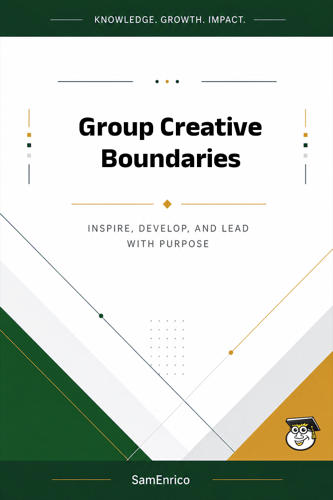
Group Creative Boundaries eBook
Sets clear parameters that focus rather than limit
by Berry Dana
Sets clear parameters that focus rather than limit team creativity.
Formats
Free sample
Chapter 1: The Blank Page Lie--–- In 1958, a Yale University researcher named John Rawlinson ran an experiment that should have ended the brainstorming industry before it began. He gathered dozens of engineers, split them into two groups, and gave them the same creative problem: design a better way to measure the volume of irregularly shaped objects. The first group was told to brainstorm in the classic style—anything goes, no criticism, generate as many ideas as possible. The second group was given a simple constraint: each person would work alone, then share ideas, then vote anonymously. The result was so lopsided that Rawlinson ran the experiment multiple times, certain he had made a mistake.
The constrained group consistently produced between 30 and 40 percent more ideas. Their ideas were rated significantly more creative by independent judges. And they reported enjoying the process more.The unconstrained brainstorming group? They produced fewer ideas, lower-quality ideas, and walked out feeling frustrated and exhausted.This finding has been replicated dozens of times across six decades. Yet the myth of the blank page—the belief that creativity flourishes when all boundaries are removed—remains one of the most stubbornly persistent fallacies in business.
Walk into almost any corporate innovation workshop, and you will still hear the facilitator say something like, "There are no bad ideas here," or "The sky's the limit," or "Don't constrain yourselves." These phrases are delivered with the warm assurance of someone offering a gift. In reality, they are handing the team a straightjacket.This chapter dismantles the blank page myth. It explains why unlimited options create anxiety rather than inspiration, why your brain actually craves structure when trying to be creative, and how to distinguish between the kind of constraints that kill creativity and the kind that unlock it. By the time you finish this chapter, you will never again start a creative session by telling your team that anything is possible. You will start by telling them exactly what is not possible.
And that simple shift will transform everything.The Rawlinson Trap: What the Data Actually Says Let us linger on Rawlinson's experiment for a moment, because its implications are deeper than they first appear. The engineers who were told "anything goes" did not simply produce fewer ideas. They produced a different kind of thinking. Their ideas tended to be safer, more incremental, and clustered around obvious solutions. The engineers who worked under the constraint of individual ideation followed by anonymous voting produced ideas that were stranger, more divergent, and more likely to challenge underlying assumptions.Why?
The answer lies in what psychologists call evaluation apprehension. When a group is told that all ideas are welcome, participants immediately begin to monitor the social environment. They ask themselves: Will my idea sound stupid? Will the boss judge me? Will the senior engineer in the room think I'm wasting time?
This anxiety does not disappear just because someone says "no bad ideas." In fact, it can intensify, because the absence of explicit criteria means the criteria for judgment are invisible and therefore impossible to satisfy. Teams with no constraints are like archers shooting in the dark—they cannot tell if they are hitting the target, so every shot feels risky.Rawlinson's constrained condition removed this anxiety through a simple but powerful mechanism: it changed who was watching. When engineers generated ideas alone, there was no audience to impress or fear. When they submitted ideas anonymously, there was no reputation to protect. The constraint forced the social dynamics to change.
That is the essence of a generative constraint: it does not limit what you can think; it limits the social fears that stop you from thinking at all.This pattern appears across dozens of studies. Teresa Amabile, a Harvard Business School professor who has spent four decades studying creativity, found that the single biggest predictor of creative output in teams is not intelligence, not expertise, not even passion. It is the presence of what she calls "moderate constraints"—boundaries that are tight enough to focus attention but loose enough to allow exploration. Teams with no constraints consistently underperform. Teams with overly rigid constraints (like strict budgets or impossible deadlines) also underperform.
The sweet spot is somewhere in the middle, and finding it requires understanding why the blank page fails.The Paradox of Choice, Applied to Teams In 2000, psychologists Sheena Iyengar and Mark Lepper published a now-famous study on jam. Shoppers at an upscale grocery store were offered samples of either 6 jams or 24 jams. The larger display attracted more attention. But when it came time to buy, shoppers who had seen 24 jams were one-tenth as likely to make a purchase as those who had seen only 6. The researchers called this the "paradox of choice": more options led to less action.The same paradox operates in group creativity, but with an added twist.
When an individual faces too many choices, they freeze. When a team faces too many choices, they freeze and then fight. The freezing comes from cognitive overload—the team's collective working memory cannot hold and compare infinite possibilities. The fighting comes from divergent assumptions—without constraints, each team member brings their own implicit boundaries, and these invisible differences create conflict.Imagine a team given the prompt: "Design a better way for people to get around cities." That sounds liberating. In practice, it is a disaster.
One person assumes the problem is traffic congestion. Another assumes it is carbon emissions. A third assumes it is cost. A fourth assumes it is accessibility for elderly people. Within fifteen minutes, the team is not collaborating; they are talking past each other, each solving a different problem under the banner of the same vague prompt.
The absence of constraints did not create freedom. It created four parallel conversations that never touched.Now imagine the same team given the prompt: "Design a way for a person in a wheelchair to get from their front door to a grocery store one mile away in under twenty minutes, using only human power and existing infrastructure." This is a highly constrained prompt. It specifies the user, the distance, the time limit, the power source, and the infrastructure constraint. A naive reader might think this prompt is less creative than the open-ended version. In fact, it is vastly more creative.
The constraints force the team to confront real trade-offs. They cannot hand-wave away accessibility by saying "we'll figure that out later." They cannot propose magical solutions like flying cars. They have to think deeply, specifically, and inventively within the walls they have been given.This is the paradox of choice applied to teams: constraints are not the opposite of creativity. They are the engine of creativity. A blank page is not an invitation to create; it is an invitation to panic.Your Brain on Constraints: A Neuroscientific Perspective Why does the human brain respond this way?
The answer lies in the interaction between two neural networks: the default mode network (DMN) and the executive control network (ECN).The DMN is often called the "imagination network." It activates when you daydream, reminisce, or engage in free association. It is the source of novel connections, unexpected insights, and creative leaps. The ECN, by contrast, is the…
This is the end of the free sample. Get the eBook to keep going. Buy now
About this book
Details
- Author
- Berry Dana
- Publisher
- SamEnrico
- Language
- English
- Genre
- Non-Fiction, Self-Help, Creative Boundaries
- Released
- 2026-06-08
- Pages (approx.)
- 144
- Available as
- eBook, Audiobook

Read better in the ZLOADR app
Your eBooks on your phone or tablet. Sign in with your SamEnrico account and start reading.
More by Berry Dana
 The Positive Self Talk WorkbookBerry Dana$11.99
 TM for BiologistsBerry Dana$11.99
 Sales Quota Stress ManagementBerry Dana$11.99
 Schizophrenia And Nicotine GuideBerry Dana$11.99
 Intermittent Fasting AssessmentBerry Dana$11.99
 South African Green HandbookBerry Dana$11.99
 HGH Side Effects ManagementBerry Dana$11.99
 The Lost Code of the Rosetta StoneBerry Dana$11.99
 Starlight Exodus: The Last Song of the ArgonautsBerry Dana$11.99
 Shaka Zulu: The Spear That Shook a ContinentBerry Dana$11.99
 The Dancer's Guide to MinuetBerry Dana$11.99
 London Pop Up Legal GuideBerry Dana$12.99